Our lives, for each of us, are individualized journeys of discovery.
It is about discovering who we are as individuals – not based on someone else’s expectations of who we should be or how we should act, but grounded in our own convictions and beliefs.
It is about discovering what our passions truly are, whether in the STEM environment, the liberal arts, or a vocation that does not require a college degree. Again, this must not be driven by the desires of others, even well-meaning parents or mentors, but found through our own active process of self-discovery.
It means discovering our strengths and weaknesses through a continuous process of self-assessment, recognizing just how strong we can be in the face of adversity.
It requires discovering what we need to be truly successful: communication skills, study habits, a growth mindset, perseverance, and resilience.
For this path of discovery to be effective, we must remain open to constructive criticism, instruction from our parents, teachers, and mentors, and an honest appraisal of ourselves and the skills, personality traits, and tendencies essential for personal growth. The accumulation of knowledge for its own sake is important, but it does not entirely define who we are.
Ultimately, we must acknowledge that there is always more to learn and more to reflect upon. Regardless of our age, there is always room to improve—not just as engineers, scientists, or teachers, but as caring, compassionate human beings.
Your present circumstances don’t determine where you can go; they merely determine where you start.
– Nido Qubein
Nido Qubein immigrated to the United States from Jordan in 1966. He arrived as a teenager with very little money and a limited grasp of English.
In 2005, he became the President of High Point University, a small liberal arts college in High Point, North Carolina. Under Qubein’s leadership, HPU is now globally recognized as an extraordinary institution, earning three #1 rankings in U.S. News & World Report’s 2026 Best Colleges edition. He is renowned for emphasizing that students need more than just technical knowledge – they need “life skills”, such as communication skills, the ability to adapt to different situations, and a growth mindset.
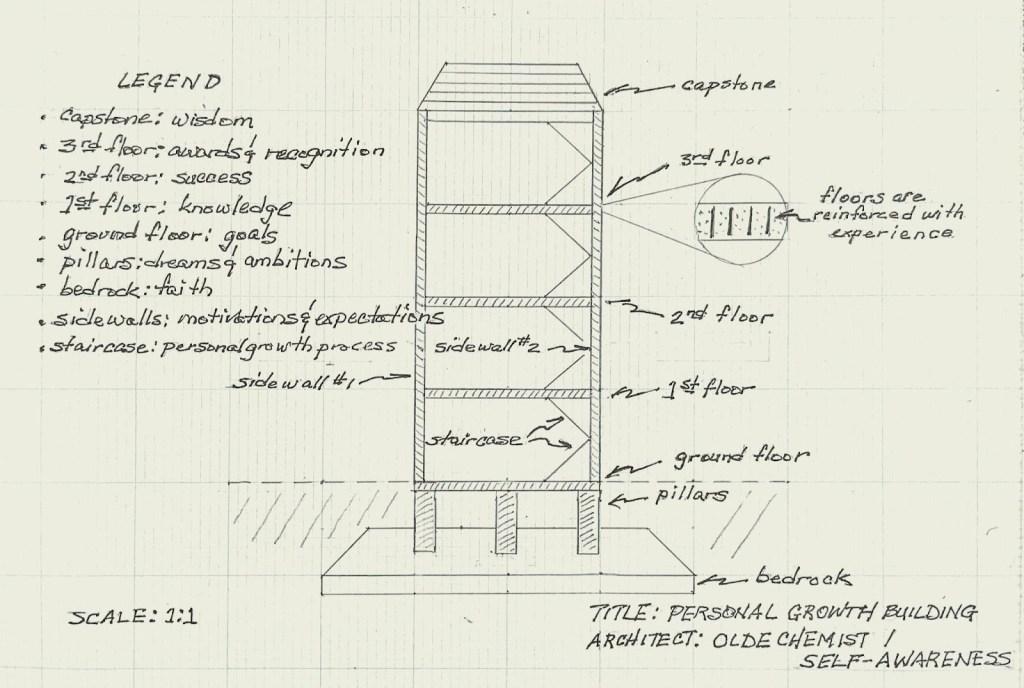
I’ve recently been asked why my Personal Growth Building (Revision 2) focuses so heavily on the specific structural components for personal growth rather than just the “foundational” traits we all value: Curiosity, a GrowthMindset, the Passion for Solving Problems, and a Passion for Learning.
It is a fair question. The “foundational” traits we value in STEM and other fields are often considered the prerequisites for student achievement. However, from my perspective, having spent time in scientific labs and learning drafting and surveying with my Dad, a civil engineer, I see a crucial element that is often overlooked: As Dr. Walkup famously stated, “You can’t build a skyscraper on an outhouse foundation.”
1. “Readiness” vs. The “System.”
Curiosity and a GrowthMindset represent how prepared a student is; they indicate if a student is trulyready to jump into learning.
The elements in the Personal Growth Building, though, are all about what a student does. They’re the tools that turn that potential into real results.
Think about a student who’s “passionate about learning” but doesn’t have a solid understanding of the base of knowledge required to succeed. They’re like a car engine revving high but stuck in neutral. They have the “energy” necessary but no way to actually use it effectively. The “Building” provides the process and structure they need to shift a “simpleinterest” into “genuineunderstanding.”
2. The Sustainability of Growth
My intent is to prepare students for a 40-year career, not just a four-year degree. Traits like “Passion” can flicker and fade under the pressure of a professional environment.
The components and structure of the “Building” are designed to train and support students so they’re capable of “adapting.” When a chemist’s specific technical knowledge becomes obsolete, it is the structure of their learning – their ability to categorize new information and logically assess and apply it – that allows them to pivot to new challenges. We don’t just want “curious” students; we want intellectually sound professionals.
Closing Thought
We shouldn’t choose between “traits” and “frameworks.” We must recognize that the traits are what make the building possible, but the framework is what makes the student useful to the world and resilient to change.
The Revised Blueprint for Our Personal Growth Building
“You can’t build a skyscraper on an outhouse foundation.”
– Dr. John Walkup
In a series of early posts, I created a simplified building blueprint with Motivation and Expectations resting on a foundation of Dreams, Aspirations, and Goals as the primary supports of our outer growth.
But these layers and supported walls cannot reside on dirt. They must rest on something deeper and more concrete. This creates a complete, logically sound structure:
That is why I am updating the blueprint to detail what components lie beneath the surface: the building’s” Substructure.”
The Substructure consists of:
The Ground Floor: Short-term and Long-term Goals
The interface between the superstructure and the substructure, the ground floor “slab”, consists of our short-term and long-term goals. These serve as the perfect transition; our goals are based on our dreams and ambitions, and require our motivations and expectations to achieve personal growth and obtain our definition of success.
The Support Pillars: Dreams and Aspirations
Our personal growth building requires two different types of columns or supports: our Dreams and Aspirations.
Our Dreams are fundamental, our “dream” of what we want to accomplish, providing passion and purpose. Aspirations represent the big-picture vision that provides direction and purpose. They both act as the support mechanism for the personal growth process. While goals and objectives focus on the near-term path and immediate results, dreams and aspirations provide the irresistible ‘why.’ Why the ultimate result justifies the effort, keeping all your actions aligned with your personal “mission.” Both your dreams and aspirations must be defined and nurtured, as they determine the degree and enduring strength of your personal growth.
The Bedrock of Faith
The bedrock of your personal growth journey is the foundation of your “personal growth building.” This isn’t a superficial structure built on temporary fixes or fleeting inspiration; it is a deep, resilient base that withstands the inevitable challenges of life. This foundation is critically established through faith—a profound conviction that gives direction and meaning to your efforts.
Faith can manifest in several powerful ways:
For some, it is an unwavering faith in self, a deep-seated belief in one’s own capabilities, resilience, and potential to evolve and overcome. This self-trust is the engine that drives consistency and perseverance.
For others, the foundation is a belief in a higher power or a universal order. This perspective provides comfort, a sense of belonging to something greater than oneself, and a moral or philosophical framework that guides decision-making.
Still, for many, this foundation is built upon a personal, intimate relationship with God, offering a spiritual anchor, a source of grace, and a transcendent purpose that elevates personal ambition beyond the purely material.
Regardless of its specific form, this core belief system serves as the unshakeable ground upon which all other aspects of personal development—such as discipline, knowledge acquisition, and skill-building—are securely erected. Without this strong foundational faith, the entire structure of personal growth can become fragile and prone to collapse under pressure.
Key Personal Growth Building’s Blueprint Components
The Two Columns of the Superstructure
You can visualize the “Superstructure” portion (Outer Growth) as being held up by two massive structural walls or columns.
The Left Support: Motivation
Motivation is basically that core, inner engine – the essential “oomph” – that pushes you to get better. It’s your natural wanting to hit goals, your curiosity, and just your general drive. This baseline motivation is key; if you don’t have it, you won’t feel engaged enough to “show up,” and your efforts to grow just won’t have the necessary “boost” to really take off.
The Right Support: Expectations
Think of expectations as the crucial support for your career—it gives it shape, defines it, and lets you reach high. They’re not just “pressure”; they’re a necessary strength, representing the standards you set for yourself, plus those from your industry, professors, and the world in general. A career built just on good intentions would be shaky. Expectations provide that solid framework, forcing you to be precise, stick to the measurements, and commit to getting a certain grade. Ultimately, they push your structure into a definite, strong form.
The Interaction Between the Two Columns
To successfully build anything solid or achieve your goals, you need a healthy mix of motivation and expectations.
Motivation without expectations creates what is simply a “blob.” It’s a ton of energy, but without any discipline, a clear goal, or focus on quality, it just ends up as a huge, messy pile that falls apart. On the other hand,
Expectations without motivation create a “hollow shell.” You are just going through the motions, maybe to please a boss or meet a deadline, but your heart isn’t in it. That empty effort will eventually collapse because the internal drive is missing.
To build something truly resilient and lasting – think of a towering skyscraper – you have to blend the powerful inner drive of high motivation with the solid structure of high expectations.
Goals
Goals serve as the essential ground floor in any personal growth model, acting as the critical interface between abstract desires and concrete action. Think of them as the “Slab” connecting the internal, conceptual “substructure” (Dreams and Aspirations) with the functional structure “superstructure.” While a dream is an abstract feeling, such as “I want to be an engineer,” a goal formalizes this feeling into a binding commitment or contract, such as “I will enroll in this specific university’s engineering program.” This distinction is structurally vital because you cannot generate effective motivation—the “walls” of your growth structure—without a concrete goal—the “floor“—to anchor it. Motivation without a defined goal is simply wasted or misdirected energy, highlighting why this step is the necessary foundation for all further personal growth.
The Staircase: The Personal Growth Process
Is the personal growth process considered an elevator or a stairway upward towards wisdom? An elevator implies you can push a button and arrive at wisdom without doing the work. The biggest, and often toughest, lesson when pursuing something big, our definition of “success,” is this: We must recognize that there is no “express” pathway to success and wisdom; we must “visit” each “floor” to reach the capstone.
The Stairway to Success: It’s All About the Climb
Within our personal growth building, the staircase is the connection that makes the journey and flow of the building work. Architecturally, it’s the main path for moving up – a physical sign of progress, and the only way to reach those higher goals. In this “success” metaphor, the staircase takes you from the ground floor (Your Goals), up through the essential phase of the first floor (Learning), and then on to the more ambitious higher levels.
The most important part of this whole idea is the actual climb. You actually have to climb the stairs; there’s no express elevator straight to the top (Success). That idea of instantly zipping to the top is a myth that screws up real, lasting achievement. The Capstone (Wisdom), or the pinnacle of your success, isn’t something you can skip or cheat your way to by avoiding the necessary hard work.
To truly and permanently land on the Success floor, you absolutely must first spend quality time on the Knowledge floor. And by “quality time,” I mean more than a quick stop; it means putting in the effort to learn, practice, and internalize the necessary skills, information, and wisdom. Knowledge is the solid ground that Success stands on. If you skip this crucial step, you end up with a shaky achievement—a “success” that just doesn’t have the strength to handle things when the going gets tough. The climb itself—the effort, the patience, and the sheer persistence—is what makes your Capstone a genuinely earned and lasting one.
The Rebar (Reinforcing Bars): Experience
In an Engineering context, concrete is strong when compressed, but it also cracks easily. To make it durable, you add rebar.
In our building metaphor, the third floor, Awards and Recognition are the components of the “concrete’s” structure. Experience (the rebar) helps us manage the pressure that awards and recognition may place on us – specifically, dealing with the disappointments that come when we are not recognized for our hard work, or managing our egos when we receive recognition and awards.
Self-Awareness: The Blueprint Itself
Since you are your life’s architect, and responsible for drawing this set of blueprints, self-awareness isn’t just a box on the drawing; it is the drawing itself. The blueprint represents your intended design; it is the standard against which your personal growth is measured.
What happens when we follow a specific “blueprint” and, for whatever reason, whether it is wrong decisions, personality traits that betray us, family concerns, or health issues, we arrive at a place in our lives that is not where we envisioned we would be? It still brings us to our personal “capstone” of wisdom; but the question of how we deal with disappointment is a concern in the process.
In construction, the blueprint is the architect’s dream or vision. It is drawn in a sterile office, assuming perfect soil conditions, perfect weather, and perfect materials. However in our personal growth building scenario, once the “ground” is broken, reality hits. You have an unexpected health issue; you lose your job; there is a dramatic shift in the economy or the stock market affecting your retirement savings; your personal decisions change the outlook for your success (changing jobs); there are family concerns (death of a parent, a chronic illness, or divorce). When these things happen, you, as the architect of your personal growth, don’t tear down the building. You adapt.
Disappointment comes when comparing your new reality to your blueprint. Wisdom comes from accepting your new reality. If you look at the blueprint of a life that went perfectly according to plan—straight path, no mistakes, no tragedy—that sheet of paper is clean. It is white and pristine.
A clean blueprint has no wisdom.
Conclusion
There is a reason why the substructure is essential.
When we are young, we trust our blueprints. We tend to believe that if we just build the walls straight and the floors level, our personal growth building will stand forever as is. We put our faith solely in the superstructure – in our own ability to execute the blueprint.
But as we grow older, we realize there are floors we didn’t plan for. There are cracks where the foundation has shifted. Some floors may have never been built because life got in the way.
When our blueprint fails, and the disappointment of unmet expectations sets in, the weight of that disappointment has to go somewhere. If your pillars (motivations and expectations) are resting on the sand of your own ego, you will crumble.
But if you have pillars (dreams and aspirations) that are anchored deep into your faith, you’ll find something surprising. You’ll find that the disappointments don’t destroy the building; they strengthen it.
“When you see something that is technically sweet, you go ahead and do it, and you argue about what to do about it only after you have had your technical success. That is the way it was with the atomic bomb.”
– J. Robert Oppenheimer
A review of 20th-century history reveals a critical, undeniable fact: Intelligence is not a guarantee of a positive result.
The Manhattan Project stands as a technical masterpiece, having assembled the foremost experts in physics to tackle intricate theoretical challenges surrounding nuclear fission. The team successfully developed and engineered a mechanism to initiate this reaction in a practical setting, meticulously following every step to achieve a logical and verifiable result. However, despite this technical brilliance, the outcome was the creation of a weapon with the power to extinguish human civilization.
J. Robert Oppenheimer, the lead physicist, later famously quoted Hindu scripture, realizing the gravity of what his “success” meant: “Now I am become Death, the destroyer of worlds.”
How can a project be a perfect success in the lab, but a potential failure for humanity? Knowledge and Expertise do not equate with Wisdom.
What is “Wisdom?”
Wisdom as a Mathematical Equation
If you are entering a STEM field today, you are spending years building your intellect. You are accumulating Knowledge (formulas, axioms, laws of physics) and gaining Experience (labs, internships, projects). These are the tools that help you succeed in the world.
But intellect without wisdom is just an uncontrolled force.
“Yesterday, we fought wars which destroyed cities. Today, we are concerned with avoiding a war which will destroy the Earth. We can adapt atomic energy to produce electricity and move ships, but can we control its use in anger?”
– Robert Kennedy
To be truly successful – not just as a scientist, but as a leader, and a human being – you need more than just the inputs of knowledge and experience. You need to solve for a different variable entirely. You need to solve for Wisdom.
Wisdom is not a mystical concept reserved for philosophers on a mountain top. It is a function of four specific variables. And just like any complex system, if you ignore one variable, the equation falls apart.
Defining the Wisdom Function
If we accept that Wisdom is the desired outcome, we need to understand the components (inputs) required to generate it. Wisdom is not a random occurrence; it is the result of a specific integration of variables.
We can define the Wisdom Function as follows:
To solve for W (Wisdom), you must understand the nature and function of each variable.
1. = Knowledge (Your Database)
In our equation, Knowledge is the raw data. It is the accumulation of facts, information, and established laws.
Think of Knowledge as the hard drive of your computer (your brain). It is filled with terabytes of information – years of research, chemical equations, and physics constants.
But a hard drive full of facts has a limitation; it knows that a tomato is a fruit (botanical classification), but it does not know that a tomato does not belong in a fruit salad. It has content, but no context.
2. = Experience (Real-life Application)
Experience is the application of Knowledge in a real-world environment. It is the process of converting theory into practice through repetition.
Consider this analogy: experience is the Lab Experiment. You take a hypothesis () and test it against reality. Experience is the collection of data points derived from failures and successes.
But experience has a limitation: It is reactive. It tells you what has worked in the past, but it cannot always predict what will work in a completely new future environment or application.
3. = Self-Awareness (Internal Calibration)
Self-Awareness is the understanding of our own influence on the data.
Consider this instrumental chemistry analogy: Instrument Calibration. In any experiment, the instrument used to measure the data may affect the result. For example, if your electronic balance is not zeroed out (tared), every measurement you take is flawed.
Self-awareness is the process of checking to see if we’re solving problems the right way, and for the right reasons. It forces us to stop and ask: What am I really trying to do here? Are my actions to benefit the project’s outcome, to fix a problem, or just to make myself look better? Are my personal feelings clouding my judgment? Am I ignoring facts that don’t fit my hypothesis? And ultimately, does the outcome match my core beliefs? If you skip this internal check, all your knowledge () and experience () may not matter, and the solution will be biased.
4. = Faith (The Constant)
This is often the most difficult variable for the scientific mind to accept, yet it is essential for the equation. Faith has many forms. There is a faith in a set of scientific axioms or principles, which may or may not continue to be valid in the current situation. There is faith in your knowledge and skill, the ability to adapt and solve any problem you may face. And there is a faith in God or a higher power, which gives you strength and guides your moral compass.
Faith acts as a moral constant, an internal compass guiding you when all the facts are not yet known. It’s what helps you discern not just what can be achieved, but what is right, connecting what is understood to what is yet to be discovered.
The Scientific Analogy: A great deal of scientific work starts with a theory or idea that hasn’t been completely proven yet. It’s all built on a fundamental trust – like believing the established rules of physics will hold up in any new situation, no matter what.
Personal Commentary
He who can no longer pause to wonder and stand rapt in awe is as good as dead; his eyes are closed.
– Albert Einstein
Sometimes, because we are trained to be analytical thinkers, we convince ourselves that we are agnostic. And when we look and see something we don’t understand, when we should be filled with awe and wonder, we are so busy trying to find a scientific explanation that we convince ourselves it’s not a miracle, that it is not the act of God or a higher power. Wisdom, for me personally, is my recognition that I cannot underestimate the power of God and his plan.
Now that we have defined the variables, we can see how they interact. The mistake most students make – and the mistake the educational system often encourages – is focusing entirely on the first two variables, Knowledge and Experience.
Two Wisdom Function Analogies
Scalar vs Vector Measurement Example
Most of us in the science realm were introduced to the concept of vectors and the difference between scalar and vector measurements in our middle school science classes and again in our high school and college physics classes.
As a refresher for these concepts, consider the following example: Imagine you were to ask me directions to a local restaurant, and I were to say you drive 45 miles per hour for 15 minutes. This is a scalar measurement. You have no idea which direction you were to drive; you have only one piece of information, the velocity at which you are to drive, and you need the direction. The definition of a vector is that it has a magnitude, in this example, 45 miles per hour, and a direction, let’s say directly east. You now have both components of a vector. The directions to the restaurant are to drive east at 45 miles per hour (vector) for 15 minutes.
Now, think of your career trajectory as a Vector.
The sheer power of your abilities, the Magnitude of your professional vector, is determined by your Knowledge () and Experience ().
These factors directly influence:
The depth of intellect you can bring to bear on any challenge.
The speed with which you can reach a solution.
The sophistication and complexity of the problems you are capable of solving.
A person with great intellect and extensive experience is a force to be reckoned with. However, magnitude is a scalar quantity, it lacks direction.
The Direction in your life’s “vector” is determined by Self-Awareness and Faith.
Self-Awareness provides calibration for the “Why?”: It answers the question, ‘Why am I doing this?’
Faith ensures your internal belief system is aligned: It addresses where your actions fit within your personal moral and internal convictions.
The Guided Missile Example
Our scientific power has outrun our spiritual power. We have guided missiles and misguided men.
– Martin Luther King, Jr.
Imagine a missile guidance system.
If you have low Knowledge and Experience (Low Magnitude), the missile barely leaves the launchpad. It’s ineffective and harmless.
However, if you have incredible Knowledge and Experience (high Magnitude) but lack Self-awareness and Faith to set the coordinates in the right Direction, you have created a disaster. You have a high-speed projectile aimed at the wrong target.
The STEM Trap
In your classes, you are graded almost exclusively on Magnitude. Did you get the right answer? Did the chemical reaction work? Did the bridge you designed hold the weight?
But in life, Wisdom is the vector sum. It is useless to be the smartest engineer in the company if you are building something that ultimately causes harm because you didn’t ask the “faith” or “self-awareness” questions.
Conclusion
Wisdom () is the alignment of your Magnitude () with the correct Direction ().
Wisdom is not an accident. It is not a trait you simply “pick up” as you get older. It is the deliberate integration of what you know (), what you do or have done (), who you are (), and what you believe ().
If you are an aspiring STEM student, or the parent of one, I want you to consider a terrifying possibility: It is possible to have a 4.0 GPA and know/retain almost nothing.
I saw this contradiction in the students I would tutor. They were bright, hardworking, and ambitious. They had mastered the art of getting the “A.” They knew how to take tests, follow instructions, and allocate their time to receive a high score.
However, if I asked them to apply a physics concept from two weeks before to a new problem assigned that day, they would freeze. Their knowledge of the material (data) was gone.
This is the Grade Illusion. We have built an educational culture – especially in high-stakes fields like STEM, where the “High Score” has become the product. But in the real world, the test scores from high school and college courses are irrelevant. The only thing that matters is mastering the content.
If you want to survive the transition from “A-student” to “successful scientist,” you need to understand how your own mind works. You need to stop renting knowledge and start owning it.
The Knowledge Retention Misconception: RAM vs. Hard Drive
To understand why intelligent students often feel like impostors, we need to examine how the brain stores information.
Think of your brain like a computer. You have two types of storage:
RAM (Random Access Memory): This is short-term, high-speed memory storage. It holds the data you need right now. It is volatile; when the power cuts (or the test ends), the data is wiped to make room for the next task.
The Hard Drive: This is long-term storage. It is slower to write to, but the data remains there forever, ready to be recalled years later.
The modern educational system encourages you to use your RAM, not your Hard Drive. We call this Cramming, or as we discussed in an earlier blog post, the act of memorization/regurgitation.
When you cram for a calculus midterm, you are loading complex formulas into your RAM. You hold them there—stressfully—for 24 hours. You walk into the exam, dump the RAM onto the paper, and get a 95%. You feel successful.
But 48 hours later, that RAM is cleared to make space for Chemistry. The “Save to Hard Drive” function never happened.
The Science of Forgetting
This isn’t just a metaphor; it is a biological fact. In the late 19th century, psychologist Hermann Ebbinghaus mapped the “Forgetting Curve.”
The curve shows that without deep processing (the struggle necessary to understand something), humans lose roughly 50% of new information within a day and 90% within a week.
The student who crams and gets an “A” peaks at 100% on Tuesday morning. By next Tuesday, their retention dropped to nearly the same level as that of the student who failed. The grade is a record of what you knew for one hour, not what you carry into your career.
From an economics perspective, consider this as the difference between Renting and Owning.
Cramming is Renting. You pay a high price in stress and sleep deprivation. You get to “live” in the knowledge for a day. But once the test is over, your “lease” is up, and you are evicted. You have zero equity.
Deep Learning is Owning. You pay a “mortgage” of daily, consistent study. It feels slower. It feels harder. But two years later, when you are designing a load-bearing bridge, for example, that physics principle is yours.
The Illusion of Competence
“But I got an A!” you might argue. “The test says I know the material.”
Does it?
In 1956, in the publication “Taxonomy of Educational Objectives: The Classification of Educational Goals,” a committee of educators chaired by Benjamen Bloom developed a framework to rank levels of understanding called “Bloom’s Taxonomy.”
Shutterstock
Most high school tests—and frankly, many college exams—operate at the bottom three levels: Knowledge (learn the formula), Comprehension (understand when to use the formula), and Application (plug numbers into the formula).
If you are good at memorization, you can ace these tests without ever moving up the pyramid. But a career in STEM fields lives entirely at the top three levels:
Analysis: Why did the experiment fail?
Evaluation: Which method is best for this specific application?
Synthesize (Create): Develop an improved solution that isn’t in the textbook.
The Illusion of Competence
This creates the Illusion of Competence. You have a transcript full of “A’s” that certify you are an expert, but your internal drive has never been stress-tested at the “Analysis” or “Synthesis” level. When you eventually hit a problem that requires those skills, you don’t just struggle—you crash.
The most dangerous side effect of the Grade Illusion isn’t academic; it’s psychological.
The Performance = Identity Misconception
When you spend your entire life chasing the “High Score,” you begin to associate your Performance with your Identity. You believe the equation: My Grade = My Worth.
In STEM, this is lethal. In English class, a grade of “C” might seem subjective. In Physics or Chemistry, a “wrong answer” is objectively wrong. If you tie your self-worth to getting the right answer, every mistake feels like a character flaw.
You need to adopt the mindset of a Scientist:
You are the Learning Process itself. You are the curiosity, the work ethic, the resilience.
The Grade is just Data. It is simply the output of a single, specific experiment on a single specific day.
For example, if a Ferrari engine performs poorly because it had bad fuel, we don’t say the engine is trash. We say the input (fuel) was wrong. Similarly, if you fail a test, it doesn’t mean you are broken. It means your variables—your study habits, your sleep, your preparation—were off.
A bad grade is not your identity. It is guidance.
Breaking the Cycle
Ready to shift from being a “Grade Hunter” to a true “Learner”? Use these two simple techniques to pinpoint where you are in that transition and determine the necessary steps to move forward.
1. The “Two-Week Audit.”
I challenge you to a challenging experiment. Take a test you aced two weeks ago. Sit down and take it right now, without reviewing your notes.
The difference between your score then (95%) and your score now (55%) is your Fake (Lost) Knowledge. That 40-point gap represents wasted energy. It is time spent renting, not owning. If the gap is huge, your study method is broken, regardless of your GPA.
2. The Feynman Technique (The Ownership Test)
Physicist Richard Feynman had a simple rule for understanding, which he borrowed from Albert Einstein. To prove you have mastered a concept, you must be able to explain it in simple language, without jargon, to someone who has no background in the topic (like a smart 12-year-old).
If you can’t explain it simply, you don’t understand it. You have only memorized the definition. You are stuck at the bottom of Bloom’s Taxonomy.
The Bottom Line
The world is full of influencers and algorithms showing you the easy way to obtain a high test score on the ACT and achieve the most sought-after degrees, jobs, and accolades. Yet they rarely show you how to retain the knowledge required for long-term success.
Success in STEM requires three “old school” prerequisites that cannot be skipped: Curiosity, a Passion for Learning, and a Passion for Solving Problems.
If you have these, the grades will eventually follow. But more importantly, later in life, when the grades stop mattering, the expertise will remain.
When we talk about the subject of personal growth, we usually split things into two buckets: “Inner” growth (a growth mindset, self-awareness, and resilience) and “Outer” growth (relationships, communication skills, achievements, and recognition). However, here’s the missing piece in our model: Emotional Intelligence (EQ). Emotional Intelligence (EQ) is the bridge that unites these two separate ideas, preparing you to be successful as a functioning member of society, regardless of your chosen career path. Producing real-world success that people actually notice.
Emotional Intelligence (EQ) isn’t just about being nice; it is the ability to understand and manage your own emotions while recognizing and acknowledging the feelings of others. If your IQ measures your intelligence or book knowledge, EQ measures your people skills and self-control. It is the connection between thinking and feeling.
The Four Core Pillars of Emotional Intelligence (EQ)
Pillar #1: Self-awareness
In a previous blog post, we defined Self-Awareness as the GPS for our process of personal growth. And it is the absolute starting point for emotional intelligence (EQ). It’s all about understanding your own moods, feelings, what drives you, and how all that affects the people around you. To master this, you need to take an honest look at what you’re good at and what you struggle with, and feel genuinely confident in yourself. The key thing is, a self-aware person doesn’t just feel an emotion; they can actually figure out why they’re feeling frustrated, happy, or stressed. This deep internal check is the groundwork for everything else in emotional intelligence.
Pillar #2: Self-control
The second component, self-control (self-management), follows self-awareness. It is crucial for keeping destructive emotions and urges in check, so you can stay calm and collected, even when things get stressful. Think of it as emotional control—it’s that ability to hit the pause button between feeling an impulse and actually doing something about it. This pause allows you to make smart, principled decisions instead of just reacting impulsively or defensively. Self-management includes being flexible, taking initiative, and keeping a positive attitude in order to reach your goals, even when you face roadblocks.
Common Examples:
When receiving constructive criticism, someone with low emotional intelligence (EQ) might immediately become defensive, blame someone else for their mistake, or just give the person the silent treatment, which is not helpful. In contrast, a person with high emotional intelligence will pause, acknowledge that the criticism, while it may feel uncomfortable, is justified, and then ask what they need to do to improve, genuinely thanking the person for being honest.
When having a “bad day,” a person with low emotional intelligence stressed about a meeting or a deadline, might react by snapping at their parents, spouse, friend, or even someone in a restaurant or store, just because they are in the way. A highly emotionally intelligent response is to recognize the feeling of being overwhelmed and directly tell a partner, “I’m having a ridiculously stressful day and I’m a bit on edge. I need 20 minutes of quiet to de-stress so I don’t accidentally take it out on you.”
Pillar #3: Social Awareness
Social Awareness (Empathy) is the third key ability, which is shifting your focus away from yourself and focusing on others. This crucial skill enables you to sense, understand, and respond well to the emotional needs and concerns of those around you. Often described as being able to “read the room”, it requires you to see things from someone else’s perspective and grasp the mood of the situation. It goes beyond just seeing that someone is upset; strong social awareness helps you to understand why they are feeling that way, which is critical for great relationships and connecting with others.
For Example:
During a big disagreement, either at home, school, or at work, a person with low emotional intelligence makes their goal to “win” the argument and prove the other person is wrong. Conversely, a highly emotionally intelligent individual focuses on understanding the other person’s perspective, asking questions like, “Help me out here – why is this so important to you?” because they value the relationship more than being right.
Pillar #4: Building Relationships
Building Relationships is the final stage of emotional intelligence. It’s where you combine your emotional intelligence and social skills to manage complicated social situations, inspiring others. This is the top level of emotional intelligence, showing how well you can influence people, get them on board, and help them grow. It covers multiple social and communication skills—things like building trust and connection, communicating your message clearly and powerfully, addressing disagreements without a fight, and promoting change in a variety of settings, at home, school, and work. Bottom line? Relationship Management is about taking what you know about yourself (self-awareness) and what you feel for others (empathy) and turning that into positive interactions with those around you.
Conclusion
Emotional intelligence (EQ) is an essential skill for genuine, lasting success. Without it, attempts at inner growth become mere wishful thinking that fails when the pressure mounts. And outer growth results in shallow relationships that lack the trust necessary for long-term progress and achievement. Emotional intelligence links your inner strength to your outer results, establishing a mechanism that accelerates both personal growth and professional success.
The “Truck on a Ramp” model is a classic physics scenario that involves the principle of energy conservation. Its focus is on the emergency truck ramps often seen on mountain interstates. These extremely steep ramps are strategically placed to safely stop a speeding, out-of-control truck, a truck whose brakes may have failed while descending a steep mountain grade.
The “Truck on a Ramp” Scenario
Assume a truck descending Interstate 1-75 through the mountains north of Chattanooga, Tennessee, is travelling 80 miles per hour () when its brakes fail. What height in meters must the highest point of an emergency truck ramp be (assuming the force due to friction and air resistance is equal to zero) for the truck to come to a complete stop ()? Assume the force of gravity (). Round your answer to significant figures, because the value for the force of gravity, , has significant figures.
Background
One of my favorite topics in science is the conservation of energy. I could teach an entire semester of an “Introduction to Chemistry and Physics” high school science course on this topic.
In this post, we will examine the Conservation of Mechanical Energy, one of the most powerful concepts in your physics toolbox.
The introductory physics world often relies on ideal scenarios, telling us to “assume a frictionless system” or “neglect air resistance.” While these assumptions don’t reflect the real world, they are essential for isolating and understanding the central physical laws.
By understanding the relationship between kinetic and potential energy in an ideal system, you gain the ability to solve complex problems without ever needing to calculate acceleration or time.
Solution Strategy:
In a perfect world free of non-conservative forces (like friction affecting the scenario and turning motion into heat), the total amount of mechanical energy in a system never changes. It just transforms.
The formula: , where the () is always the sum of the energy of motion ( ()) and stored energy of position ( ). The units for energy are in
: ()
: ()
Let’s examine this transformation as our truck enters the ramp.
Situation 1: The Bottom of the Ramp ()
Imagine the truck moving at full speed right at the base of the ramp.
At this exact moment and location, we set our reference point for height to zero (). Because potential energy relies on position, or height, (), if .
The formula for becomes:
Therefore, at the lowest point of the ramp, the . The truck is going as fast as it ever will.
Situation 2: The Top of Ramp (Maximum Height, ()
Now, the truck races up the ramp. Gravity is doing negative work on it, slowing it down. The truck reaches its highest point and, for just a split second, it stops moving before it starts rolling back down.
At that exact split second when velocity is zero , the kinetic energy vanishes ().
Where did that energy go? It didn’t disappear. It transformed into gravitational potential energy. The truck is now at its maximum height ().
At the highest point of the ramp,the). This is the instant when the truck is completely stopped.
Calculations
Because we are in a frictionless system, we know that the Total Energy TE must be the same at the bottom and at the top.
This gives us one of the most useful problem-solving equations in mechanics:
Values from the scenario:
Substituting:
Cancelling the truck’s mass from both sides:
Solving for the final height :
Performing the calculations:
Rounding to significant figures, the final height of the ramp will need to be: or approximately .
Why This is Valuable
By understanding that in a frictionless scenario, total mechanical energy transitions between these two forms (kinetic energy and potential energy), you can skip having to use complicated kinematics equations to solve the problem.
If you know how fast the truck was going at the bottom, you can instantly calculate exactly how to design the ramp, specifically how high the ramp needs to go.
And, conceptually, this relationship between Total Energy, Potential Energy, and Kinetic Energy also explains why the initial hill on a roller coaster is higher than any subsequent hill or loop in the rest of the ride.
If you can grasp these energy exchange calculations, you’ve mastered a cornerstone of classical mechanics.
To follow up on my previous post, I cannot stress enough that four basic math skills: dimensional analysis, scientific notation, estimation, and significant figures – are prerequisites for anyone interested in math and sciences. Mastering these concepts helps stop the “operator headspace” mistakes that happen when you use your calculator as a crutch.
My biggest concern is that leaning too much on calculators is actually making students worse at fundamental math. For example, in the students I tutor, I’m seeing a drop in their ability to do mental math, a poor sense of estimation, and a failure to build that crucial “number sense” – that gut feeling about how numbers work and whether an answer makes any sense.
It’s a bit disappointing to me when I can perform math functions such as addition, subtraction, multiplication, division, and PEMDAS calculations faster and more accurately in my head than my students can on their fancy $100 calculator.
Therefore, the question I’m asking is:
“When kids let the calculator do the work, do they skip the mental practice needed to really lock in these vital skills?”
What Do the Experts Say?
Educational research points to a broader consensus: the impact of calculators isn’t automatically negative. The general feeling among experts is that when calculators are used correctly, they don’t inherently make students less capable at math. Instead, they suggest that any negative results usually come not from the calculator itself, but from using it poorly or too much. This often boils down to schools failing to have an intelligent, deliberate plan for when and how to bring this technology into the classroom. When the calculator becomes a crutch – used for problems students could easily do in their heads or on paper – that feared skill loss can definitely happen. But on the flip side, when they’re introduced as tools for digging into tougher concepts, checking answers, or handling the annoying arithmetic in advanced problem-solving, they can be helpful. They let students focus on deeper mathematical thinking and understanding.
How Should We Address These Concerns?
Math educators strongly advocate a structured, phased approach to the introduction of calculators:
Prioritize Traditional Methods: Students must first be required to build a strong foundation in mathematics through traditional mental math and written arithmetic methods. This guarantees that these techniques and number sense are firmly established.
Introduce Calculators as a Tool, Not a Replacement: Calculators should be introduced later in the elementary school years (not second grade), transitioning from an everyday practice to a valuable educational tool. Their primary function should be to support the student, not replace mental calculations.
Introduce Calculators as a Resource for Checking Answers: Confirming answers acquired through mental or written technique.
Introduce Calculators for Exploring Complex Numerical Systems: In secondary and post-secondary classrooms, calculators are introduced as a tool for investigating sequences or statistics on large data sets where calculation time is prohibitive.
Introduce Calculators for Solving Conceptually Challenging Problems: Working with complex problems where the challenge lies in understanding the concept and setup, not in the basic arithmetic calculation itself.
This is an intelligent approach to introducing the calculator in the classroom, as it allows students to actively check their work. This is all about helping them master the calculations and truly understand how the math works. The goal here is to boost their learning, not get in the way of it.
High School and College STEM Courses: The Dangers of Calculator Over-Dependence
When you get to advanced math and science courses, relying too much on a calculator isn’t just about whether you can do the basic arithmetic (you should be able to); it’s about some more concerning issues. Specifically, whether using the calculator too often can affect your grasp of the concepts, make you rusty at solving problems algebraically, and weaken your crucial ability to estimate answers quickly to check your work.
Using powerful tools like TI graphing calculators can be a risk for learning. Certainly, these instruments make complex math operations simple, but that convenience can slow down a student’s development. Students who always simply punch numbers into their calculator to get an answer often miss out on building important “number sense.” This basic skill is key to quickly seeing if an answer is logical. Without it, students are more likely to accept completely wrong answers due to simple input errors because they haven’t developed the gut feeling that an answer is just plain wrong. Getting that immediate result skips the necessary learning steps of estimating and checking the math in your head.
Graphing calculators, while excellent tools that may assist a student’s understanding of the relationship between an algebraic equation and its graph, may also lead to over-reliance. When students rely too heavily on the calculator, they may be satisfied with merely seeing relationships – such as the curve’s shape or the location of an equation’s roots – without making the effort to understand the fundamental mathematical reasoning.
True mathematical mastery requires knowing not only what the graph looks like, but why it is structured that way. This deeper knowledge develops through hands-on engagement, not just by pressing buttons. The danger is that the calculator becomes a black box: it provides correct answers without explaining the logic behind the calculations, ultimately blocking the development of real mathematical understanding.
I must admit I am not a fan of the Ti-83/84 series of graphing calculators, perhaps because I have not used them as much as the students I‘ve tutored. I use the Ti-30 series for calculations, and for graphing functions, I use Desmos (www.Desmos.com), which I find to be a powerful tool that produces graphs I can easily manipulate and that are easier to see on my computer screen. I recommend it to every student I work with.
I believe it is crucial to learn how to evaluate a graph, a skill that goes beyond just plugging an equation into your graphing calculator and seeing the resulting graph on the screen. I had a Physics professor at Centre College, Dr. Marshall Wilt, who insisted that we learn how to graph and interpret the experimental data we obtained in the laboratory, as well as the relationships between small changes in inputs and the resulting output for equations such as the distance equation: ( ). Albeit this was in the late 1970s, before graphing calculators were available, this was a skill that I used throughout my career.
Learning to evaluate graphs, regardless of how they are produced, and understanding the data they represent is a critical skill, useful, for example, on the ACT Science section, where graphical interpretation determines the correct answer.
Also, understanding graphical components such as slope and y-intercept is important for data interpretation, especially in chemistry, where they represent the reaction rate and the endpoints of a reaction.
From a Positive Perspective: How Calculators Help
Calculators are beneficial because they automate the long, repetitive mathematical calculations. This automation means you don’t have to waste time doing tedious work manually; for example, long division problems, complex multiplications, or solving big sets of equations.
The payoff? Students can focus their attention on bigger concepts. Instead of endless drills, the focus shifts to building higher-order thinking skills, figuring out the best way to tackle a problem, and really getting the math – like understanding of why a procedure works and when to use it. Basically, students can put their energy into setting up the problem, interpreting what the answer means, and grasping the core math ideas rather than getting bogged down in the steps of calculation itself.
Graphing calculators are great tools for exploring, questioning, and visualizing math concepts, turning complex equations into graphs. Students can quickly try out ideas and immediately see what happens when they tweak a function—like instantly watching how changing the numbers in a quadratic function () shifts the parabola’s shape, direction, and peak. This fast, back-and-forth feedback encourages students to ask “what if?”, sparks their curiosity, and helps them really see the connection between the formula and the graph.
Calculators promote real-world data analysis skills. Restricting math problems to simple, whole numbers creates an artificial learning environment that fails to prepare students for the “messy” data they will encounter in professional fields such as science, finance, and engineering. Real-world applications invariably involve complex and irregular numbers. By using calculators, students can engage with authentic, complex data sets. This practice not only allows them to tackle applicable, practical problems that mirror professional scenarios but also reinforces the practical application of mathematics, thereby significantly boosting their skills in data interpretation and analysis.
Summary
The answer to my initial question:
“When kids let the calculator do the work, do they skip the mental practice needed to really lock in these vital skills?”
is complex. The expert consensus suggests the answer is no, not necessarily. The problem isn’t the calculator itself, but how it is used.
When a calculator is used too soon, as a replacement for mental math and estimation, it becomes a crutch for problems a student should solve independently. It clearly sidesteps the mental exercise required to master fundamental skills such as dimensional analysis, estimation, and significant figures.
The path forward is clear: a structured, phased approach to integrate this technology is essential.
Foundation First: Students must first master fundamental arithmetic and algebraic manipulation using traditional methods. This ensures the critical development of number sense and the ability to estimate and check answers quickly.
Calculators as Investigational Tools: Once the foundation is solid, the calculator changes from a potential crutch into a powerful tool for learning. It allows students to automate tedious calculations in advanced problems, freeing them to focus on setting up the problem, understanding the concept, how changes in variables affect the algebra, and interpreting results.
Understanding the “Why”: For advanced topics, particularly in STEM, the goal is not just the correct answer, but mastering the math itself – understanding why the graph looks a certain way or why a procedure works. The graphing calculator can illustrate the relationship between algebraic equations and their graphs (), but it must be paired with a conceptual understanding beyond merely pressing buttons.
The goal is to develop mathematically proficient students capable of determining when to rely on mental calculation, when to use written methods, and when to employ a powerful device like a calculator. While the calculator is an essential instrument for today’s STEM students, it must serve as a secondary aid to mathematical reasoning, not a substitute for it.
Doing good science relies upon building your conclusions on solid, trustworthy observations and data. But what happens when you substitute your own critical thinking with blind faith in your calculator? This is the core of the “operator headspace” error concept. The situation that occurs when students trust the calculated result without performing a validity test, leading to a series of undetected errors.
One of my concerns is that allowing students to use calculators too early—or requiring expensive ones later—will cause their fundamental math skills to weaken. However, most experts agree that calculators are not the obstacle to learning math. The true hazard lies in misusing them in the educational setting.
The issue isn’t the number-crunching technology itself; it’s our failure to equip students with the essential “thinking skills” required to use it correctly. We must emphasize when to employ mental math to boost speed and cultivate number sense, and when to reach for a calculator for complex problems to save time.
A quick assessment of your mental safety net: If a calculation yielded a speed of for a jogger, would you catch the error? To build this internal defense mechanism, you must master the core principles: Dimensional Analysis, Scientific Notation, Estimation, and Significant Figures. These are more than just exam topics; they serve as your personal safeguards to ensure your answers are mathematically sound, logically consistent with the real world, and scientifically precise.
Skills First: You Master It Before You Automate It.
The absolute most important step is making sure you have a solid grasp of basic arithmetic, number sense, and estimation long before calculators become your go-to for everything. A student who understands why a calculation is happening won’t rely blindly on the machine.
The Calculator is a Helper, Not a Brain Replacement.
When you hit high school and college, advanced calculators become a must for dealing with complex equations and large amounts of data. At this point, the focus shifts to equipping yourself with the mental defenses you need to spot input errors and verify the machine’s answer. These are the higher-level skills that turn the calculator into a productivity boost instead of a crutch:
Unit Tracking (Dimensional Analysis): Making sure to follow the units throughout a problem to confirm the final unit makes sense. It’s a great way to catch a blunder.
Building a strong intuition for how big or small numbers really are: Scientific Notation.
Estimation: Performing a fast, mental estimate before punching in the numbers. If the calculator spits out something wildly different, you know to check your work immediately.
Precision Rules (Significant Figures): Learning when and how to report answers so you don’t claim more accuracy than the original measurements allow—it’s a sign of scientific maturity.
Breaking Down the Skills
I. Dimensional Analysis
Dimensional Analysis is the key to error-free unit conversions. It operates on a simple principle: treat units like algebraic variables that must cancel out during multiplication or division. This is an immediate safeguard against the complex mistakes that arise when converting between different measurement systems (e.g., converting miles per hour to meters per second).
An incorrect final unit (e.g., calculating square feet when you need cubic feet for the volume of a dimensional object) is a certain sign that a conversion error occurred. It’s a proactive way to prevent errors and an effective tool for diagnosing exactly where a calculation went wrong.
The Golden Rule: Every conversion factor must equal 1. For example:
Example 1
Convert into
We start with the known value and multiply by a chain of conversion factors, ensuring units cancel diagonally:
The calculation then becomes:
II. Scientific Notation
Scientific Notation is the indispensable tool for understanding the magnitude of a number at a glance. By expressing a number as a coefficient multiplied by a power of ten (), it instantly reveals the number’s true magnitude—its actual size. The exponent () gives an immediate order-of-magnitude check, eliminating the complex demand for counting zeros.
This system protects against two common errors: mistyping the number of zeros (e.g., instead of ) and losing perspective on the number’s scale during long calculations. Seeing immediately communicates its small size, which is far clearer than counting a long string of leading zeros.
The calculator’s exponent function (or EE) is a safety mechanism against inputting long strings of zeros incorrectly. also streamlines the multiplication and division of huge and tiny numbers, making estimation easier.
Another bonus of using scientific notation, is that the value of is always <math data-latex="1\;\frac{<}{=}\;A1<=A<101\;\frac{<}{=}\;A<10. Which simplifies the division or multiplication of very large or small numbers. allowing you to very easily estimate the results.
For Example:
Using the Law of Exponents, to divide two numbers in scientific notation form:
This type of manipulation of large and small numbers and the use of estimations will allow you to closely approximate the value to expect from your calculator. And, on multiple choice, timed exams (I.e. ACT, SAT), gives you an advantage, allowing you not to be dependent on using your calculator on these types of calculations at all.
III. Estimation
Estimation is arguably the most vital practice for combating “operator headspace errors,” and is the ultimate defense against absurd results. It involves performing a rapid, rough calculation—either mentally or on scratch paper—to determine the approximate range for the correct answer before running the precise, final calculation.
Estimation serves as a personal warning bell for:
Dumb Data Entry: It flags typos or misplaced decimal points that make the final answer ten, a hundred, or a thousand times too large or too small.
Crazy Results: If your calculation suggests a baseball is moving at , your estimate should instantly scream, “Impossible!” and prompt you to re-check your entire process.
IV. Significant Figures
Significant Figures are the foundation of scientific honesty in measuring the precision of a measurement. Every instrument has limits; a ruler marked only in millimeters cannot yield a micrometer measurement. Significant figures ensure that your calculated answer never claims a higher level of precision than the least precise measurement used in the initial data set.
Significant figure rules prevent the final answer from misleadingly implying high precision. If your calculator displays , but the least precise input you used had only , you must round the result to match that lowest value . This practice accurately communicates the reliability and uncertainty inherent in experimental data.
Summary
We’ve established that Estimation and Dimensional Analysis are the non-negotiable mental defenses you must learn to employ before committing to a calculation. These protocols are your barrier against operator headspace errors. However, the widespread introduction and mandatory use of powerful calculators—from simple four-function models in grade school to the advanced TI-series in college science and engineering—raises a critical and timely question:
“Does our reliance on these powerful tools effectively eliminate the very mental skills we’ve just deemed essential? ”
In my next post, I will address the concerns surrounding the appropriate use of calculators in the classroom to ensure the tool aids, rather than undermines, your scientific integrity.