Musings of an Old Chemist

A Chemist's Perspective on the Habits and Skills STEM Students Need For Success

Category: IV. Foundations of Personal Growth

  • The Grade Illusion: Why High Test Scores Don’t Necessarily Equate With Concept Mastery (And How to Fix It)

    The Grade Illusion: Why High Test Scores Don’t Necessarily Equate With Concept Mastery (And How to Fix It)

    If you are an aspiring STEM student, or the parent of one, I want you to consider a terrifying possibility: It is possible to have a 4.0 GPA and know/retain almost nothing.

    I saw this contradiction in the students I would tutor. They were bright, hardworking, and ambitious. They had mastered the art of getting the “A.” They knew how to take tests, follow instructions, and allocate their time to receive a high score.

    However, if I asked them to apply a physics concept from two weeks before to a new problem assigned that day, they would freeze. Their knowledge of the material (data) was gone.

    This is the Grade Illusion. We have built an educational culture – especially in high-stakes fields like STEM, where the “High Score” has become the product. But in the real world, the test scores from high school and college courses are irrelevant. The only thing that matters is mastering the content.

    If you want to survive the transition from “A-student” to “successful scientist,” you need to understand how your own mind works. You need to stop renting knowledge and start owning it.


    The Knowledge Retention Misconception: RAM vs. Hard Drive

    To understand why intelligent students often feel like impostors, we need to examine how the brain stores information.

    Think of your brain like a computer. You have two types of storage:

    1. RAM (Random Access Memory): This is short-term, high-speed memory storage. It holds the data you need right now. It is volatile; when the power cuts (or the test ends), the data is wiped to make room for the next task.
    2. The Hard Drive: This is long-term storage. It is slower to write to, but the data remains there forever, ready to be recalled years later.

    The modern educational system encourages you to use your RAM, not your Hard Drive. We call this Cramming, or as we discussed in an earlier blog post, the act of memorization/regurgitation.

    When you cram for a calculus midterm, you are loading complex formulas into your RAM. You hold them there—stressfully—for 24 hours. You walk into the exam, dump the RAM onto the paper, and get a 95%. You feel successful. 

    But 48 hours later, that RAM is cleared to make space for Chemistry. The “Save to Hard Drive” function never happened.


    The Science of Forgetting

    This isn’t just a metaphor; it is a biological fact. In the late 19th century, psychologist Hermann Ebbinghaus mapped the “Forgetting Curve.”

    The curve shows that without deep processing (the struggle necessary to understand something), humans lose roughly 50% of new information within a day and 90% within a week.

    The student who crams and gets an “A” peaks at 100% on Tuesday morning. By next Tuesday, their retention dropped to nearly the same level as that of the student who failed. The grade is a record of what you knew for one hour, not what you carry into your career.

    From an economics perspective, consider this as the difference between Renting and Owning.

    • Cramming is Renting. You pay a high price in stress and sleep deprivation. You get to “live” in the knowledge for a day. But once the test is over, your “lease” is up, and you are evicted. You have zero equity.
    • Deep Learning is Owning. You pay a “mortgage” of daily, consistent study. It feels slower. It feels harder. But two years later, when you are designing a load-bearing bridge, for example, that physics principle is yours.

    The Illusion of Competence

    “But I got an A!” you might argue. “The test says I know the material.”

    Does it?

    In 1956, in the publication “Taxonomy of Educational Objectives: The Classification of Educational Goals,” a committee of educators chaired by Benjamen Bloom developed a framework to rank levels of understanding called “Bloom’s Taxonomy.”


    Shutterstock


    Most high school tests—and frankly, many college exams—operate at the bottom three levels: Knowledge (learn the formula), Comprehension (understand when to use the formula), and Application (plug numbers into the formula).

    If you are good at memorization, you can ace these tests without ever moving up the pyramid. But a career in STEM fields lives entirely at the top three levels:

    • Analysis: Why did the experiment fail?
    • Evaluation: Which method is best for this specific application?
    • Synthesize (Create): Develop an improved solution that isn’t in the textbook.

    The Illusion of Competence

    This creates the Illusion of Competence. You have a transcript full of “A’s” that certify you are an expert, but your internal drive has never been stress-tested at the “Analysis” or “Synthesis” level. When you eventually hit a problem that requires those skills, you don’t just struggle—you crash.

    The most dangerous side effect of the Grade Illusion isn’t academic; it’s psychological.


    The Performance = Identity Misconception

    When you spend your entire life chasing the “High Score,” you begin to associate your Performance with your Identity. You believe the equation: My Grade = My Worth.

    In STEM, this is lethal. In English class, a grade of “C” might seem subjective. In Physics or Chemistry, a “wrong answer” is objectively wrong. If you tie your self-worth to getting the right answer, every mistake feels like a character flaw.

    You need to adopt the mindset of a Scientist:

    • You are the Learning Process itself. You are the curiosity, the work ethic, the resilience.
    • The Grade is just Data. It is simply the output of a single, specific experiment on a single specific day.

    For example, if a Ferrari engine performs poorly because it had bad fuel, we don’t say the engine is trash. We say the input (fuel) was wrong. Similarly, if you fail a test, it doesn’t mean you are broken. It means your variables—your study habits, your sleep, your preparation—were off.

    A bad grade is not your identity. It is guidance.


    Breaking the Cycle

    Ready to shift from being a “Grade Hunter” to a true “Learner”? Use these two simple techniques to pinpoint where you are in that transition and determine the necessary steps to move forward.

    1. The “Two-Week Audit.”

    I challenge you to a challenging experiment. Take a test you aced two weeks ago. Sit down and take it right now, without reviewing your notes.

    The difference between your score then (95%) and your score now (55%) is your Fake (Lost) Knowledge. That 40-point gap represents wasted energy. It is time spent renting, not owning. If the gap is huge, your study method is broken, regardless of your GPA.

    2. The Feynman Technique (The Ownership Test)

    Physicist Richard Feynman had a simple rule for understanding, which he borrowed from Albert Einstein. To prove you have mastered a concept, you must be able to explain it in simple language, without jargon, to someone who has no background in the topic (like a smart 12-year-old).

    If you can’t explain it simply, you don’t understand it. You have only memorized the definition. You are stuck at the bottom of Bloom’s Taxonomy.


    The Bottom Line

    The world is full of influencers and algorithms showing you the easy way to obtain a high test score on the ACT and achieve the most sought-after degrees, jobs, and accolades. Yet they rarely show you how to retain the knowledge required for long-term success.

    Success in STEM requires three “old school” prerequisites that cannot be skipped: Curiosity, a Passion for Learning, and a Passion for Solving Problems.

    If you have these, the grades will eventually follow. But more importantly, later in life, when the grades stop mattering, the expertise will remain.

  • Mastering Emotional Intelligence for Personal Growth

    Mastering Emotional Intelligence for Personal Growth

    When we talk about the subject of personal growth, we usually split things into two buckets: “Inner” growth (a growth mindset, self-awareness, and resilience) and “Outer” growth (relationships, communication skills, achievements, and recognition). However, here’s the missing piece in our model: Emotional Intelligence (EQ). Emotional Intelligence (EQ) is the bridge that unites these two separate ideas, preparing you to be successful as a functioning member of society, regardless of your chosen career path. Producing real-world success that people actually notice.

    Emotional Intelligence (EQ) isn’t just about being nice; it is the ability to understand and manage your own emotions while recognizing and acknowledging the feelings of others. If your IQ measures your intelligence or book knowledge, EQ measures your people skills and self-control. It is the connection between thinking and feeling.


    The Four Core Pillars of Emotional Intelligence (EQ)


    Pillar #1: Self-awareness

    In a previous blog post, we defined Self-Awareness as the GPS for our process of personal growth. And it is the absolute starting point for emotional intelligence (EQ). It’s all about understanding your own moods, feelings, what drives you, and how all that affects the people around you. To master this, you need to take an honest look at what you’re good at and what you struggle with, and feel genuinely confident in yourself. The key thing is, a self-aware person doesn’t just feel an emotion; they can actually figure out why they’re feeling frustrated, happy, or stressed. This deep internal check is the groundwork for everything else in emotional intelligence.


    Pillar #2: Self-control

    The second component, self-control (self-management), follows self-awareness. It is crucial for keeping destructive emotions and urges in check, so you can stay calm and collected, even when things get stressful. Think of it as emotional control—it’s that ability to hit the pause button between feeling an impulse and actually doing something about it. This pause allows you to make smart, principled decisions instead of just reacting impulsively or defensively. Self-management includes being flexible, taking initiative, and keeping a positive attitude in order to reach your goals, even when you face roadblocks.

    Common Examples:

    When receiving constructive criticism, someone with low emotional intelligence (EQ) might immediately become defensive, blame someone else for their mistake, or just give the person the silent treatment, which is not helpful. In contrast, a person with high emotional intelligence will pause, acknowledge that the criticism, while it may feel uncomfortable, is justified, and then ask what they need to do to improve, genuinely thanking the person for being honest. 

    When having a “bad day,” a person with low emotional intelligence stressed about a meeting or a deadline, might react by snapping at their parents, spouse, friend, or even someone in a restaurant or store, just because they are in the way. A highly emotionally intelligent response is to recognize the feeling of being overwhelmed and directly tell a partner, “I’m having a ridiculously stressful day and I’m a bit on edge. I need 20 minutes of quiet to de-stress so I don’t accidentally take it out on you.” 


    Pillar #3: Social Awareness

    Social Awareness (Empathy) is the third key ability, which is shifting your focus away from yourself and focusing on others. This crucial skill enables you to sense, understand, and respond well to the emotional needs and concerns of those around you. Often described as being able to “read the room”, it requires you to see things from someone else’s perspective and grasp the mood of the situation. It goes beyond just seeing that someone is upset; strong social awareness helps you to understand why they are feeling that way, which is critical for great relationships and connecting with others.

    For Example:

    During a big disagreement, either at home, school, or at work, a person with low emotional intelligence makes their goal to “win” the argument and prove the other person is wrong. Conversely, a highly emotionally intelligent individual focuses on understanding the other person’s perspective, asking questions like, “Help me out here – why is this so important to you?” because they value the relationship more than being right.


    Pillar #4: Building Relationships

    Building Relationships is the final stage of emotional intelligence. It’s where you combine your emotional intelligence and social skills to manage complicated social situations, inspiring others. This is the top level of emotional intelligence, showing how well you can influence people, get them on board, and help them grow. It covers multiple social and communication skills—things like building trust and connection, communicating your message clearly and powerfully, addressing disagreements without a fight, and promoting change in a variety of settings, at home, school, and work. Bottom line? Relationship Management is about taking what you know about yourself (self-awareness) and what you feel for others (empathy) and turning that into positive interactions with those around you.


    Conclusion

    Emotional intelligence (EQ) is an essential skill for genuine, lasting success. Without it, attempts at inner growth become mere wishful thinking that fails when the pressure mounts. And outer growth results in shallow relationships that lack the trust necessary for long-term progress and achievement. Emotional intelligence links your inner strength to your outer results, establishing a mechanism that accelerates both personal growth and professional success.

  • Essential Skills for Success in STEM: Initiative, Resolve, Perseverance, Resilience

    Essential Skills for Success in STEM: Initiative, Resolve, Perseverance, Resilience

    You may be doing well in your math and science courses, or perhaps you’re already interested in areas such as computer programming, robotics, or video game design. While a passion for STEM and strong academic performance are certainly vital, true success in these fields requires more than just intelligence.

    The key drivers—the qualities that will propel you through challenging projects, demanding courses, and even career setbacks—are the four absolutely vital tools in your personal growth toolkit for anyone charting a course in STEM: Initiative, Resolve, Perseverance, and Resilience.


    What is Initiative, Resolve, Perseverance, and Resilience? 


    1. Initiative

    What it is: The ability to self-start, take action without being told, and seek out new opportunities or skills.

    Why it matters in STEM: The STEM fields are constantly evolving. What you learn today may be outdated in five years. Initiative is crucial for lifelong learning—the willingness to constantly teach yourself new skills (computer programming, robotics, advanced data analysis, or new analytical instrumentation) to remain current and competitive in the industry.

    When performing research or problem-solving, it takes initiative to troubleshoot errors, design a better experiment, or learn to use a new piece of equipment before it’s required. It’s what drives you to excel.

    Example: Your Chemistry professor assigns an open-ended laboratory project. The explicit expectation is a successful, unique final product. You must show the initiative to search for resources, organize the necessary equipment and reagents, and learn to operate the necessary tools needed to complete the project because the assignment demands it, not just because you feel like it.


    2. Resolve

    What it is: A firm determination to achieve a specific goal, resisting distractions, and maintaining focus even when things get tough. The unwavering focus needed to complete a difficult project, solve a complex equation, or commit to the years of study required for a specialized field of study.

    Why it matters in STEM: STEM fields demand long-term commitment. Resolve is what helps you stay committed to completing that difficult assignment, even when exhaustion hits. Push through a difficult physics derivation, knowing the understanding will unlock new perspectives. See past a frustrating semester or a challenging first-year chemistry, physics, or math course, reminding you of your ultimate career aspirations. It’s the inner conviction that keeps you on track.

    Example: Introductory college courses, such as Organic Chemistry, Physics, and Calculus, are often intentionally challenging to test your preparedness to succeed in upper level courses. When faced with a low grade, resolve is the quality that prevents you from abandoning your major. Initiative is the drive to seek out help by finding a tutor, joining a study group, or meeting with the professor to grasp the material you do not understand, instead of simply giving up.


    3. Perseverance

    What it is: The sustained effort to keep working despite difficulties, serving as the dedication required to solve tough problems through hours of calculations, research, or repeated experiments. It’s the long-term, consistent effort.

    Why it matters in STEM: STEM is rarely a straight line to success. Perseverance means spending countless hours debugging computer programming, even when you’re convinced it’s flawless. Re-running an experiment five times because you’re confident there’s a pattern you’re missing. Staying up late to understand a complex mathematical concept until it finally clicks.

    Example: You struggle with a Chemistry laboratory assignment and are tempted to give up. Your instructor intervenes, not by giving you the answer, but by offering a small suggestion, confirming the difficulty of the task, and requiring you to follow up in an hour. This structured support prevents you from feeling abandoned in your efforts, reinforces the importance of struggle, and teaches you the value of perseverance.

    While the ultimate decision to continue is yours, external factors, the support from your instructor, are essential. The setting of an expectation, the modelling of how to continue in the process, and the structured support act as powerful motivations, transforming your ability to just keep going into an established, automatic behavior (perseverance).


    4. Resilience

    What it is: The capacity to recover quickly from setbacks, disappointments, or outright failures, viewing setbacks not as defining moments but as valuable data and learning opportunities. 

    Why it matters in STEM: Failure isn’t a setback in STEM; it’s a feature. Scientific discovery often involves many “failed” experiments before a breakthrough. Resilience allows you to: bounce back from a low test score, analyze what went wrong, and adjust your study habits.

    Example: It can be challenging for you to picture what “resilience” looks like. Mentors provide a crucial model. When you witness your research advisor’s experiment fail, and instead of getting discouraged, your advisor calmly analyzes the data, identifies the potential sources of error, and immediately starts correcting the issues for the next trial run. These actions model resilience and teaches you how to respond appropriately to setbacks.

    STEM fields are characterized by constant challenges and an emphasis on complex problem-solving. Success relies less on your natural talent and more on your willingness to engage in a productive learning process. And that success rarely comes on the first try. It is common for an experiment to produce unexpected results or a mathematical proof to contain an error. Instead of seeing these setbacks as personal shortcomings, students need the mindsets of resilience and perseverance to see a failure as a starting point.


    Is Initiative, Resolve, Perseverance, and Resilience a Personality Trait or a Learned Skill?

    Initiative, resolve, perseverance, and resilience are generally understood as learned behaviors. Psychologists like Carol Dweck argue that these qualities stem from a Growth Mindset—the belief that our abilities and intelligence can be developed, rather than a fixed personality trait.  While some people might appear naturally more determined to manage and learn from their struggles, everyone has the capacity to develop these essential skills. 

    Think of initiative, resolve, perseverance, and resilience as learned skills that, when practiced consistently, become an integral, defining part of your character or personality. For a STEM student, it is critical to recognize the value in treating them as skills that require deliberate practice.


    The Power of Role Models, Mentors, and External Expectations

    The skills of initiative, resolve, perseverance, and resilience isn’t something you can achieve entirely on your own, however you can always begin the process. The most effective and the smoothest path to growth in these areas requires external guidance. Role models, mentors, and the right external expectations act as a vital catalyst in forging these qualities.

    How do role models, mentors, and external expectations cultivate these critical skills? Here are four key examples:

    Observation: Professors, Mentors, and Role Models provide critical “how-to” knowledge. Observing an experienced chemist handle an instrument failure calmly or a scientist gracefully accept and learn from a failed experiment offers a real-world demonstration of resilience and perseverance in action.

    Accountability: External expectations, whether it is from a professor, mentor, or a course syllabus, establish defined goals and deadlines that require action. Taking on a challenging project with its external pressures, its deadlines and reporting requirements, serves as a catalyst. It triggers the initiative needed to start and, crucially, builds the internal resolve and strength required for sustained effort toward completion.

    A Defined Strategy for Success: Effective teachers and mentors avoid simply giving answers. Instead, they offer focused, constructive feedback, guide individuals through roadblocks, and recognize small achievements. This strategic support reinforces successful behaviors, driving long-term competence and success.

    Reinforcement and Feedback: These critical skills are only learned effectively when you receive balanced feedback from your professors and mentors, parents as well – positive reinforcement when you suceed and constructive criticism when you fall short. 


    A Strategy for Your Personal Growth and Success

    As you navigate your academic life and plan for a career in science, technology, engineering, or math, your focus must extend beyond formulas and facts. You need to actively look for opportunities to develop your initiative, resolve, perseverance, and resilience. So take action with the following approach:

    1. Embrace the Hard Stuff: Never shy away from difficult assignments or complex projects. Challenges are opportunities in disguise.

    2. Treat Failures as Data: Every setback is not an end, but a valuable data point. Analyze what went wrong and adjust your approach.

    3. Actively Seek Mentors: Find someone whose approach to challenges inspires you, and commit to learning from their wisdom and experience.

    4. Practice Self-Reflection: When things get tough, take a moment to ask yourself: How did I react? What could I do differently next time?


    Conclusion

    These qualities are not just career buzzwords; they are the foundation of personal growth and the essential fuel for scientific discovery and innovation. The combination of strong grades and these four psychological attributes is what ultimately separates a good student from future success in their career path, capable of making a difference in a STEM field. Cultivate them, and you will do more than just succeed in STEM; you will thrive in every aspect of your life.

  • Self-Awareness: Your Internal GPS for Personal Growth

    Self-Awareness: Your Internal GPS for Personal Growth

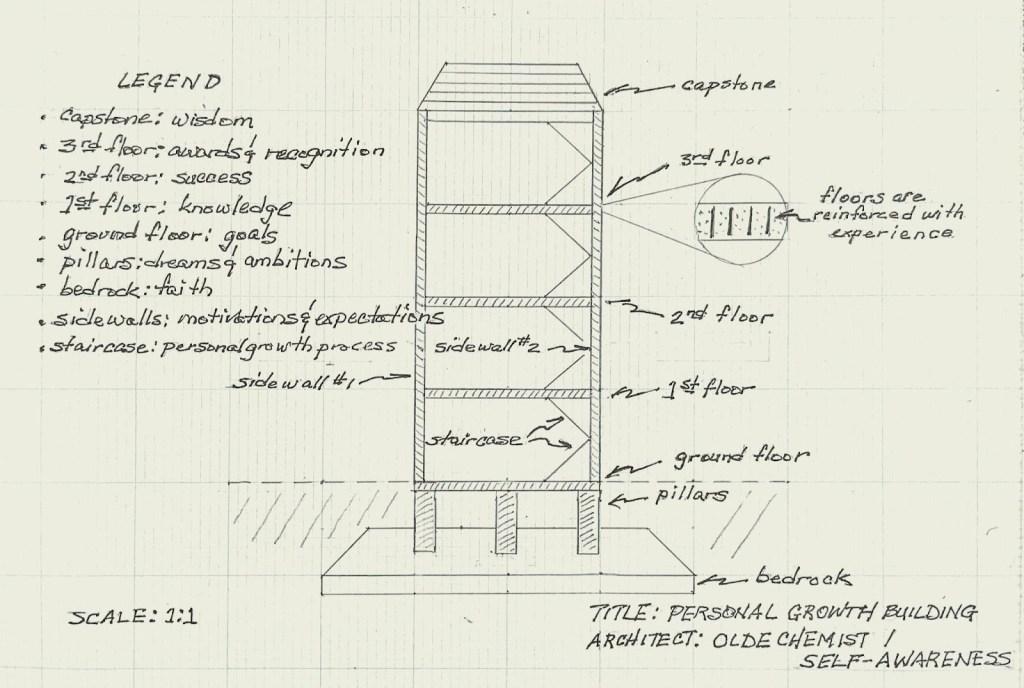
    So, we have this incredible building of personal growth, with its strong foundation and aspiring capstone. But how do we know we’re heading in the right direction? That’s where self-awareness, our internal “GPS” comes in.. It helps us pinpoint where we are right now and where we truly want to go. And once we have that clarity, we can then step into an even more powerful role: that of our architect, consciously designing and constructing the path to that very destination we desire.

    Think about your favorite video game or an elaborate set of LEGO™  building blocks. Before you can build something amazing or conquer a level, you need to know the rules, the tools you have, and where you want to go, right? Well, the same goes for growing as a person! Self-awareness is like having your internal map and knowing yourself really well – your strengths, your feelings, and what you truly care about. Understanding yourself is the first step to designing the kind of person you want to become and the life you want to build.

    Now imagine you’re the architect of your personal growth building. You get to design who you want to be and what you want to achieve. But just like any good architect, you need to know your materials and have a clear vision, a good set of blueprints. That is the role of self-awareness. Self-awareness is the process of getting to know your values, your skills, and what sparks your interest. It’s the foundation for making smart choices and building a future that’s uniquely yours.

    And just like a GPS helps you navigate physical terrain, self-awareness helps you navigate your personal landscape. Self-awareness is like your inner moral compass, helping you make choices that truly align with your gut feelings and what you value most. It’s about figuring out what truly matters to you, ensuring that your actions reflect who you genuinely are. This inner guide also helps you set goals based on your dreams and aspirations, turning them into clear “checkpoints” on your life’s journey. 

    Also, self-awareness, acting as your internal GPS, lets you see how far you’ve come, and how much further you have to go, giving you clarity on your journey and chances to celebrate all your wins, big or small. Life isn’t usually a straight line; it’s more like a complex roadmap with twists, turns, and unexpected detours. In this ever-changing landscape, self-awareness is beneficial. By regularly thinking about your experiences, changing values, and goals, it lets you adjust your “direction” when you need to. This ability to make important course corrections keeps you aligned with your evolving self, leading to a deeper understanding of who you’re becoming.

    Plus, this metaphorical GPS can show you different ways to reach your goals, giving you practical ideas about how long it might take and how much effort you’ll need. It encourages flexibility, helping you gracefully handle unexpected challenges and changes. When you inevitably feel “lost” or unsure, self-awareness shines a light on where you are in your journey. It not only shows you how far you’ve come but also reminds you of your inner strength and all the amazing progress you’ve made.  Recognizing where we are on our personal map, even when feeling disoriented, can be immensely reassuring. It helps us appreciate the progress we’ve made, recalibrate our direction when needed, and refuel our motivation to continue our journey.

    Ultimately, self-awareness is key to appreciating your ongoing progress, adjusting your course when things go off track, and boosting your motivation, pushing you forward with a fresh and clear sense of purpose. 


    How to Cultivate Your Self-awareness

    Self-awareness is a skill that, like a musical talent, such as playing the piano or the guitar, can be significantly improved through consistent effort, or practice, combined with specific techniques and activities. While you may already have a natural ability for playing an instrument or in the case of self-awareness, introspection or reflection, these are skills must still be developed. For self-awareness is an ongoing journey of discovery, where your investment of your time in mastering the following techniques along with a willingness to explore your inner self can lead to your significant growth as a person.

    This growth goes beyond understanding your strengths and weaknesses; it involves a deeper understanding of your emotions, thoughts, values, and motivations. It requires observing how these shape our behaviors and how we react to the world around us. Consider it like possessing an internal GPS system that continuously calibrates and refines its accuracy. Our constantly evolving and improving inner compass helps us navigate life’s obstacles, make well-informed choices, and encourage more honest relationships.

    To develop your self-awareness, consider these three components: an honest self-assessment, journaling, and seeking feedback from trusted peers (parents, mentors, teachers, and close friends). Each offers a distinct perspective on your inner workings, revealing valuable insights into your patterns and tendencies. The consistent commitment to these practices sharpens your awareness of your inner self, helping you to understand and control your emotions, improve your decision-making, and provide a clearer sense of purpose. Ultimately, self-awareness is a continuous journey of growth, changing as we mature and experience new things.


    The best place to start to grow your self-awareness is with a comprehensive self-assessment that encourages you to think about your:

    • Dreams and Aspirations: What is your long-term vision? What impact do you want to make in the world? What kind of future do you imagine for yourself?
    • Goals: What specific goals are you working towards in your academic and personal lives?
    • Strengths: What are you naturally good at? What skills and talents come easily to you? What do others praise you for?
    • Weaknesses (or Areas for Growth): Where do you struggle? What skills need development? What habits might be holding you back?

    This initial self-assessment provides a valuable foundation for building self-awareness. It helps you understand your internal compass and identify areas where you want to focus your energy.


    Next, I encourage you to keep a personal journal or even a private blog where you reflect on what you are learning in your courses, interactions with others, and daily activities, plus the challenges you are facing and how you are overcoming them. Journaling provides you an opportunity to:

    • Map  Your Progress: Regularly writing down your experiences, thoughts, and feelings related to your goals allows you to track how far you’ve come and identify patterns in your progress.
    • Reflect on Your Struggles: Journaling provides a safe space to explore challenges, frustrations, and setbacks. By writing about these difficulties, you can gain clarity, identify potential solutions, and learn from your experiences. 
    • Deepen Your Understanding of Who You Are: The act of writing forces you to express your thoughts and emotions, leading to a deeper understanding of your motivations, expectation and how you react in different situations.
    • Identify Patterns: Over time, journaling can reveal recurring patterns in your thoughts, behaviors, and emotional responses, offering valuable insights into your personality and habits. Journaling encourages you to explore and define your core values through self-reflection. 

    With practice, you will learn to spend time in deliberate  reflection, asking yourself questions such as: How did I feel today and why?, Why did I react that way in that situation and what can I learn from it?, What can I do differently given the same situation?, What are my core values and are they changing?, What are my current goals and why are they important to me?


    Finally, learn to ask others for their feedback on your progress, your actions and behavior, keeping an open mind and without getting defensive. I suggest asking trusted friends, family, or mentors for constructive feedback on how you come across to others. And while this can be challenging, it provides valuable perspective. More importantly, your willingness to reflect on this feedback objectively and identify patterns or areas where you can grow is a beneficial component of your personal growth.

    As a STEM student, this combination of activities can be particularly effective. You should appreciate the logical and scientific approach, a self-assessment followed by consistent journaling provides the framework for self-awareness. And, journaling can be seen as a way to collect “data” about yourself, which you can then analyze for insights and trends. This aligns with the analytical mindset you’ll need for success in the STEM fields. And finally, this process has its focus on growth and Improvement. It naturally encourages a growth mindset by prompting you to identify areas for improvement and track your development over time.


    In conclusion, do not forget that self-awareness is a continuous process, not a one-time activity. Practice it daily. Connect it to your goals. Remember self-awareness is a great tool to help you succeed in your studies, your future careers, and all areas of your life. Ultimately, self-awareness is the key to appreciating your ongoing progress, adjusting your course when things go off track, and boosting your motivation, pushing you forward with a fresh and clear sense of purpose. 

  • The Essential Traits for Personal Growth

    The Essential Traits for Personal Growth

    “You can’t build a skyscraper on an outhouse foundation.”

    Dr. John Walkup

    Three integral, interrelated traits: curiosity, a passion for learning, and a passion for solving problems, when combined with self-awareness, are the foundation or prerequisites for personal growth and eventual success, regardless of which career path you may choose.

    By definition, prerequisite is something that has to happen first, something that must occur, or in this case, a personality trait that must be developed, before you can get to the next step or goal.

    For example, in education, a prerequisite is a course or subject that a student must complete before enrolling in a more advanced course. This ensures that a student has the foundational knowledge or skills needed to succeed in the more complex material.

    For the sake of our discussion, these three prerequisites, curiosity, a passion for learning, and the passion for solving problems, ensure that we have the necessary foundation, the skills necessary to succeed on our journey of personal growth.

    Curiosity

    “We keep moving forward, opening new doors, and doing new things, because we’re curious and curiosity keeps leading us down new paths”.

    Walt Disney

    It all begins with curiosity – always asking “why?” and “how?”. Curiosity is a fundamental human trait, our longing to understand the world around us. Curiosity is the spark for our desire to learn and explore, to ask questions, and to seek knowledge beyond the obvious. It opens the door for new experiences and perspectives. And enriches our understanding of the world around us.

    When you’re curious, learning isn’t just memorizing facts. It’s actively exploring ideas, solving problems, and discovering what truly interests you. This makes learning more engaging, turns you into a better thinker, and fuels your creativity. It’s also key to understanding yourself and what you’re passionate about, setting you up for a lifetime of exciting discoveries and personal growth.

    And when combined with open-mindedness, seeking answers to questions in areas that interest us stimulates our passion for learning and our desire to solve problems, to investigate, experiment, and discover.

    While some people may be more naturally curious than others, the good news is that curiosity can be cultivated and nurtured.

    • The most effective way to build your curiosity, ask questions, lots of them. No question is too simple or too complex as long as the purpose is to gain more knowledge. Strive for deeper understanding in your learning, asking “why” and “how,” refusing to accept surface-level explanations. 
    • Listen and be open to different points of view, and actively seek out knowledge and understanding. Take time to research, participate in conversations, and explore diverse perspectives different than your own, which can broaden your horizons and deepen your understanding. Maintaining an open mind, willing to consider new ideas and perspectives, is essential to staying curious.
    • Embracing your passions is another powerful way to develop your curiosity. When we immerse ourselves in subjects that truly fascinate us, the desire to learn becomes naturally motivated.
    • Finally, persistence is the key. When faced with challenges or setbacks, a curious person will persevere, viewing obstacles as opportunities for learning and growth.

    Passion for Solving Problems

    Problems are a natural part of life, and the ability to solve them effectively is essential for success in both your personal and professional life. The passion for solving problems is the strong desire to identify and overcome challenges. It is the driving force that keeps you focused, motivated, and driven to find creative solutions to the complex and some not-so-complex problems you face in your lifetime. Without a passion for problem-solving, you may be less likely to take risks and try new things, and more importantly, less likely to persevere in the face of failure. This will greatly impact your career success regardless of what field you choose.

    Problem-solving skills are more important now than ever and are in demand by employers who want employees who can rapidly adapt to new situations and find innovative solutions to challenges they encounter in the workplace. People passionate about solving problems are looking for new challenges and ways to improve things. They are not afraid to think outside the box and create innovative solutions. This is a valuable skill in any field, as it allows people to overcome obstacles and achieve their goals.

    Here are some of the benefits of having a passion for solving problems:

    • It makes you more versatile. The ability to solve problems is essential for adapting to change. When things don’t go according to plan, people passionate about solving problems quickly come up with a new solution. This is a valuable skill in today’s rapidly changing world.
    • It makes you more creative and innovative. Problem solving requires creativity and innovation. People who are passionate about solving problems are always looking for new and better ways to do things. This is an important skill for success in any field, as it allows people to develop new products, services, and processes.
    • It makes you more competitive. In today’s competitive job market, it is important to stand out from the crowd. A passion for problem-solving is a great way to do this. Employers are always looking for people who can solve problems and improve things.
    • It makes you more successful in your career. Studies have shown that people who are passionate about their work are more likely to be successful in their careers. They are also more likely to be happy and fulfilled in their work.

    How can you develop or enhance your passion for solving problems?

    • The first step to developing a passion for problem solving is to find a problem that you are passionate about. This could be anything from a personal problem to a global issue.
    • Then, do your research. Once you have found a problem that you are passionate about, learn as much as you can about it. This will help you to better understand the problem and to develop potential solutions.
    • Be creative and think outside the box. Don’t be afraid to think outside the box and come up with innovative solutions. The best solutions are often the ones that no one else has thought of.
    • Don’t be afraid to fail. Failure is a natural part of the problem-solving process. It is an opportunity to learn and grow.
    • Finally, take time to celebrate your success. This will help you to stay motivated and to keep solving problems.

    Developing a passion for problem-solving takes time and effort, but it is worth it. A passion for problem-solving will help you to succeed in any career path you choose, making you a more valuable asset to your employer and to society as a whole.

    Passion for learning

    A passion for learning is important for success, in school and whichever career path you choose. This is because the world is constantly changing, and new technologies and ways of doing things are emerging all the time. In order to stay ahead of the curve and be successful in any field, it is important to be willing to learn new things and adapt to change.

    A need to be “the expert” about something rarely impresses others and can actually hinder your own growth. Always be in the process of learning. Seek the counsel of others. Listen to their experiences. Feel free to say, “I don’t know—instruct me.” And let them fuel your growth.

    Here are some of the ways a passion for learning can contribute to your success:

    • It makes you more adaptable. The ability to adapt to change is essential for success in today’s rapidly changing world. A passion for learning will help you to be more adaptable and to learn new things quickly.
    • It makes you more creative and innovative. A passion for learning will help you to think more creatively and come up with innovative solutions to problems. This is an important skill for success in any field.
    • It makes you more competitive. In today’s competitive job market, it is important to stand out from the crowd. A passion for learning will help you to develop the skills and knowledge you need to be more competitive and to land your dream job.
    • It makes you more successful in your career. Studies have shown that people who are passionate about their work are more likely to be successful in their careers. They are also more likely to be happy and fulfilled in their work.

    If you are passionate about learning, you will be more likely to succeed in any career path you choose. You will be more adaptable, more creative, more innovative, and more competitive. You will also be more likely to be happy and fulfilled in your work.

    Here are some tips to develop or enhance your passion for learning:

    • Find something you are interested in. The first step to developing a passion for learning is to find something that you are interested in. This could be anything from a hobby to a subject in school.
    • Set goals for yourself. Once you have found something you are interested in, set some goals for yourself. What do you want to learn about it? How can you learn it?
    • Find a mentor. If you are serious about learning about something, find a mentor, a friend, a teacher, or a boss who can help you. And be willing to listen and open to their instruction. A mentor can provide you with guidance and support and help you to stay on track.
    • Join a group of people with similar interests and goals. There are many cohorts of people who are passionate about learning. Joining a group can help you stay motivated and connect with other people who share your interests.
    • And finally, make an investment to make learning a part of your daily routine. Set aside some time each day to learn something new. This could be reading a book, watching a documentary, or taking a class.

    Commentary

    I would like to think that my foundational skills were sufficient for me to succeed. I was, and still am, extremely curious about the subjects I am passionate about. I still keep up on discoveries in chemistry, physics, and education, and have acquired new interests such as gardening and writing, with this blog being an example.

    I had the passion for solving problems throughout my childhood, then, nurtured in college under the mentorship of Dr. Walkup and then the technical training I received in my years with Hewlett-Packard’s Analytical Products Division, it has become a major strength.

    Looking back, I can clearly see my past and present weaknesses. While my passion for learning is a strength, I’ve always been an independent learner, often to a fault. This reluctance to seek direction or advice from others is a significant weakness. I cannot stress enough the importance of developing and nurturing the skill of asking for guidance and humbly accepting instruction without defensiveness. My pride and arrogance led me to believe I knew more than those around me, and I deeply regret the missed opportunities to learn from them.