
The Revised Blueprint for Our Personal Growth Building
“You can’t build a skyscraper on an outhouse foundation.”
– Dr. John Walkup
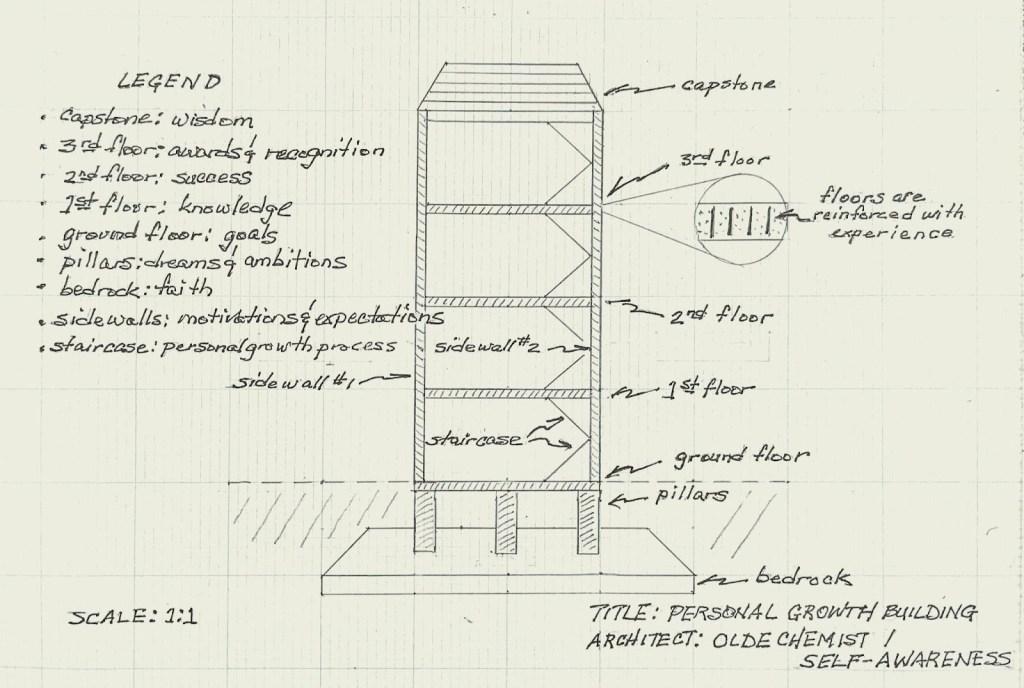
In a series of early posts, I created a simplified building blueprint with Motivation and Expectations resting on a foundation of Dreams, Aspirations, and Goals as the primary supports of our outer growth.

But these layers and supported walls cannot reside on dirt. They must rest on something deeper and more concrete. This creates a complete, logically sound structure:
That is why I am updating the blueprint to detail what components lie beneath the surface: the building’s” Substructure.”
The Substructure consists of:
The Ground Floor: Short-term and Long-term Goals
The interface between the superstructure and the substructure, the ground floor “slab”, consists of our short-term and long-term goals. These serve as the perfect transition; our goals are based on our dreams and ambitions, and require our motivations and expectations to achieve personal growth and obtain our definition of success.
The Support Pillars: Dreams and Aspirations
Our personal growth building requires two different types of columns or supports: our Dreams and Aspirations.
Our Dreams are fundamental, our “dream” of what we want to accomplish, providing passion and purpose. Aspirations represent the big-picture vision that provides direction and purpose. They both act as the support mechanism for the personal growth process. While goals and objectives focus on the near-term path and immediate results, dreams and aspirations provide the irresistible ‘why.’ Why the ultimate result justifies the effort, keeping all your actions aligned with your personal “mission.” Both your dreams and aspirations must be defined and nurtured, as they determine the degree and enduring strength of your personal growth.
The Bedrock of Faith
The bedrock of your personal growth journey is the foundation of your “personal growth building.” This isn’t a superficial structure built on temporary fixes or fleeting inspiration; it is a deep, resilient base that withstands the inevitable challenges of life. This foundation is critically established through faith—a profound conviction that gives direction and meaning to your efforts.
Faith can manifest in several powerful ways:
For some, it is an unwavering faith in self, a deep-seated belief in one’s own capabilities, resilience, and potential to evolve and overcome. This self-trust is the engine that drives consistency and perseverance.
For others, the foundation is a belief in a higher power or a universal order. This perspective provides comfort, a sense of belonging to something greater than oneself, and a moral or philosophical framework that guides decision-making.
Still, for many, this foundation is built upon a personal, intimate relationship with God, offering a spiritual anchor, a source of grace, and a transcendent purpose that elevates personal ambition beyond the purely material.
Regardless of its specific form, this core belief system serves as the unshakeable ground upon which all other aspects of personal development—such as discipline, knowledge acquisition, and skill-building—are securely erected. Without this strong foundational faith, the entire structure of personal growth can become fragile and prone to collapse under pressure.
Key Personal Growth Building’s Blueprint Components
The Two Columns of the Superstructure
You can visualize the “Superstructure” portion (Outer Growth) as being held up by two massive structural walls or columns.
The Left Support: Motivation
Motivation is basically that core, inner engine – the essential “oomph” – that pushes you to get better. It’s your natural wanting to hit goals, your curiosity, and just your general drive. This baseline motivation is key; if you don’t have it, you won’t feel engaged enough to “show up,” and your efforts to grow just won’t have the necessary “boost” to really take off.
The Right Support: Expectations
Think of expectations as the crucial support for your career—it gives it shape, defines it, and lets you reach high. They’re not just “pressure”; they’re a necessary strength, representing the standards you set for yourself, plus those from your industry, professors, and the world in general. A career built just on good intentions would be shaky. Expectations provide that solid framework, forcing you to be precise, stick to the measurements, and commit to getting a certain grade. Ultimately, they push your structure into a definite, strong form.
The Interaction Between the Two Columns
To successfully build anything solid or achieve your goals, you need a healthy mix of motivation and expectations.
Motivation without expectations creates what is simply a “blob.” It’s a ton of energy, but without any discipline, a clear goal, or focus on quality, it just ends up as a huge, messy pile that falls apart. On the other hand,
Expectations without motivation create a “hollow shell.” You are just going through the motions, maybe to please a boss or meet a deadline, but your heart isn’t in it. That empty effort will eventually collapse because the internal drive is missing.
To build something truly resilient and lasting – think of a towering skyscraper – you have to blend the powerful inner drive of high motivation with the solid structure of high expectations.
Goals
Goals serve as the essential ground floor in any personal growth model, acting as the critical interface between abstract desires and concrete action. Think of them as the “Slab” connecting the internal, conceptual “substructure” (Dreams and Aspirations) with the functional structure “superstructure.” While a dream is an abstract feeling, such as “I want to be an engineer,” a goal formalizes this feeling into a binding commitment or contract, such as “I will enroll in this specific university’s engineering program.” This distinction is structurally vital because you cannot generate effective motivation—the “walls” of your growth structure—without a concrete goal—the “floor“—to anchor it. Motivation without a defined goal is simply wasted or misdirected energy, highlighting why this step is the necessary foundation for all further personal growth.
The Staircase: The Personal Growth Process
Is the personal growth process considered an elevator or a stairway upward towards wisdom? An elevator implies you can push a button and arrive at wisdom without doing the work. The biggest, and often toughest, lesson when pursuing something big, our definition of “success,” is this: We must recognize that there is no “express” pathway to success and wisdom; we must “visit” each “floor” to reach the capstone.
The Stairway to Success: It’s All About the Climb
Within our personal growth building, the staircase is the connection that makes the journey and flow of the building work. Architecturally, it’s the main path for moving up – a physical sign of progress, and the only way to reach those higher goals. In this “success” metaphor, the staircase takes you from the ground floor (Your Goals), up through the essential phase of the first floor (Learning), and then on to the more ambitious higher levels.
The most important part of this whole idea is the actual climb. You actually have to climb the stairs; there’s no express elevator straight to the top (Success). That idea of instantly zipping to the top is a myth that screws up real, lasting achievement. The Capstone (Wisdom), or the pinnacle of your success, isn’t something you can skip or cheat your way to by avoiding the necessary hard work.
To truly and permanently land on the Success floor, you absolutely must first spend quality time on the Knowledge floor. And by “quality time,” I mean more than a quick stop; it means putting in the effort to learn, practice, and internalize the necessary skills, information, and wisdom. Knowledge is the solid ground that Success stands on. If you skip this crucial step, you end up with a shaky achievement—a “success” that just doesn’t have the strength to handle things when the going gets tough. The climb itself—the effort, the patience, and the sheer persistence—is what makes your Capstone a genuinely earned and lasting one.
The Rebar (Reinforcing Bars): Experience
In an Engineering context, concrete is strong when compressed, but it also cracks easily. To make it durable, you add rebar.
In our building metaphor, the third floor, Awards and Recognition are the components of the “concrete’s” structure. Experience (the rebar) helps us manage the pressure that awards and recognition may place on us – specifically, dealing with the disappointments that come when we are not recognized for our hard work, or managing our egos when we receive recognition and awards.
Self-Awareness: The Blueprint Itself
Since you are your life’s architect, and responsible for drawing this set of blueprints, self-awareness isn’t just a box on the drawing; it is the drawing itself. The blueprint represents your intended design; it is the standard against which your personal growth is measured.
What happens when we follow a specific “blueprint” and, for whatever reason, whether it is wrong decisions, personality traits that betray us, family concerns, or health issues, we arrive at a place in our lives that is not where we envisioned we would be? It still brings us to our personal “capstone” of wisdom; but the question of how we deal with disappointment is a concern in the process.
In construction, the blueprint is the architect’s dream or vision. It is drawn in a sterile office, assuming perfect soil conditions, perfect weather, and perfect materials. However in our personal growth building scenario, once the “ground” is broken, reality hits. You have an unexpected health issue; you lose your job; there is a dramatic shift in the economy or the stock market affecting your retirement savings; your personal decisions change the outlook for your success (changing jobs); there are family concerns (death of a parent, a chronic illness, or divorce). When these things happen, you, as the architect of your personal growth, don’t tear down the building. You adapt.
Disappointment comes when comparing your new reality to your blueprint. Wisdom comes from accepting your new reality. If you look at the blueprint of a life that went perfectly according to plan—straight path, no mistakes, no tragedy—that sheet of paper is clean. It is white and pristine.
A clean blueprint has no wisdom.
Conclusion
There is a reason why the substructure is essential.
When we are young, we trust our blueprints. We tend to believe that if we just build the walls straight and the floors level, our personal growth building will stand forever as is. We put our faith solely in the superstructure – in our own ability to execute the blueprint.
But as we grow older, we realize there are floors we didn’t plan for. There are cracks where the foundation has shifted. Some floors may have never been built because life got in the way.
When our blueprint fails, and the disappointment of unmet expectations sets in, the weight of that disappointment has to go somewhere. If your pillars (motivations and expectations) are resting on the sand of your own ego, you will crumble.
But if you have pillars (dreams and aspirations) that are anchored deep into your faith, you’ll find something surprising. You’ll find that the disappointments don’t destroy the building; they strengthen it.
