
Musings of an Old Chemist

A Chemist's Perspective on the Habits and Skills STEM Students Need For Success

Tag: faith

  • Building a Stronger Foundation for Personal Growth

    Building a Stronger Foundation for Personal Growth

    The Revised Blueprint for Our Personal Growth Building
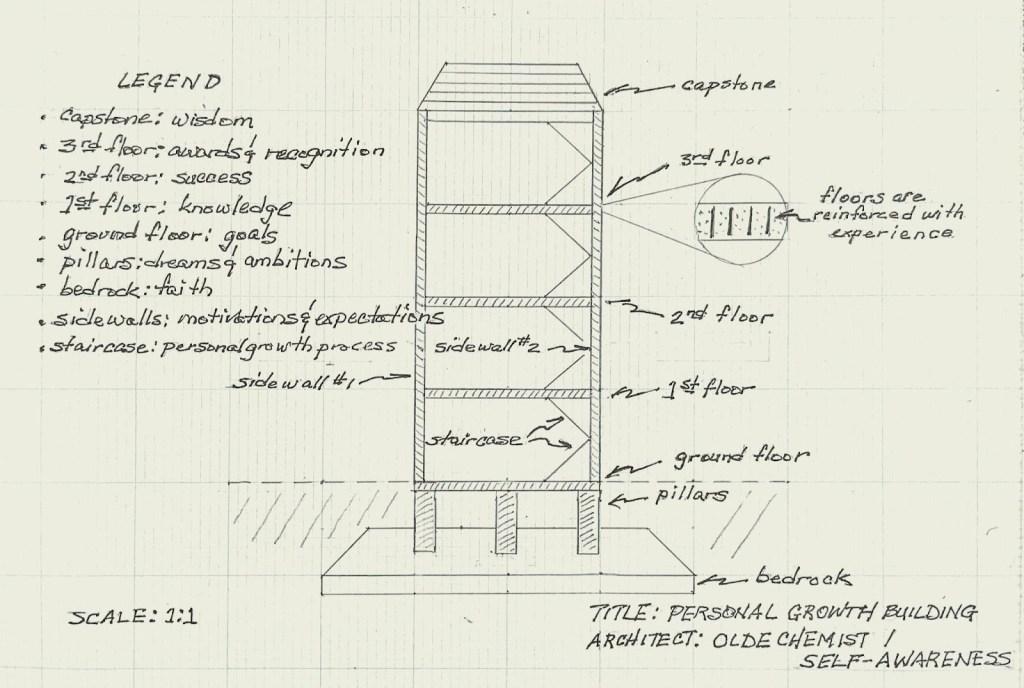
    “You can’t build a skyscraper on an outhouse foundation.”

     – Dr. John Walkup

    In a series of early posts, I created a simplified building blueprint with Motivation and Expectations resting on a foundation of Dreams, Aspirations, and Goals as the primary supports of our outer growth.

    But these layers and supported walls cannot reside on dirt. They must rest on something deeper and more concrete. This creates a complete, logically sound structure:

    FaithDreamsGoals(SupportedbyMotivation/Expectations)SuccessWisdom.Faith \rightarrow Dreams \rightarrow Goals \rightarrow (Supported by Motivation/Expectations) \rightarrow Success \rightarrow Wisdom.

    That is why I am updating the blueprint to detail what components lie beneath the surface: the building’s” Substructure.”


    The Substructure consists of:


    The Ground Floor: Short-term and Long-term Goals

    The interface between the superstructure and the substructure, the ground floor “slab”, consists of our short-term and long-term goals. These serve as the perfect transition; our goals are based on our dreams and ambitions, and require our motivations and expectations to achieve personal growth and obtain our definition of success. 


    The Support Pillars: Dreams and Aspirations

    Our personal growth building requires two different types of columns or supports: our Dreams and Aspirations

    Our Dreams are fundamental, our “dream” of what we want to accomplish, providing passion and purpose. Aspirations represent the big-picture vision that provides direction and purpose. They both act as the support mechanism for the personal growth process. While goals and objectives focus on the near-term path and immediate results, dreams and aspirations provide the irresistible ‘why.’ Why the ultimate result justifies the effort, keeping all your actions aligned with your personal “mission.” Both your dreams and aspirations must be defined and nurtured, as they determine the degree and enduring strength of your personal growth.


    The Bedrock of Faith

    The bedrock of your personal growth journey is the foundation of your “personal growth building.” This isn’t a superficial structure built on temporary fixes or fleeting inspiration; it is a deep, resilient base that withstands the inevitable challenges of life. This foundation is critically established through faith—a profound conviction that gives direction and meaning to your efforts.

    Faith can manifest in several powerful ways:

    For some, it is an unwavering faith in self, a deep-seated belief in one’s own capabilities, resilience, and potential to evolve and overcome. This self-trust is the engine that drives consistency and perseverance. 

    For others, the foundation is a belief in a higher power or a universal order. This perspective provides comfort, a sense of belonging to something greater than oneself, and a moral or philosophical framework that guides decision-making. 

    Still, for many, this foundation is built upon a personal, intimate relationship with God, offering a spiritual anchor, a source of grace, and a transcendent purpose that elevates personal ambition beyond the purely material. 

    Regardless of its specific form, this core belief system serves as the unshakeable ground upon which all other aspects of personal development—such as discipline, knowledge acquisition, and skill-building—are securely erected. Without this strong foundational faith, the entire structure of personal growth can become fragile and prone to collapse under pressure.


    Key Personal Growth Building’s Blueprint Components


    The Two Columns of the Superstructure

    You can visualize the “Superstructure” portion (Outer Growth) as being held up by two massive structural walls or columns.


    The Left Support: Motivation

    Motivation is basically that core, inner engine – the essential “oomph” – that pushes you to get better. It’s your natural wanting to hit goals, your curiosity, and just your general drive. This baseline motivation is key; if you don’t have it, you won’t feel engaged enough to “show up,” and your efforts to grow just won’t have the necessary “boost” to really take off.


    The Right Support: Expectations

    Think of expectations as the crucial support for your career—it gives it shape, defines it, and lets you reach high. They’re not just “pressure”; they’re a necessary strength, representing the standards you set for yourself, plus those from your industry, professors, and the world in general. A career built just on good intentions would be shaky. Expectations provide that solid framework, forcing you to be precise, stick to the measurements, and commit to getting a certain grade. Ultimately, they push your structure into a definite, strong form.


    The Interaction Between the Two Columns

    To successfully build anything solid or achieve your goals, you need a healthy mix of motivation and expectations

    Motivation without expectations creates what is simply a “blob.” It’s a ton of energy, but without any discipline, a clear goal, or focus on quality, it just ends up as a huge, messy pile that falls apart. On the other hand, 

    Expectations without motivation create a “hollow shell.” You are just going through the motions, maybe to please a boss or meet a deadline, but your heart isn’t in it. That empty effort will eventually collapse because the internal drive is missing. 

    To build something truly resilient and lasting – think of a towering skyscraper – you have to blend the powerful inner drive of high motivation with the solid structure of high expectations.


    Goals

    Goals serve as the essential ground floor in any personal growth model, acting as the critical interface between abstract desires and concrete action. Think of them as the “Slab” connecting the internal, conceptual “substructure” (Dreams and Aspirations) with the functional structure “superstructure.” While a dream is an abstract feeling, such as “I want to be an engineer,” a goal formalizes this feeling into a binding commitment or contract, such as “I will enroll in this specific university’s engineering program.” This distinction is structurally vital because you cannot generate effective motivation—the “walls” of your growth structure—without a concrete goal—the “floor“—to anchor it. Motivation without a defined goal is simply wasted or misdirected energy, highlighting why this step is the necessary foundation for all further personal growth.


    The Staircase: The Personal Growth Process

    Is the personal growth process considered an elevator or a stairway upward towards wisdom? An elevator implies you can push a button and arrive at wisdom without doing the work. The biggest, and often toughest, lesson when pursuing something big, our definition of “success,” is this: We must recognize that there is no “express” pathway to success and wisdom; we must “visit” each “floor” to reach the capstone.


    The Stairway to Success: It’s All About the Climb

    Within our personal growth building, the staircase is the connection that makes the journey and flow of the building work. Architecturally, it’s the main path for moving up – a physical sign of progress, and the only way to reach those higher goals. In this “success” metaphor, the staircase takes you from the ground floor (Your Goals), up through the essential phase of the first floor (Learning), and then on to the more ambitious higher levels.

    The most important part of this whole idea is the actual climb. You actually have to climb the stairs; there’s no express elevator straight to the top (Success). That idea of instantly zipping to the top is a myth that screws up real, lasting achievement. The Capstone (Wisdom), or the pinnacle of your success, isn’t something you can skip or cheat your way to by avoiding the necessary hard work. 

    To truly and permanently land on the Success floor, you absolutely must first spend quality time on the Knowledge floor. And by “quality time,” I mean more than a quick stop; it means putting in the effort to learn, practice, and internalize the necessary skills, information, and wisdom. Knowledge is the solid ground that Success stands on. If you skip this crucial step, you end up with a shaky achievement—a “success” that just doesn’t have the strength to handle things when the going gets tough. The climb itself—the effort, the patience, and the sheer persistence—is what makes your Capstone a genuinely earned and lasting one.


    The Rebar (Reinforcing Bars): Experience 

    In an Engineering context, concrete is strong when compressed, but it also cracks easily. To make it durable, you add rebar.

    In our building metaphor, the third floor, Awards and Recognition are the components of the “concrete’s” structure. Experience (the rebar) helps us manage the pressure that awards and recognition may place on us – specifically, dealing with the disappointments that come when we are not recognized for our hard work, or managing our egos when we receive recognition and awards.


    Self-Awareness: The Blueprint Itself

    Since you are your life’s architect, and responsible for drawing this set of blueprints, self-awareness isn’t just a box on the drawing; it is the drawing itself. The blueprint represents your intended design; it is the standard against which your personal growth is measured. 

    What happens when we follow a specific “blueprint” and, for whatever reason, whether it is wrong decisions, personality traits that betray us, family concerns, or health issues, we arrive at a place in our lives that is not where we envisioned we would be? It still brings us to our personal “capstone” of wisdom; but the question of how we deal with disappointment is a concern in the process.

    In construction, the blueprint is the architect’s dream or vision. It is drawn in a sterile office, assuming perfect soil conditions, perfect weather, and perfect materials. However in our personal growth building scenario, once the “ground” is broken, reality hits. You have an unexpected health issue; you lose your job; there is a dramatic shift in the economy or the stock market affecting your retirement savings; your personal decisions change the outlook for your success (changing jobs); there are family concerns (death of a parent, a chronic illness, or divorce). When these things happen, you, as the architect of your personal growth, don’t tear down the building. You adapt.

    Disappointment comes when comparing your new reality to your blueprint. Wisdom comes from accepting your new reality. If you look at the blueprint of a life that went perfectly according to plan—straight path, no mistakes, no tragedy—that sheet of paper is clean. It is white and pristine.

    A clean blueprint has no wisdom.


    Conclusion

    There is a reason why the substructure is essential.

    When we are young, we trust our blueprints. We tend to believe that if we just build the walls straight and the floors level, our personal growth building will stand forever as is. We put our faith solely in the superstructure – in our own ability to execute the blueprint.

    But as we grow older, we realize there are floors we didn’t plan for. There are cracks where the foundation has shifted. Some floors may have never been built because life got in the way.

    When our blueprint fails, and the disappointment of unmet expectations sets in, the weight of that disappointment has to go somewhere. If your pillars (motivations and expectations) are resting on the sand of your own ego, you will crumble.

    But if you have pillars (dreams and aspirations) that are anchored deep into your faith, you’ll find something surprising. You’ll find that the disappointments don’t destroy the building; they strengthen it. 

  • Wisdom: A Function of Knowledge, Experience, Self-awareness, and Faith

    Wisdom: A Function of Knowledge, Experience, Self-awareness, and Faith

    Introduction

    “When you see something that is technically sweet, you go ahead and do it, and you argue about what to do about it only after you have had your technical success. That is the way it was with the atomic bomb.”

     – J. Robert Oppenheimer

    A review of 20th-century history reveals a critical, undeniable fact: Intelligence is not a guarantee of a positive result.

    The Manhattan Project stands as a technical masterpiece, having assembled the foremost experts in physics to tackle intricate theoretical challenges surrounding nuclear fission. The team successfully developed and engineered a mechanism to initiate this reaction in a practical setting, meticulously following every step to achieve a logical and verifiable result. However, despite this technical brilliance, the outcome was the creation of a weapon with the power to extinguish human civilization.

    J. Robert Oppenheimer, the lead physicist, later famously quoted Hindu scripture, realizing the gravity of what his “success” meant: “Now I am become Death, the destroyer of worlds.”

    How can a project be a perfect success in the lab, but a potential failure for humanity? Knowledge and Expertise do not equate with Wisdom.


    What is “Wisdom?”


    Wisdom as a Mathematical Equation

    If you are entering a STEM field today, you are spending years building your intellect. You are accumulating Knowledge (formulas, axioms, laws of physics) and gaining Experience (labs, internships, projects). These are the tools that help you succeed in the world.

    But intellect without wisdom is just an uncontrolled force.

    “Yesterday, we fought wars which destroyed cities. Today, we are concerned with avoiding a war which will destroy the Earth. We can adapt atomic energy to produce electricity and move ships, but can we control its use in anger?”

     – Robert Kennedy

    To be truly successful – not just as a scientist, but as a leader, and a human being – you need more than just the inputs of knowledge and experience. You need to solve for a different variable entirely. You need to solve for Wisdom.

    Wisdom is not a mystical concept reserved for philosophers on a mountain top. It is a function of four specific variables. And just like any complex system, if you ignore one variable, the equation falls apart.


    Defining the Wisdom Function

    If we accept that Wisdom is the desired outcome, we need to understand the components (inputs) required to generate it. Wisdom is not a random occurrence; it is the result of a specific integration of variables.

    We can define the Wisdom Function as follows:

    W=f(K,E,S,F)W = f(K, E, S, F)

    To solve for W (Wisdom), you must understand the nature and function of each variable.


    1. KK= Knowledge (Your Database)

    In our equation, Knowledge is the raw data. It is the accumulation of facts, information, and established laws.

    Think of Knowledge as the hard drive of your computer (your brain). It is filled with terabytes of information – years of research, chemical equations, and physics constants.

    But a hard drive full of facts has a limitation; it knows that a tomato is a fruit (botanical classification), but it does not know that a tomato does not belong in a fruit salad. It has content, but no context.

    2. EE = Experience (Real-life Application)

    Experience is the application of Knowledge in a real-world environment. It is the process of converting theory into practice through repetition.

    Consider this analogy: experience is the Lab Experiment. You take a hypothesis (KK) and test it against reality. Experience is the collection of data points derived from failures and successes.

    But experience has a limitation: It is reactive. It tells you what has worked in the past, but it cannot always predict what will work in a completely new future environment or application.

    3. SS = Self-Awareness (Internal Calibration)

    Self-Awareness is the understanding of our own influence on the data.

    Consider this instrumental chemistry analogy: Instrument Calibration. In any experiment, the instrument used to measure the data may affect the result. For example, if your electronic balance is not zeroed out (tared), every measurement you take is flawed.

    Self-awareness is the process of checking to see if we’re solving problems the right way, and for the right reasons. It forces us to stop and ask: What am I really trying to do here? Are my actions to benefit the project’s outcome, to fix a problem, or just to make myself look better? Are my personal feelings clouding my judgment? Am I ignoring facts that don’t fit my hypothesis? And ultimately, does the outcome match my core beliefs? If you skip this internal check, all your knowledge  (KK) and experience (EE) may not matter, and the solution will be biased.

    4. FF = Faith (The Constant)

    This is often the most difficult variable for the scientific mind to accept, yet it is essential for the equation. Faith has many forms. There is a faith in a set of scientific axioms or principles, which may or may not continue to be valid in the current situation. There is faith in your knowledge and skill, the ability to adapt and solve any problem you may face. And there is a faith in God or a higher power, which gives you strength and guides your moral compass.

    Faith acts as a moral constant, an internal compass guiding you when all the facts are not yet known. It’s what helps you discern not just what can be achieved, but what is right, connecting what is understood to what is yet to be discovered.

    The Scientific Analogy: A great deal of scientific work starts with a theory or idea that hasn’t been completely proven yet. It’s all built on a fundamental trust – like believing the established rules of physics will hold up in any new situation, no matter what.


    Personal Commentary

    He who can no longer pause to wonder and stand rapt in awe is as good as dead; his eyes are closed.

    – Albert Einstein

    Sometimes, because we are trained to be analytical thinkers, we convince ourselves that we are agnostic. And when we look and see something we don’t understand, when we should be filled with awe and wonder, we are so busy trying to find a scientific explanation that we convince ourselves it’s not a miracle, that it is not the act of God or a higher power. Wisdom, for me personally, is my recognition that I cannot underestimate the power of God and his plan. 


    Now that we have defined the variables, we can see how they interact. The mistake most students make – and the mistake the educational system often encourages – is focusing entirely on the first two variables, Knowledge and Experience.


    Two Wisdom Function Analogies


    Scalar vs Vector Measurement Example

    Most of us in the science realm were introduced to the concept of vectors and the difference between scalar and vector measurements in our middle school science classes and again in our high school and college physics classes.

    As a refresher for these concepts, consider the following example: Imagine you were to ask me directions to a local restaurant, and I were to say you drive 45 miles per hour for 15 minutes. This is a scalar measurement. You have no idea which direction you were to drive; you have only one piece of information, the velocity at which you are to drive, and you need the direction. The definition of a vector is that it has a magnitude, in this example, 45 miles per hour, and a direction, let’s say directly east. You now have both components of a vector. The directions to the restaurant are to drive east at 45 miles per hour (vector) for 15 minutes.

    Now, think of your career trajectory as a Vector.

    The sheer power of your abilities, the Magnitude of your professional vector, is determined by your Knowledge (KK) and Experience (EE).

    These factors directly influence:

    • The depth of intellect you can bring to bear on any challenge.
    • The speed with which you can reach a solution.
    • The sophistication and complexity of the problems you are capable of solving.

    A person with great intellect and extensive experience is a force to be reckoned with. However, magnitude is a scalar quantity, it lacks direction.

    The Direction in your life’s “vector” is determined by Self-Awareness and Faith.

    • Self-Awareness provides calibration for the “Why?”: It answers the question, ‘Why am I doing this?’
    • Faith ensures your internal belief system is aligned: It addresses where your actions fit within your personal moral and internal convictions.

    The Guided Missile Example

    Our scientific power has outrun our spiritual power. We have guided missiles and misguided men.

    – Martin Luther King, Jr.

    Imagine a missile guidance system.

    • If you have low Knowledge and Experience (Low Magnitude), the missile barely leaves the launchpad. It’s ineffective and harmless.
    • However, if you have incredible Knowledge and Experience (high Magnitude) but lack Self-awareness and Faith to set the coordinates in the right Direction, you have created a disaster. You have a high-speed projectile aimed at the wrong target.

    The STEM Trap

    In your classes, you are graded almost exclusively on Magnitude. Did you get the right answer? Did the chemical reaction work? Did the bridge you designed hold the weight?

    But in life, Wisdom is the vector sum. It is useless to be the smartest engineer in the company if you are building something that ultimately causes harm because you didn’t ask the “faith” or “self-awareness” questions.


    Conclusion

    Wisdom (WW) is the alignment of your Magnitude (K+EK+E) with the correct Direction (S+FS+F).

    Wisdom is not an accident. It is not a trait you simply “pick up” as you get older. It is the deliberate integration of what you know (KK), what you do or have done (EE), who you are (SS), and what you believe (FF).

    If you remove any variable, the function fails.

    • Without Knowledge, you are clueless.
    • Without Experience, you are just theoretical.
    • Without Self-Awareness, you are unreliable.
    • Without Faith, you are adrift.
  • Self-assessment Exercise Four: Practicing the Art of Self-reflection and Evaluating Your Openness for Change 

    Self-assessment Exercise Four: Practicing the Art of Self-reflection and Evaluating Your Openness for Change 

    For your consideration:

    “You know, to be able to do something great in your life, you’re gonna have to realize your failures. You’re gonna have to embrace them and figure out how to overcome it.” 

    – Dave Chappelle


    Introduction


    Honest self-reflection is a precursor to self-awareness and the starting point for our discussion of personal growth. To start to know yourself, you need to consider who you are and what’s important to you at this point in your life. This is the final of four exercises designed to encourage you to take the time to think about and identify your goals and motivations. This exercise is designed to help you understand the forces driving your pursuit of a key personal or professional goal. It may help you know yourself better, figure out your goals, and make more informed decisions about your future. It may also help you to develop a stronger sense of purpose and direction in life. 


    Key Points to Remember

    Be honest with yourself; there are no right or wrong answers, and no judgment is attached to your responses.

    Take your time with these exercises, thinking about what is important to you and why.

    As you work through each prompt, take a moment to record your thoughts. These reflections serve as a valuable resource when developing self-awareness.


    Self-reflection and Your Openness for Change


    Prompts


    Prompt #1: 

    Think back over the past year. List one thing that you wish you could do over. Did you react harshly to a person’s comments or criticize someone unfairly? Were you given an opportunity to display your talents and skills or asked to do something meaningful and, for whatever reason, failed to meet expectations? Is there a decision you made whose consequences did you more harm than good? If so, what did you learn from the situation? What could you have done differently? If this is a repeating occurrence or behavior, are you willing to and how do you intend to change your behavior in the future?


    Prompt #2:

    Is there someone in your past who has left a lasting impression due to their constant support and guidance? This person consistently stood by you during times of need, providing advice, emotional and financial assistance, all without expecting anything in return. Someone who may not have said what you wanted to hear at the time, but precisely what you needed to hear. How did you respond to their guidance: were you grateful for their wisdom, or did you harbor resentment? Do you consider this person to be a role model for you? If so, how have these interactions changed your perspective on life and working with others?


    Prompt #3

    List three things you value most regarding your personal growth, for example: Faith, Family, Financial Freedom, Recognition, Success. Now, look back at the past 2 weeks, what was your time investment on your personal growth process? How many hours did you dedicate to activities directly serving these three values? Which activity or relationship gave you the greatest sense of satisfaction or positive reinforcement (exothermic growth)? Was there a drain on your energy levels (endothermic growth)? What activity or relationship consumed the most of your emotional or mental energy, often leaving you depleted?


    Self-assessment Conclusion


    You’ve completed the vital work of moving from self-reflection to action by honestly considering answering these questions. You’ve identified and acknowledged any recurring failures and regrets (Prompt #1), influential mentors and guidance in your life (Prompt #2), and, most importantly, evaluated your personal energy investment (Prompt #3).

    As discussed in a previous blog post, the Law of Conservation of Energy applies to personal growth: you cannot generate more personal energy; you can only reallocate it to different endeavors. 

    Your life is subject to this law. Every time you dedicate mental or emotional energy to low-value activities or relationships that drain you, you’re experiencing endothermic growth; that energy is simply lost.

    Conversely, when you commit to activities aligned with your most important values—such as your faith, mastering concepts or talents, your family, or financial desires – you’re exhibiting exothermic personal growth. You’re releasing your stored personal energy, producing serious personal growth. While these endeavors may be challenging in the moment, this process (perseverance and resilience) builds the person you truly desire to be.

    With the four parts of your self-assessment now complete and your answers identified, the crucial next step is to actively pursue the traits, habits, and desires that will help you become your best self. We all need, no, we all must, stop passively waiting for change. So utilize this blueprint of your values and begin, right now, to invest your personal energy in becoming the person you desire to be.

  • Weekly Quotation: September 24, 2025: Embracing Resilience: Overcoming Life’s Challenges

    Weekly Quotation: September 24, 2025: Embracing Resilience: Overcoming Life’s Challenges

    For your consideration:

    I think that life is difficult. People have challenges. Family members get sick, people get older, you don’t always get the job or the promotion that you want. You have conflicts in your life. And really, life is about your resilience and your ability to go through your life and all of the ups and downs with a positive attitude.

    Jennifer Hyman


    After undergoing five spinal surgeries in the past twelve years, I’ve come to accept chronic pain as my new normal. I understand this is the hand I’ve been dealt and must manage it daily. My faith in God and my perspective on life are the only things I truly control. I lean into stoicism, focusing on what I can control: my emotions, my reactions to situations, and my demeanor. I accept what is beyond my control—the actions and behaviors of others, external events, and fate.

    I strive to prevent my countenance from revealing my pain and discomfort, choosing not to complain about my situation. Instead, I try to be a concerned, interested, and active listener, showing compassion for others’ challenges. This path is not easy, but through prayer—asking for strength, wisdom, and compassion, and giving thanks for all of God’s blessings—I feel I am making progress toward becoming the best version of myself.

  • Weekly Quotation: August 20, 2025: Awe And Wonder

    Weekly Quotation: August 20, 2025: Awe And Wonder

    He who can no longer pause to wonder and stand rapt in awe, is as good as dead; his eyes are closed.
    – Albert Einstein

    Awe is a powerful emotion defined as a feeling that what we are witnessing is beyond our current understanding. But our perception of awe and wonder evolves throughout our lifetimes. For example:

    As children, our curiosity and wonder are fueled by the pure joy of discovery. A messy papier-mache volcano built on the kitchen table, or a curious question about the stars, is enough to stimulate our search for answers.

    As we get older, our perspective shifts. The world begins to measure us, and we, in turn, begin to measure ourselves. Our sense of worth becomes tied to external rewards—such as grades, test scores, titles, and salaries. The process of learning and discovery becomes a means to an end, rather than a joy in itself.

    We get so engrossed in our daily routine—rushing to appointments, ticking off to-do lists, and worrying over expectations—that we overlook the wonder in the world around us. Consider how often you’re in such a hurry while driving that you fail to notice your surroundings. Do you recall the turns you made, the roads you took, or anything that happened during your commute? 

    Now in my sixties, I consciously strive to appreciate life’s beauty and complexity, taking the time to marvel at nature. This includes the intricate details of plants and flowers in my garden, as well as observing Jupiter’s inner moons or the Pleiades constellation through my telescope on a clear night. This past Friday, at 5 a.m., while walking our dog, I noticed the stunning alignment of Venus and Jupiter on the eastern horizon. This sight filled me with such awe and reminded me of the insignificance of my daily concerns—what I needed to do that morning or what I hadn’t accomplished the day before. It reaffirmed my faith in God and highlighted my small place within these mysteries.