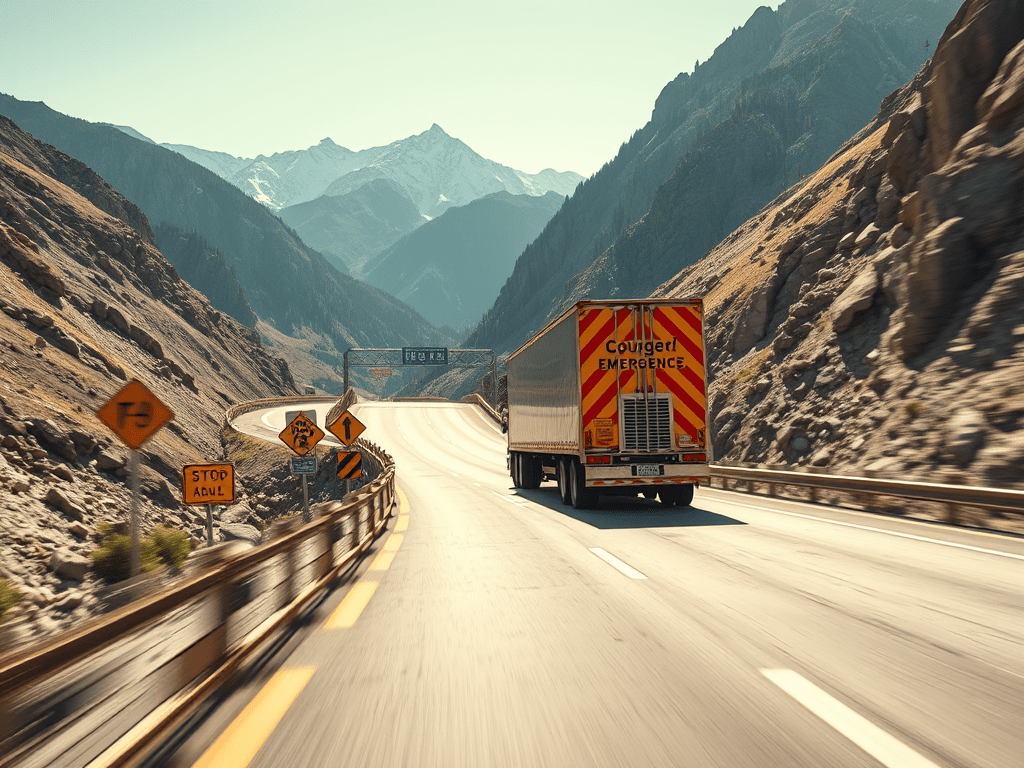
The “Truck on a Ramp” model is a classic physics scenario that involves the principle of energy conservation. Its focus is on the emergency truck ramps often seen on mountain interstates. These extremely steep ramps are strategically placed to safely stop a speeding, out-of-control truck, a truck whose brakes may have failed while descending a steep mountain grade.
The “Truck on a Ramp” Scenario
Assume a truck descending Interstate 1-75 through the mountains north of Chattanooga, Tennessee, is travelling 80 miles per hour () when its brakes fail. What height in meters must the highest point of an emergency truck ramp be (assuming the force due to friction and air resistance is equal to zero) for the truck to come to a complete stop ()? Assume the force of gravity (). Round your answer to significant figures, because the value for the force of gravity, , has significant figures.
Background
One of my favorite topics in science is the conservation of energy. I could teach an entire semester of an “Introduction to Chemistry and Physics” high school science course on this topic.
In this post, we will examine the Conservation of Mechanical Energy, one of the most powerful concepts in your physics toolbox.
The introductory physics world often relies on ideal scenarios, telling us to “assume a frictionless system” or “neglect air resistance.” While these assumptions don’t reflect the real world, they are essential for isolating and understanding the central physical laws.
By understanding the relationship between kinetic and potential energy in an ideal system, you gain the ability to solve complex problems without ever needing to calculate acceleration or time.
Solution Strategy:
In a perfect world free of non-conservative forces (like friction affecting the scenario and turning motion into heat), the total amount of mechanical energy in a system never changes. It just transforms.
The formula: , where the () is always the sum of the energy of motion ( ()) and stored energy of position ( ). The units for energy are in
- : ()
- : ()
Let’s examine this transformation as our truck enters the ramp.
Situation 1: The Bottom of the Ramp ()
Imagine the truck moving at full speed right at the base of the ramp.
At this exact moment and location, we set our reference point for height to zero (). Because potential energy relies on position, or height, (), if .
The formula for becomes:
Therefore, at the lowest point of the ramp, the . The truck is going as fast as it ever will.
Situation 2: The Top of Ramp (Maximum Height, ()
Now, the truck races up the ramp. Gravity is doing negative work on it, slowing it down. The truck reaches its highest point and, for just a split second, it stops moving before it starts rolling back down.
At that exact split second when velocity is zero , the kinetic energy vanishes ().
Where did that energy go? It didn’t disappear. It transformed into gravitational potential energy. The truck is now at its maximum height ().
At the highest point of the ramp,the). This is the instant when the truck is completely stopped.
Calculations
Because we are in a frictionless system, we know that the Total Energy TE must be the same at the bottom and at the top.
This gives us one of the most useful problem-solving equations in mechanics:
Values from the scenario:
Substituting:
Cancelling the truck’s mass from both sides:
Solving for the final height :
Performing the calculations:
Rounding to significant figures, the final height of the ramp will need to be: or approximately .
Why This is Valuable
By understanding that in a frictionless scenario, total mechanical energy transitions between these two forms (kinetic energy and potential energy), you can skip having to use complicated kinematics equations to solve the problem.
If you know how fast the truck was going at the bottom, you can instantly calculate exactly how to design the ramp, specifically how high the ramp needs to go.
And, conceptually, this relationship between Total Energy, Potential Energy, and Kinetic Energy also explains why the initial hill on a roller coaster is higher than any subsequent hill or loop in the rest of the ride.
If you can grasp these energy exchange calculations, you’ve mastered a cornerstone of classical mechanics.
