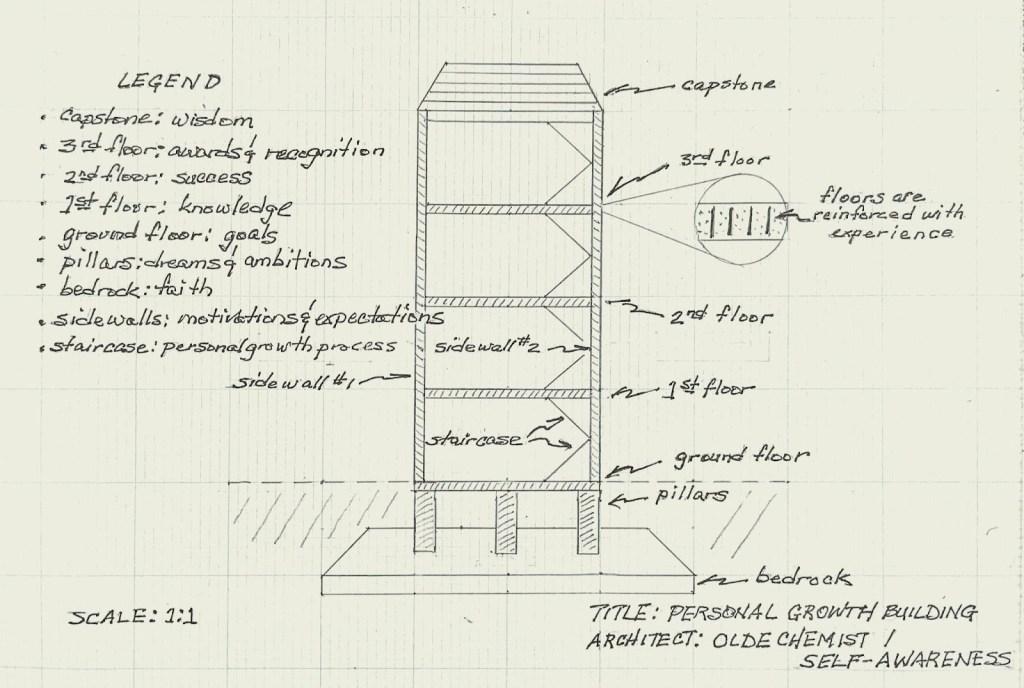
I’ve recently been asked why my Personal Growth Building (Revision 2) focuses so heavily on the specific structural components for personal growth rather than just the “foundational” traits we all value: Curiosity, a GrowthMindset, the Passion for Solving Problems, and a Passion for Learning.
It is a fair question. The “foundational” traits we value in STEM and other fields are often considered the prerequisites for student achievement. However, from my perspective, having spent time in scientific labs and learning drafting and surveying with my Dad, a civil engineer, I see a crucial element that is often overlooked: As Dr. Walkup famously stated, “You can’t build a skyscraper on an outhouse foundation.”
1. “Readiness” vs. The “System.”
Curiosity and a GrowthMindset represent how prepared a student is; they indicate if a student is trulyready to jump into learning.
The elements in the Personal Growth Building, though, are all about what a student does. They’re the tools that turn that potential into real results.
Think about a student who’s “passionate about learning” but doesn’t have a solid understanding of the base of knowledge required to succeed. They’re like a car engine revving high but stuck in neutral. They have the “energy” necessary but no way to actually use it effectively. The “Building” provides the process and structure they need to shift a “simpleinterest” into “genuineunderstanding.”
2. The Sustainability of Growth
My intent is to prepare students for a 40-year career, not just a four-year degree. Traits like “Passion” can flicker and fade under the pressure of a professional environment.
The components and structure of the “Building” are designed to train and support students so they’re capable of “adapting.” When a chemist’s specific technical knowledge becomes obsolete, it is the structure of their learning – their ability to categorize new information and logically assess and apply it – that allows them to pivot to new challenges. We don’t just want “curious” students; we want intellectually sound professionals.
Closing Thought
We shouldn’t choose between “traits” and “frameworks.” We must recognize that the traits are what make the building possible, but the framework is what makes the student useful to the world and resilient to change.
The Revised Blueprint for Our Personal Growth Building
“You can’t build a skyscraper on an outhouse foundation.”
– Dr. John Walkup
In a series of early posts, I created a simplified building blueprint with Motivation and Expectations resting on a foundation of Dreams, Aspirations, and Goals as the primary supports of our outer growth.
But these layers and supported walls cannot reside on dirt. They must rest on something deeper and more concrete. This creates a complete, logically sound structure:
That is why I am updating the blueprint to detail what components lie beneath the surface: the building’s” Substructure.”
The Substructure consists of:
The Ground Floor: Short-term and Long-term Goals
The interface between the superstructure and the substructure, the ground floor “slab”, consists of our short-term and long-term goals. These serve as the perfect transition; our goals are based on our dreams and ambitions, and require our motivations and expectations to achieve personal growth and obtain our definition of success.
The Support Pillars: Dreams and Aspirations
Our personal growth building requires two different types of columns or supports: our Dreams and Aspirations.
Our Dreams are fundamental, our “dream” of what we want to accomplish, providing passion and purpose. Aspirations represent the big-picture vision that provides direction and purpose. They both act as the support mechanism for the personal growth process. While goals and objectives focus on the near-term path and immediate results, dreams and aspirations provide the irresistible ‘why.’ Why the ultimate result justifies the effort, keeping all your actions aligned with your personal “mission.” Both your dreams and aspirations must be defined and nurtured, as they determine the degree and enduring strength of your personal growth.
The Bedrock of Faith
The bedrock of your personal growth journey is the foundation of your “personal growth building.” This isn’t a superficial structure built on temporary fixes or fleeting inspiration; it is a deep, resilient base that withstands the inevitable challenges of life. This foundation is critically established through faith—a profound conviction that gives direction and meaning to your efforts.
Faith can manifest in several powerful ways:
For some, it is an unwavering faith in self, a deep-seated belief in one’s own capabilities, resilience, and potential to evolve and overcome. This self-trust is the engine that drives consistency and perseverance.
For others, the foundation is a belief in a higher power or a universal order. This perspective provides comfort, a sense of belonging to something greater than oneself, and a moral or philosophical framework that guides decision-making.
Still, for many, this foundation is built upon a personal, intimate relationship with God, offering a spiritual anchor, a source of grace, and a transcendent purpose that elevates personal ambition beyond the purely material.
Regardless of its specific form, this core belief system serves as the unshakeable ground upon which all other aspects of personal development—such as discipline, knowledge acquisition, and skill-building—are securely erected. Without this strong foundational faith, the entire structure of personal growth can become fragile and prone to collapse under pressure.
Key Personal Growth Building’s Blueprint Components
The Two Columns of the Superstructure
You can visualize the “Superstructure” portion (Outer Growth) as being held up by two massive structural walls or columns.
The Left Support: Motivation
Motivation is basically that core, inner engine – the essential “oomph” – that pushes you to get better. It’s your natural wanting to hit goals, your curiosity, and just your general drive. This baseline motivation is key; if you don’t have it, you won’t feel engaged enough to “show up,” and your efforts to grow just won’t have the necessary “boost” to really take off.
The Right Support: Expectations
Think of expectations as the crucial support for your career—it gives it shape, defines it, and lets you reach high. They’re not just “pressure”; they’re a necessary strength, representing the standards you set for yourself, plus those from your industry, professors, and the world in general. A career built just on good intentions would be shaky. Expectations provide that solid framework, forcing you to be precise, stick to the measurements, and commit to getting a certain grade. Ultimately, they push your structure into a definite, strong form.
The Interaction Between the Two Columns
To successfully build anything solid or achieve your goals, you need a healthy mix of motivation and expectations.
Motivation without expectations creates what is simply a “blob.” It’s a ton of energy, but without any discipline, a clear goal, or focus on quality, it just ends up as a huge, messy pile that falls apart. On the other hand,
Expectations without motivation create a “hollow shell.” You are just going through the motions, maybe to please a boss or meet a deadline, but your heart isn’t in it. That empty effort will eventually collapse because the internal drive is missing.
To build something truly resilient and lasting – think of a towering skyscraper – you have to blend the powerful inner drive of high motivation with the solid structure of high expectations.
Goals
Goals serve as the essential ground floor in any personal growth model, acting as the critical interface between abstract desires and concrete action. Think of them as the “Slab” connecting the internal, conceptual “substructure” (Dreams and Aspirations) with the functional structure “superstructure.” While a dream is an abstract feeling, such as “I want to be an engineer,” a goal formalizes this feeling into a binding commitment or contract, such as “I will enroll in this specific university’s engineering program.” This distinction is structurally vital because you cannot generate effective motivation—the “walls” of your growth structure—without a concrete goal—the “floor“—to anchor it. Motivation without a defined goal is simply wasted or misdirected energy, highlighting why this step is the necessary foundation for all further personal growth.
The Staircase: The Personal Growth Process
Is the personal growth process considered an elevator or a stairway upward towards wisdom? An elevator implies you can push a button and arrive at wisdom without doing the work. The biggest, and often toughest, lesson when pursuing something big, our definition of “success,” is this: We must recognize that there is no “express” pathway to success and wisdom; we must “visit” each “floor” to reach the capstone.
The Stairway to Success: It’s All About the Climb
Within our personal growth building, the staircase is the connection that makes the journey and flow of the building work. Architecturally, it’s the main path for moving up – a physical sign of progress, and the only way to reach those higher goals. In this “success” metaphor, the staircase takes you from the ground floor (Your Goals), up through the essential phase of the first floor (Learning), and then on to the more ambitious higher levels.
The most important part of this whole idea is the actual climb. You actually have to climb the stairs; there’s no express elevator straight to the top (Success). That idea of instantly zipping to the top is a myth that screws up real, lasting achievement. The Capstone (Wisdom), or the pinnacle of your success, isn’t something you can skip or cheat your way to by avoiding the necessary hard work.
To truly and permanently land on the Success floor, you absolutely must first spend quality time on the Knowledge floor. And by “quality time,” I mean more than a quick stop; it means putting in the effort to learn, practice, and internalize the necessary skills, information, and wisdom. Knowledge is the solid ground that Success stands on. If you skip this crucial step, you end up with a shaky achievement—a “success” that just doesn’t have the strength to handle things when the going gets tough. The climb itself—the effort, the patience, and the sheer persistence—is what makes your Capstone a genuinely earned and lasting one.
The Rebar (Reinforcing Bars): Experience
In an Engineering context, concrete is strong when compressed, but it also cracks easily. To make it durable, you add rebar.
In our building metaphor, the third floor, Awards and Recognition are the components of the “concrete’s” structure. Experience (the rebar) helps us manage the pressure that awards and recognition may place on us – specifically, dealing with the disappointments that come when we are not recognized for our hard work, or managing our egos when we receive recognition and awards.
Self-Awareness: The Blueprint Itself
Since you are your life’s architect, and responsible for drawing this set of blueprints, self-awareness isn’t just a box on the drawing; it is the drawing itself. The blueprint represents your intended design; it is the standard against which your personal growth is measured.
What happens when we follow a specific “blueprint” and, for whatever reason, whether it is wrong decisions, personality traits that betray us, family concerns, or health issues, we arrive at a place in our lives that is not where we envisioned we would be? It still brings us to our personal “capstone” of wisdom; but the question of how we deal with disappointment is a concern in the process.
In construction, the blueprint is the architect’s dream or vision. It is drawn in a sterile office, assuming perfect soil conditions, perfect weather, and perfect materials. However in our personal growth building scenario, once the “ground” is broken, reality hits. You have an unexpected health issue; you lose your job; there is a dramatic shift in the economy or the stock market affecting your retirement savings; your personal decisions change the outlook for your success (changing jobs); there are family concerns (death of a parent, a chronic illness, or divorce). When these things happen, you, as the architect of your personal growth, don’t tear down the building. You adapt.
Disappointment comes when comparing your new reality to your blueprint. Wisdom comes from accepting your new reality. If you look at the blueprint of a life that went perfectly according to plan—straight path, no mistakes, no tragedy—that sheet of paper is clean. It is white and pristine.
A clean blueprint has no wisdom.
Conclusion
There is a reason why the substructure is essential.
When we are young, we trust our blueprints. We tend to believe that if we just build the walls straight and the floors level, our personal growth building will stand forever as is. We put our faith solely in the superstructure – in our own ability to execute the blueprint.
But as we grow older, we realize there are floors we didn’t plan for. There are cracks where the foundation has shifted. Some floors may have never been built because life got in the way.
When our blueprint fails, and the disappointment of unmet expectations sets in, the weight of that disappointment has to go somewhere. If your pillars (motivations and expectations) are resting on the sand of your own ego, you will crumble.
But if you have pillars (dreams and aspirations) that are anchored deep into your faith, you’ll find something surprising. You’ll find that the disappointments don’t destroy the building; they strengthen it.
Throughout our lives, we are constantly asked, “What do you want to do?” “What are your goals?” and “What do you expect to achieve?” These aren’t just questions in a job interview or at a parent-teacher conference; they are at the heart of our motivations and expectations.
Motivations: The Source of Your Personal Growth Blueprint
Motivations are the “why” behind your work. Think of them as the desire that inspires you as the architect of your personal growth —the deep, personal reasons you to start your personal growth journey in the first place.
Why do you wake up every morning and choose to work hard? Is it to solve a problem that fascinates you, to help others, for financial security, or to gain recognition? The reasons we tackle any task are our motivations. Knowing what truly motivates you is the difference between building a life that fulfills you and simply going through the motions. Without understanding your motivations, you risk creating a blueprint that someone else designed for you, leaving you feeling empty even after you’ve “finished” the job. Your motivations are your fuel. They provide the passion and perseverance necessary to overcome challenges and bring a vision to life.
Intrinsic Motivation
Intrinsic motivation is deeply personal and originates from within us. It is a dynamic force that drives us to participate in activities simply for the joy and satisfaction they bring. This type of motivation is closely tied to our dreams and aspirations. It is what pushes us to achieve personal goals, pursue our passions, and continuously work to improve ourselves. When you’re driven by what you truly want and value, not just other people’s demands, you feel in control and that you’re making your own choices.
Extrinsic Motivation
On the other hand, extrinsic motivation comes from outside influences and the rewards they offer. You do the activity not because you enjoy it, but because of what you’ll get from it, whether that’s something you can touch or something less tangible. These benefits could include things like grades, praise, recognition, money, or social status. While extrinsic motivation can be a useful tool for achieving specific goals, it is important to recognize that it can also have its limitations. If we completely rely on extrinsic motivation, not on our desires and expectations, it can leave us feeling unsatisfied, empty, even though we have achieved the benefits we were seeking.
How They Relate to Each Other
What really drives us comes from both intrinsic and extrinsic motivations. We might do things just because they make us feel good or because we’re curious (that’s intrinsic). Or, we might do things for external reasons, like getting a bonus or to get an “A” on a report card (that’s extrinsic). Usually, it’s a mix of both. Take getting a master’s degree, for instance, you might want the opportunity to learn and grow (intrinsic), but you may also think about the better job opportunities the degree provides and the more money you can make (extrinsic).
Striking a balance between intrinsic and extrinsic motivation is often the key to achieving long-term success and happiness. While external rewards can provide a temporary boost, it is the internal drive and passion that sustains us over time. It is important to cultivate your intrinsic motivation by identifying activities that you genuinely enjoy and find meaningful. This may involve exploring our interests, discovering your passions, and setting personal goals that align with your values.
To truly understand our motivations, we must also practice the art of self-reflection. This means asking yourself tough questions about what drives you, what rewards are you seeking, and if your motivations align with your fundamental values. As you grow, your motivations change, so it’s an ongoing process. You’ll need to regularly check if what drives you still aligns with your goals and helps you feel good overall.
When we get to know ourselves better and understand what really motivates us, we can make smarter decisions, set goals that truly matter, and live a life that feels more deliberate and fulfilling. Just remember, real motivation comes from within, and that inner drive is what helps us reach our full potential.
Expectations: The Specifications of Your Personal Growth Blueprint
While motivations explain the “why,” expectations clarify the “what” and “how much,” serving as precise specifications on a blueprint. Expectations come from two sources: external expectations, which are standards set by others, like our parents’ expectations for us or a boss’s performance objectives, which represents what the world anticipates from you. Internal expectations, which are the standards you impose on yourself, such as desired grades, work quality, or personal values, representing the standards you uphold for yourself.
As the architect of your personal growth, you must be keenly aware of both. You cannot build a solid structure without a clear plan. Your expectations provide the necessary direction and the measurable goals that turn your motivations into real actions.
External Motivations
Throughout our lives, external expectations are placed upon us by others. During childhood and our teenage years, these expectations primarily come from parents and teachers, who set standards for how well we do in school, our behavior, and how we act in social settings. As we enter adulthood, the sources of external expectations broaden to include employers, people we work with, friends, partners, and society in general. These can include a wide range of areas, such as our career success, being stable financially, our relationships, and meeting society’s expectations.
It’s great to get guidance and motivation from others, but remember that what others expect isn’t always what we really want or value. Trying to make everyone happy can leave you feeling overwhelmed, not good enough, and like you’ve lost control. It’s important to figure out which external expectations are worth chasing and which ones you should politely pass on, always putting your own well-being and personal growth first.
Internal Expectations
Our internal expectations originate from our personal values, goals, and aspirations, reflecting our beliefs about our capabilities. These internal expectations span various aspects of life, including personal growth, career success, healthy living, our relationships, and our creative pursuits. While they can be a powerful motivator, driving us to excel, it’s vital that that our internal expectations remain realistic.
Let’s be honest, most of us, myself included, have at some point in our lives created unrealistic expectations about how quickly we should be able to master something – studying for an exam, getting a promotion, completing a training course. Perhaps it’s “I expect to be paid ‘x’ number of dollars for working as a (fill in the blank) because they’re lucky to have me.” Or, “I shouldn’t have to start at the bottom and work my way up, because they’re lucky to have me.”
Unattainable standards or expecting instant success can lead to frustration and a sense of failure. It is crucial to be patient with yourself, practice self-compassion, acknowledge that progress requires time and effort, remember to embrace a growth mindset, and celebrate minor achievements to keep motivated.
How They Relate to Each Other
What we expect from ourselves often comes from outside sources like what society tells us, educational standards, and seeing what other people have achieved. It’s important to know yourself and your aspirations, and consider just where these expectations come from. Do they actually fit with what we value and love, or are we just trying to please others and get their approval?
How we feel about ourselves, our self-worth, and self-esteem really gets shaped by a combination of what we expect of ourselves and what others expect of us. When we meet or even go beyond those expectations, it feels great. But if we miss the mark, it can lead to feeling down, ashamed, or just not good enough.
Remember that your value as a person isn’t tied to always meeting every expectation, whether it’s something we put on ourselves or something someone else expects. You’re growing and changing all the time, and hitting roadblocks or messing up is just part of the deal. By being kind to yourself, accepting who you are, and focusing on what truly drives you from the inside, you can build a strong sense of self-worth that will stick with you, no matter what others think or how much pressure we feel.
The Role of Our Aspirations
Knowing what you want, your aspirations, is key to setting your own expectations. When your expectations come from inside you, they lead to lasting happiness. But if they’re just based on what others think, that happiness won’t stick around. To find balance, make sure your goals match your aspirations, what you truly important to you. Be proud of what you achieve, even if no one else is cheering, and be kind to yourself when things don’t go as planned. Always put your values, passions, and goals first.
Motivations, Expectations, and Your Blueprint for Personal Growth
The true strength of motivations and expectations is how they interact with each other. Motivations provide vision and energy, while expectations offer the set of instructions on our blueprint for personal growth.
Personal growth occurs when your internal motivations are in harmony with your chosen expectations. This alignment is key to truly designing your growth blueprint. For example, if you love helping people, you might volunteer or work in public service. Or, if you’re motivated to become an expert, you’ll naturally keep learning and improving your skills.
Remember, in the end, life is not just about ticking off a bunch of external boxes on a to-do list. It’s about really understanding what drives you and then picking goals that help you build a life that feels truly meaningful and personal.
Imagine trying to build a house, but everyone around you has a different blueprint for what it should look like. That’s often what personal growth feels like. Our parents, teachers, mentors, bosses – each brings their own blueprint, their own vision for our success. We often feel like our lives are a reaction to what others want from us. They tell us what we “should” do, what we “could” become, and what they “expect” from us. These figures in our lives have their own perspectives, their unique viewpoint, shaped by their experiences, beliefs, values, and career paths. For example, a parent’s perspective on your career might be shaped by their own experiences with financial matters or their view on traditional career opportunities. And their expectations for us often stem from their motivations (e.g., love, a desire for our success, ot perhaps their unfulfilled dreams, or their understanding of “what works”).
Yet, the story of our success – or our struggle – isn’t decided solely by these external expectations. It’s profoundly shaped by the intricate connection between their perspective, our perception of that perspective, the expectations that emerge, and ultimately, our motivation to meet (or redefine) them.
Perception is how you interpret or make sense of what you see, hear, or experience. It’s your internal processing of information received. So, while your parent has a perspective on your career, your perception of their advice might be that it’s supportive, or controlling, or outdated, depending on your internal filters. It’s how you receive and understand something based on your unique emotional viewpoint.
If we see these expectations as fair, supportive, and in line with our dreams, for example: “They care about me,” “This expectation is good for my growth.” We’re more likely to accept and respect them. This positive outlook can then really motivate us, inspiring us to work towards meeting those expectations and reaching shared goals.
On the flip side, if we see these expectations as unfair, unrealistic, or manipulative, for example: “They’re being unfair,” “They don’t understand me”, our reaction can be totally different. Such a negative view can lead to feeling resentful, like we’re being controlled, and ultimately, a lack of motivation. In these cases, what started as an external push for our personal growth can turn into an emotional barrier, holding us back and making us feel unsatisfied.
Several other factors influence our ability to perceive, interpret, and respond to external expectations:
Our self-perception, which includes our self-esteem, confidence, and past successes or failures, significantly filters these expectations. For instance, having low self-esteem can cause even positive expectations to feel like criticism or an unachievable burden.
The timing and our stage of personal growth also play a crucial role. An expectation that might be welcomed at one point in life could be resented at another, depending on our maturity, the context, and other life circumstances.
Finally, how expectations are communicated is crucial. A dictatorial approach (“You must do this my way,” or “Because I told you so.”) will be perceived very differently than a supportive conversation, drastically altering our reception of external expectations.
This complex relationship between perspective, perception, expectation, and motivation is the very foundation upon which we build our future, layer by layer, brick by self-chosen brick. In a world full of blueprints laid out by others, understanding how these four elements collide within us is the secret to becoming the true architect of our personal growth building.
A common theme that I heard during the time I was tutoring students, and even from my grandchildren when talking with them about their classes, was their perception of their teachers and their teacher’s expectations for them.. It seemed that if their teacher’s expectations required them to follow strict guidelines as far as classroom behavior, no talking or no cell phones, for example, or the timely submission of homework to receive full credit, then the teacher was being “mean.” And, I imagine the same concept applied when our parents said we had a certain curfew and they held us accountable when we were home late; were they being “mean”? If we had a brother or sister who got to do something that we weren’t allowed to do because they were older or there were special circumstances were our parents being “mean” then as well? And as we become adults and enter the workforce, if we submit a request for certain vacation days and our supervisor denies it for whatever reason, are they just being”mean”?
How we perceive situations that don’t go our way, or there are expectations for us that we disagree with, whether it is for our behavior or our performance, as a son or daughter, as a student in the classroom, or the workplace, is critical to our success in life.
I never struggled when it came to my perception of what my parents or my teachers expected of me. It was a combination of respect and fear as it pertained to my parents; I could not bear to disappoint them for fear of the consequences. I spent most of my life trying to meet the expectations of others. It’s only in the later years of my career when I admit my arrogance and sense of self-importance led me to question or rebel against the expectations of others above me. Never perceiving them as being “mean”, but simply that their expectations and requirements did not apply when it came to me, which is even worse.
So if you’ll allow me to make the following observation based upon my years of experience, my successes, and my failures. When dealing with someone’s expectations for you, regardless of the circumstances, see it as an opportunity for growth. Before you react, ask yourself why these expectations exist, and how you can utilize the situation to make you better, as a student, an employee, or as a son or daughter. You are the architect of your personal growth and only you are responsible for creating your blueprint for success.
You’re building your personal growth building, and you’re the architect. This “architect” is your guide, turning your dreams into a clear vision of what you want to achieve. Acting as your personal growth architect will create a “blueprint” for your development, showing you the structure and key parts of your metaphorical building. Making sure your goals are solid and well defined, explaining how your dreams and goals create a strong foundation for your motivation and expectations, which then helps you move forward.
But this role of an architect isn’t just about getting things done; it also focuses on how you experience your journey. It ensures everything lines up with who you want to be, both personally and publicly, making your whole growth process real and rewarding. As you start putting your plans into action, this architect offers a blueprint to follow, providing guidance, keeping you on track, helping you adjust, and making sure everything fits with your overall strategy.
Ultimately, your growth blueprint helps you be clear on your vision, create a smart plan, connect different parts of your development, and finally build the life you imagine. Your growth architect could be your inner self, or a mentor, a coach, or even a structured way of thinking about yourself and your future. Regardless of who assumes the role of your personal growth architect, the blueprint design process begins with self-awareness.
The Role of Self-awareness
The most significant component in designing your blueprint for personal growth is self-awareness. It is the prerequisite—our knowledge of who we are and what we desire—on which our blueprint is based.
Self-awareness can be a complex idea, but consider it this way: I know I want to grow a vegetable garden (self-awareness), versus with my role as an architect on this project, which involves the actual design (blueprint), selecting the plants, and determining their care.
Self-awareness allows me to understand what I want to do and why I want to do it, my dreams, aspirations, goals, motivations, and expectations. In this particular example, it involves asking: Why do I want a garden? Why is it important to me? What do I expect it to look like? How soon do I want it ready? Once this groundwork is complete, only then can I take on the role of the architect and prepare a blueprint.
My Dad was a civil engineer. Where an architect works with people wanting to design their new home or businesses wanting to design new office space, my Dad would meet with developers planning new subdivisions, turning their ideas into detailed blueprints for streets, utilities, and home lots. Then, with a survey crew, he’d mark out key locations precisely, giving construction crews exact points to build from. His careful supervision continued until the project was complete.
I still remember spending Saturday and Sunday afternoons helping my Dad in the field, measuring distances between property lines, new home foundations, utility lines, and easements. I really liked the work, so much so that during college summers, I’d join a survey crew for the Kentucky State Department of Highways, where my Dad was the District Engineer. It allowed me to use the math and physics concepts that I enjoyed from college. Why I didn’t follow in my Dad’s footsteps and become a civil engineer, I don’t know. I guess, like all of us, I needed to find my own path in life.
I wish I had learned to create a clear blueprint for my life’s dreams and aspirations—something with defined goals and objectives, ways to track my progress, and built-in accountability. Back in college, some of my friends were way ahead of me on this. One good friend, who’s a doctor now, followed in his Dad’s footsteps. He showed up at Centre with a complete and detailed academic plan, knowing exactly which classes he needed for medical school and how hard he’d have to work to achieve the grades he wanted. He even found friends who shared his views to team up with, keeping each other accountable and supporting one another through tough times.
Looking back, I spent my years throughout high school and my freshman year at Centre unsure of my direction. It wasn’t until my sophomore year, when I met Dr. Walkup, that I found a true mentor. He guided me, set clear expectations for success, and, crucially, held me accountable. Forty-five years later, in my late 60’s, I’d like to believe I know what I’m doing, but sometimes I still have my doubts. Even now, I find myself still searching for a blueprint on how to be the best father, grandfather, husband, and person I can be.