Our lives, for each of us, are individualized journeys of discovery.
It is about discovering who we are as individuals – not based on someone else’s expectations of who we should be or how we should act, but grounded in our own convictions and beliefs.
It is about discovering what our passions truly are, whether in the STEM environment, the liberal arts, or a vocation that does not require a college degree. Again, this must not be driven by the desires of others, even well-meaning parents or mentors, but found through our own active process of self-discovery.
It means discovering our strengths and weaknesses through a continuous process of self-assessment, recognizing just how strong we can be in the face of adversity.
It requires discovering what we need to be truly successful: communication skills, study habits, a growth mindset, perseverance, and resilience.
For this path of discovery to be effective, we must remain open to constructive criticism, instruction from our parents, teachers, and mentors, and an honest appraisal of ourselves and the skills, personality traits, and tendencies essential for personal growth. The accumulation of knowledge for its own sake is important, but it does not entirely define who we are.
Ultimately, we must acknowledge that there is always more to learn and more to reflect upon. Regardless of our age, there is always room to improve—not just as engineers, scientists, or teachers, but as caring, compassionate human beings.
The Revised Blueprint for Our Personal Growth Building
“You can’t build a skyscraper on an outhouse foundation.”
– Dr. John Walkup
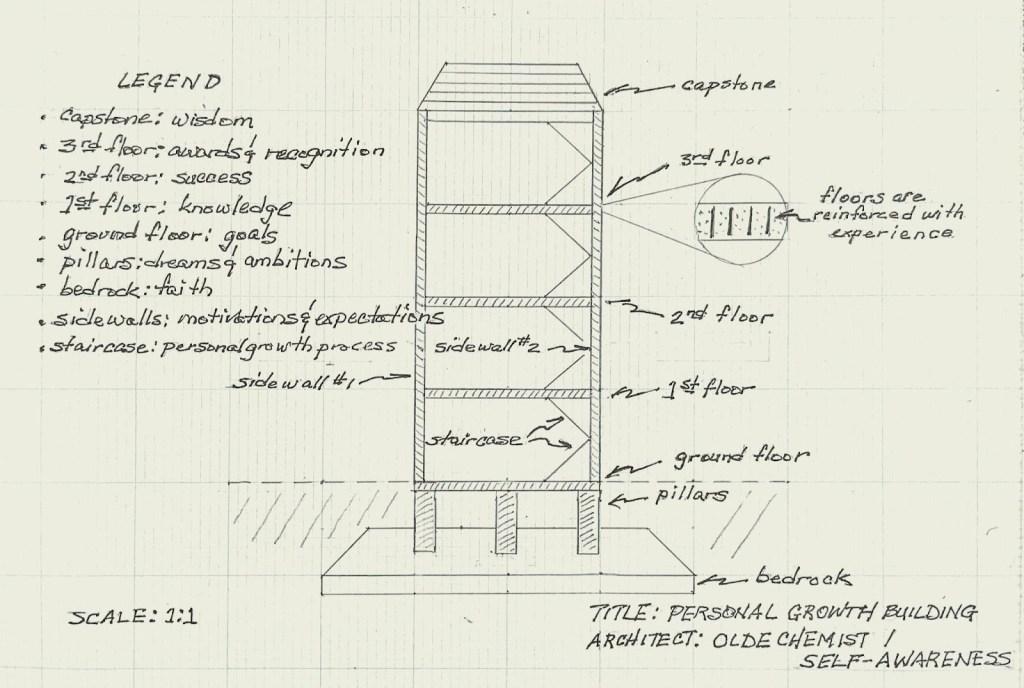
In a series of early posts, I created a simplified building blueprint with Motivation and Expectations resting on a foundation of Dreams, Aspirations, and Goals as the primary supports of our outer growth.
But these layers and supported walls cannot reside on dirt. They must rest on something deeper and more concrete. This creates a complete, logically sound structure:
That is why I am updating the blueprint to detail what components lie beneath the surface: the building’s” Substructure.”
The Substructure consists of:
The Ground Floor: Short-term and Long-term Goals
The interface between the superstructure and the substructure, the ground floor “slab”, consists of our short-term and long-term goals. These serve as the perfect transition; our goals are based on our dreams and ambitions, and require our motivations and expectations to achieve personal growth and obtain our definition of success.
The Support Pillars: Dreams and Aspirations
Our personal growth building requires two different types of columns or supports: our Dreams and Aspirations.
Our Dreams are fundamental, our “dream” of what we want to accomplish, providing passion and purpose. Aspirations represent the big-picture vision that provides direction and purpose. They both act as the support mechanism for the personal growth process. While goals and objectives focus on the near-term path and immediate results, dreams and aspirations provide the irresistible ‘why.’ Why the ultimate result justifies the effort, keeping all your actions aligned with your personal “mission.” Both your dreams and aspirations must be defined and nurtured, as they determine the degree and enduring strength of your personal growth.
The Bedrock of Faith
The bedrock of your personal growth journey is the foundation of your “personal growth building.” This isn’t a superficial structure built on temporary fixes or fleeting inspiration; it is a deep, resilient base that withstands the inevitable challenges of life. This foundation is critically established through faith—a profound conviction that gives direction and meaning to your efforts.
Faith can manifest in several powerful ways:
For some, it is an unwavering faith in self, a deep-seated belief in one’s own capabilities, resilience, and potential to evolve and overcome. This self-trust is the engine that drives consistency and perseverance.
For others, the foundation is a belief in a higher power or a universal order. This perspective provides comfort, a sense of belonging to something greater than oneself, and a moral or philosophical framework that guides decision-making.
Still, for many, this foundation is built upon a personal, intimate relationship with God, offering a spiritual anchor, a source of grace, and a transcendent purpose that elevates personal ambition beyond the purely material.
Regardless of its specific form, this core belief system serves as the unshakeable ground upon which all other aspects of personal development—such as discipline, knowledge acquisition, and skill-building—are securely erected. Without this strong foundational faith, the entire structure of personal growth can become fragile and prone to collapse under pressure.
Key Personal Growth Building’s Blueprint Components
The Two Columns of the Superstructure
You can visualize the “Superstructure” portion (Outer Growth) as being held up by two massive structural walls or columns.
The Left Support: Motivation
Motivation is basically that core, inner engine – the essential “oomph” – that pushes you to get better. It’s your natural wanting to hit goals, your curiosity, and just your general drive. This baseline motivation is key; if you don’t have it, you won’t feel engaged enough to “show up,” and your efforts to grow just won’t have the necessary “boost” to really take off.
The Right Support: Expectations
Think of expectations as the crucial support for your career—it gives it shape, defines it, and lets you reach high. They’re not just “pressure”; they’re a necessary strength, representing the standards you set for yourself, plus those from your industry, professors, and the world in general. A career built just on good intentions would be shaky. Expectations provide that solid framework, forcing you to be precise, stick to the measurements, and commit to getting a certain grade. Ultimately, they push your structure into a definite, strong form.
The Interaction Between the Two Columns
To successfully build anything solid or achieve your goals, you need a healthy mix of motivation and expectations.
Motivation without expectations creates what is simply a “blob.” It’s a ton of energy, but without any discipline, a clear goal, or focus on quality, it just ends up as a huge, messy pile that falls apart. On the other hand,
Expectations without motivation create a “hollow shell.” You are just going through the motions, maybe to please a boss or meet a deadline, but your heart isn’t in it. That empty effort will eventually collapse because the internal drive is missing.
To build something truly resilient and lasting – think of a towering skyscraper – you have to blend the powerful inner drive of high motivation with the solid structure of high expectations.
Goals
Goals serve as the essential ground floor in any personal growth model, acting as the critical interface between abstract desires and concrete action. Think of them as the “Slab” connecting the internal, conceptual “substructure” (Dreams and Aspirations) with the functional structure “superstructure.” While a dream is an abstract feeling, such as “I want to be an engineer,” a goal formalizes this feeling into a binding commitment or contract, such as “I will enroll in this specific university’s engineering program.” This distinction is structurally vital because you cannot generate effective motivation—the “walls” of your growth structure—without a concrete goal—the “floor“—to anchor it. Motivation without a defined goal is simply wasted or misdirected energy, highlighting why this step is the necessary foundation for all further personal growth.
The Staircase: The Personal Growth Process
Is the personal growth process considered an elevator or a stairway upward towards wisdom? An elevator implies you can push a button and arrive at wisdom without doing the work. The biggest, and often toughest, lesson when pursuing something big, our definition of “success,” is this: We must recognize that there is no “express” pathway to success and wisdom; we must “visit” each “floor” to reach the capstone.
The Stairway to Success: It’s All About the Climb
Within our personal growth building, the staircase is the connection that makes the journey and flow of the building work. Architecturally, it’s the main path for moving up – a physical sign of progress, and the only way to reach those higher goals. In this “success” metaphor, the staircase takes you from the ground floor (Your Goals), up through the essential phase of the first floor (Learning), and then on to the more ambitious higher levels.
The most important part of this whole idea is the actual climb. You actually have to climb the stairs; there’s no express elevator straight to the top (Success). That idea of instantly zipping to the top is a myth that screws up real, lasting achievement. The Capstone (Wisdom), or the pinnacle of your success, isn’t something you can skip or cheat your way to by avoiding the necessary hard work.
To truly and permanently land on the Success floor, you absolutely must first spend quality time on the Knowledge floor. And by “quality time,” I mean more than a quick stop; it means putting in the effort to learn, practice, and internalize the necessary skills, information, and wisdom. Knowledge is the solid ground that Success stands on. If you skip this crucial step, you end up with a shaky achievement—a “success” that just doesn’t have the strength to handle things when the going gets tough. The climb itself—the effort, the patience, and the sheer persistence—is what makes your Capstone a genuinely earned and lasting one.
The Rebar (Reinforcing Bars): Experience
In an Engineering context, concrete is strong when compressed, but it also cracks easily. To make it durable, you add rebar.
In our building metaphor, the third floor, Awards and Recognition are the components of the “concrete’s” structure. Experience (the rebar) helps us manage the pressure that awards and recognition may place on us – specifically, dealing with the disappointments that come when we are not recognized for our hard work, or managing our egos when we receive recognition and awards.
Self-Awareness: The Blueprint Itself
Since you are your life’s architect, and responsible for drawing this set of blueprints, self-awareness isn’t just a box on the drawing; it is the drawing itself. The blueprint represents your intended design; it is the standard against which your personal growth is measured.
What happens when we follow a specific “blueprint” and, for whatever reason, whether it is wrong decisions, personality traits that betray us, family concerns, or health issues, we arrive at a place in our lives that is not where we envisioned we would be? It still brings us to our personal “capstone” of wisdom; but the question of how we deal with disappointment is a concern in the process.
In construction, the blueprint is the architect’s dream or vision. It is drawn in a sterile office, assuming perfect soil conditions, perfect weather, and perfect materials. However in our personal growth building scenario, once the “ground” is broken, reality hits. You have an unexpected health issue; you lose your job; there is a dramatic shift in the economy or the stock market affecting your retirement savings; your personal decisions change the outlook for your success (changing jobs); there are family concerns (death of a parent, a chronic illness, or divorce). When these things happen, you, as the architect of your personal growth, don’t tear down the building. You adapt.
Disappointment comes when comparing your new reality to your blueprint. Wisdom comes from accepting your new reality. If you look at the blueprint of a life that went perfectly according to plan—straight path, no mistakes, no tragedy—that sheet of paper is clean. It is white and pristine.
A clean blueprint has no wisdom.
Conclusion
There is a reason why the substructure is essential.
When we are young, we trust our blueprints. We tend to believe that if we just build the walls straight and the floors level, our personal growth building will stand forever as is. We put our faith solely in the superstructure – in our own ability to execute the blueprint.
But as we grow older, we realize there are floors we didn’t plan for. There are cracks where the foundation has shifted. Some floors may have never been built because life got in the way.
When our blueprint fails, and the disappointment of unmet expectations sets in, the weight of that disappointment has to go somewhere. If your pillars (motivations and expectations) are resting on the sand of your own ego, you will crumble.
But if you have pillars (dreams and aspirations) that are anchored deep into your faith, you’ll find something surprising. You’ll find that the disappointments don’t destroy the building; they strengthen it.
“When you see something that is technically sweet, you go ahead and do it, and you argue about what to do about it only after you have had your technical success. That is the way it was with the atomic bomb.”
– J. Robert Oppenheimer
A review of 20th-century history reveals a critical, undeniable fact: Intelligence is not a guarantee of a positive result.
The Manhattan Project stands as a technical masterpiece, having assembled the foremost experts in physics to tackle intricate theoretical challenges surrounding nuclear fission. The team successfully developed and engineered a mechanism to initiate this reaction in a practical setting, meticulously following every step to achieve a logical and verifiable result. However, despite this technical brilliance, the outcome was the creation of a weapon with the power to extinguish human civilization.
J. Robert Oppenheimer, the lead physicist, later famously quoted Hindu scripture, realizing the gravity of what his “success” meant: “Now I am become Death, the destroyer of worlds.”
How can a project be a perfect success in the lab, but a potential failure for humanity? Knowledge and Expertise do not equate with Wisdom.
What is “Wisdom?”
Wisdom as a Mathematical Equation
If you are entering a STEM field today, you are spending years building your intellect. You are accumulating Knowledge (formulas, axioms, laws of physics) and gaining Experience (labs, internships, projects). These are the tools that help you succeed in the world.
But intellect without wisdom is just an uncontrolled force.
“Yesterday, we fought wars which destroyed cities. Today, we are concerned with avoiding a war which will destroy the Earth. We can adapt atomic energy to produce electricity and move ships, but can we control its use in anger?”
– Robert Kennedy
To be truly successful – not just as a scientist, but as a leader, and a human being – you need more than just the inputs of knowledge and experience. You need to solve for a different variable entirely. You need to solve for Wisdom.
Wisdom is not a mystical concept reserved for philosophers on a mountain top. It is a function of four specific variables. And just like any complex system, if you ignore one variable, the equation falls apart.
Defining the Wisdom Function
If we accept that Wisdom is the desired outcome, we need to understand the components (inputs) required to generate it. Wisdom is not a random occurrence; it is the result of a specific integration of variables.
We can define the Wisdom Function as follows:
To solve for W (Wisdom), you must understand the nature and function of each variable.
1. = Knowledge (Your Database)
In our equation, Knowledge is the raw data. It is the accumulation of facts, information, and established laws.
Think of Knowledge as the hard drive of your computer (your brain). It is filled with terabytes of information – years of research, chemical equations, and physics constants.
But a hard drive full of facts has a limitation; it knows that a tomato is a fruit (botanical classification), but it does not know that a tomato does not belong in a fruit salad. It has content, but no context.
2. = Experience (Real-life Application)
Experience is the application of Knowledge in a real-world environment. It is the process of converting theory into practice through repetition.
Consider this analogy: experience is the Lab Experiment. You take a hypothesis () and test it against reality. Experience is the collection of data points derived from failures and successes.
But experience has a limitation: It is reactive. It tells you what has worked in the past, but it cannot always predict what will work in a completely new future environment or application.
3. = Self-Awareness (Internal Calibration)
Self-Awareness is the understanding of our own influence on the data.
Consider this instrumental chemistry analogy: Instrument Calibration. In any experiment, the instrument used to measure the data may affect the result. For example, if your electronic balance is not zeroed out (tared), every measurement you take is flawed.
Self-awareness is the process of checking to see if we’re solving problems the right way, and for the right reasons. It forces us to stop and ask: What am I really trying to do here? Are my actions to benefit the project’s outcome, to fix a problem, or just to make myself look better? Are my personal feelings clouding my judgment? Am I ignoring facts that don’t fit my hypothesis? And ultimately, does the outcome match my core beliefs? If you skip this internal check, all your knowledge () and experience () may not matter, and the solution will be biased.
4. = Faith (The Constant)
This is often the most difficult variable for the scientific mind to accept, yet it is essential for the equation. Faith has many forms. There is a faith in a set of scientific axioms or principles, which may or may not continue to be valid in the current situation. There is faith in your knowledge and skill, the ability to adapt and solve any problem you may face. And there is a faith in God or a higher power, which gives you strength and guides your moral compass.
Faith acts as a moral constant, an internal compass guiding you when all the facts are not yet known. It’s what helps you discern not just what can be achieved, but what is right, connecting what is understood to what is yet to be discovered.
The Scientific Analogy: A great deal of scientific work starts with a theory or idea that hasn’t been completely proven yet. It’s all built on a fundamental trust – like believing the established rules of physics will hold up in any new situation, no matter what.
Personal Commentary
He who can no longer pause to wonder and stand rapt in awe is as good as dead; his eyes are closed.
– Albert Einstein
Sometimes, because we are trained to be analytical thinkers, we convince ourselves that we are agnostic. And when we look and see something we don’t understand, when we should be filled with awe and wonder, we are so busy trying to find a scientific explanation that we convince ourselves it’s not a miracle, that it is not the act of God or a higher power. Wisdom, for me personally, is my recognition that I cannot underestimate the power of God and his plan.
Now that we have defined the variables, we can see how they interact. The mistake most students make – and the mistake the educational system often encourages – is focusing entirely on the first two variables, Knowledge and Experience.
Two Wisdom Function Analogies
Scalar vs Vector Measurement Example
Most of us in the science realm were introduced to the concept of vectors and the difference between scalar and vector measurements in our middle school science classes and again in our high school and college physics classes.
As a refresher for these concepts, consider the following example: Imagine you were to ask me directions to a local restaurant, and I were to say you drive 45 miles per hour for 15 minutes. This is a scalar measurement. You have no idea which direction you were to drive; you have only one piece of information, the velocity at which you are to drive, and you need the direction. The definition of a vector is that it has a magnitude, in this example, 45 miles per hour, and a direction, let’s say directly east. You now have both components of a vector. The directions to the restaurant are to drive east at 45 miles per hour (vector) for 15 minutes.
Now, think of your career trajectory as a Vector.
The sheer power of your abilities, the Magnitude of your professional vector, is determined by your Knowledge () and Experience ().
These factors directly influence:
The depth of intellect you can bring to bear on any challenge.
The speed with which you can reach a solution.
The sophistication and complexity of the problems you are capable of solving.
A person with great intellect and extensive experience is a force to be reckoned with. However, magnitude is a scalar quantity, it lacks direction.
The Direction in your life’s “vector” is determined by Self-Awareness and Faith.
Self-Awareness provides calibration for the “Why?”: It answers the question, ‘Why am I doing this?’
Faith ensures your internal belief system is aligned: It addresses where your actions fit within your personal moral and internal convictions.
The Guided Missile Example
Our scientific power has outrun our spiritual power. We have guided missiles and misguided men.
– Martin Luther King, Jr.
Imagine a missile guidance system.
If you have low Knowledge and Experience (Low Magnitude), the missile barely leaves the launchpad. It’s ineffective and harmless.
However, if you have incredible Knowledge and Experience (high Magnitude) but lack Self-awareness and Faith to set the coordinates in the right Direction, you have created a disaster. You have a high-speed projectile aimed at the wrong target.
The STEM Trap
In your classes, you are graded almost exclusively on Magnitude. Did you get the right answer? Did the chemical reaction work? Did the bridge you designed hold the weight?
But in life, Wisdom is the vector sum. It is useless to be the smartest engineer in the company if you are building something that ultimately causes harm because you didn’t ask the “faith” or “self-awareness” questions.
Conclusion
Wisdom () is the alignment of your Magnitude () with the correct Direction ().
Wisdom is not an accident. It is not a trait you simply “pick up” as you get older. It is the deliberate integration of what you know (), what you do or have done (), who you are (), and what you believe ().
If you are an aspiring STEM student, or the parent of one, I want you to consider a terrifying possibility: It is possible to have a 4.0 GPA and know/retain almost nothing.
I saw this contradiction in the students I would tutor. They were bright, hardworking, and ambitious. They had mastered the art of getting the “A.” They knew how to take tests, follow instructions, and allocate their time to receive a high score.
However, if I asked them to apply a physics concept from two weeks before to a new problem assigned that day, they would freeze. Their knowledge of the material (data) was gone.
This is the Grade Illusion. We have built an educational culture – especially in high-stakes fields like STEM, where the “High Score” has become the product. But in the real world, the test scores from high school and college courses are irrelevant. The only thing that matters is mastering the content.
If you want to survive the transition from “A-student” to “successful scientist,” you need to understand how your own mind works. You need to stop renting knowledge and start owning it.
The Knowledge Retention Misconception: RAM vs. Hard Drive
To understand why intelligent students often feel like impostors, we need to examine how the brain stores information.
Think of your brain like a computer. You have two types of storage:
RAM (Random Access Memory): This is short-term, high-speed memory storage. It holds the data you need right now. It is volatile; when the power cuts (or the test ends), the data is wiped to make room for the next task.
The Hard Drive: This is long-term storage. It is slower to write to, but the data remains there forever, ready to be recalled years later.
The modern educational system encourages you to use your RAM, not your Hard Drive. We call this Cramming, or as we discussed in an earlier blog post, the act of memorization/regurgitation.
When you cram for a calculus midterm, you are loading complex formulas into your RAM. You hold them there—stressfully—for 24 hours. You walk into the exam, dump the RAM onto the paper, and get a 95%. You feel successful.
But 48 hours later, that RAM is cleared to make space for Chemistry. The “Save to Hard Drive” function never happened.
The Science of Forgetting
This isn’t just a metaphor; it is a biological fact. In the late 19th century, psychologist Hermann Ebbinghaus mapped the “Forgetting Curve.”
The curve shows that without deep processing (the struggle necessary to understand something), humans lose roughly 50% of new information within a day and 90% within a week.
The student who crams and gets an “A” peaks at 100% on Tuesday morning. By next Tuesday, their retention dropped to nearly the same level as that of the student who failed. The grade is a record of what you knew for one hour, not what you carry into your career.
From an economics perspective, consider this as the difference between Renting and Owning.
Cramming is Renting. You pay a high price in stress and sleep deprivation. You get to “live” in the knowledge for a day. But once the test is over, your “lease” is up, and you are evicted. You have zero equity.
Deep Learning is Owning. You pay a “mortgage” of daily, consistent study. It feels slower. It feels harder. But two years later, when you are designing a load-bearing bridge, for example, that physics principle is yours.
The Illusion of Competence
“But I got an A!” you might argue. “The test says I know the material.”
Does it?
In 1956, in the publication “Taxonomy of Educational Objectives: The Classification of Educational Goals,” a committee of educators chaired by Benjamen Bloom developed a framework to rank levels of understanding called “Bloom’s Taxonomy.”
Shutterstock
Most high school tests—and frankly, many college exams—operate at the bottom three levels: Knowledge (learn the formula), Comprehension (understand when to use the formula), and Application (plug numbers into the formula).
If you are good at memorization, you can ace these tests without ever moving up the pyramid. But a career in STEM fields lives entirely at the top three levels:
Analysis: Why did the experiment fail?
Evaluation: Which method is best for this specific application?
Synthesize (Create): Develop an improved solution that isn’t in the textbook.
The Illusion of Competence
This creates the Illusion of Competence. You have a transcript full of “A’s” that certify you are an expert, but your internal drive has never been stress-tested at the “Analysis” or “Synthesis” level. When you eventually hit a problem that requires those skills, you don’t just struggle—you crash.
The most dangerous side effect of the Grade Illusion isn’t academic; it’s psychological.
The Performance = Identity Misconception
When you spend your entire life chasing the “High Score,” you begin to associate your Performance with your Identity. You believe the equation: My Grade = My Worth.
In STEM, this is lethal. In English class, a grade of “C” might seem subjective. In Physics or Chemistry, a “wrong answer” is objectively wrong. If you tie your self-worth to getting the right answer, every mistake feels like a character flaw.
You need to adopt the mindset of a Scientist:
You are the Learning Process itself. You are the curiosity, the work ethic, the resilience.
The Grade is just Data. It is simply the output of a single, specific experiment on a single specific day.
For example, if a Ferrari engine performs poorly because it had bad fuel, we don’t say the engine is trash. We say the input (fuel) was wrong. Similarly, if you fail a test, it doesn’t mean you are broken. It means your variables—your study habits, your sleep, your preparation—were off.
A bad grade is not your identity. It is guidance.
Breaking the Cycle
Ready to shift from being a “Grade Hunter” to a true “Learner”? Use these two simple techniques to pinpoint where you are in that transition and determine the necessary steps to move forward.
1. The “Two-Week Audit.”
I challenge you to a challenging experiment. Take a test you aced two weeks ago. Sit down and take it right now, without reviewing your notes.
The difference between your score then (95%) and your score now (55%) is your Fake (Lost) Knowledge. That 40-point gap represents wasted energy. It is time spent renting, not owning. If the gap is huge, your study method is broken, regardless of your GPA.
2. The Feynman Technique (The Ownership Test)
Physicist Richard Feynman had a simple rule for understanding, which he borrowed from Albert Einstein. To prove you have mastered a concept, you must be able to explain it in simple language, without jargon, to someone who has no background in the topic (like a smart 12-year-old).
If you can’t explain it simply, you don’t understand it. You have only memorized the definition. You are stuck at the bottom of Bloom’s Taxonomy.
The Bottom Line
The world is full of influencers and algorithms showing you the easy way to obtain a high test score on the ACT and achieve the most sought-after degrees, jobs, and accolades. Yet they rarely show you how to retain the knowledge required for long-term success.
Success in STEM requires three “old school” prerequisites that cannot be skipped: Curiosity, a Passion for Learning, and a Passion for Solving Problems.
If you have these, the grades will eventually follow. But more importantly, later in life, when the grades stop mattering, the expertise will remain.
When we talk about the subject of personal growth, we usually split things into two buckets: “Inner” growth (a growth mindset, self-awareness, and resilience) and “Outer” growth (relationships, communication skills, achievements, and recognition). However, here’s the missing piece in our model: Emotional Intelligence (EQ). Emotional Intelligence (EQ) is the bridge that unites these two separate ideas, preparing you to be successful as a functioning member of society, regardless of your chosen career path. Producing real-world success that people actually notice.
Emotional Intelligence (EQ) isn’t just about being nice; it is the ability to understand and manage your own emotions while recognizing and acknowledging the feelings of others. If your IQ measures your intelligence or book knowledge, EQ measures your people skills and self-control. It is the connection between thinking and feeling.
The Four Core Pillars of Emotional Intelligence (EQ)
Pillar #1: Self-awareness
In a previous blog post, we defined Self-Awareness as the GPS for our process of personal growth. And it is the absolute starting point for emotional intelligence (EQ). It’s all about understanding your own moods, feelings, what drives you, and how all that affects the people around you. To master this, you need to take an honest look at what you’re good at and what you struggle with, and feel genuinely confident in yourself. The key thing is, a self-aware person doesn’t just feel an emotion; they can actually figure out why they’re feeling frustrated, happy, or stressed. This deep internal check is the groundwork for everything else in emotional intelligence.
Pillar #2: Self-control
The second component, self-control (self-management), follows self-awareness. It is crucial for keeping destructive emotions and urges in check, so you can stay calm and collected, even when things get stressful. Think of it as emotional control—it’s that ability to hit the pause button between feeling an impulse and actually doing something about it. This pause allows you to make smart, principled decisions instead of just reacting impulsively or defensively. Self-management includes being flexible, taking initiative, and keeping a positive attitude in order to reach your goals, even when you face roadblocks.
Common Examples:
When receiving constructive criticism, someone with low emotional intelligence (EQ) might immediately become defensive, blame someone else for their mistake, or just give the person the silent treatment, which is not helpful. In contrast, a person with high emotional intelligence will pause, acknowledge that the criticism, while it may feel uncomfortable, is justified, and then ask what they need to do to improve, genuinely thanking the person for being honest.
When having a “bad day,” a person with low emotional intelligence stressed about a meeting or a deadline, might react by snapping at their parents, spouse, friend, or even someone in a restaurant or store, just because they are in the way. A highly emotionally intelligent response is to recognize the feeling of being overwhelmed and directly tell a partner, “I’m having a ridiculously stressful day and I’m a bit on edge. I need 20 minutes of quiet to de-stress so I don’t accidentally take it out on you.”
Pillar #3: Social Awareness
Social Awareness (Empathy) is the third key ability, which is shifting your focus away from yourself and focusing on others. This crucial skill enables you to sense, understand, and respond well to the emotional needs and concerns of those around you. Often described as being able to “read the room”, it requires you to see things from someone else’s perspective and grasp the mood of the situation. It goes beyond just seeing that someone is upset; strong social awareness helps you to understand why they are feeling that way, which is critical for great relationships and connecting with others.
For Example:
During a big disagreement, either at home, school, or at work, a person with low emotional intelligence makes their goal to “win” the argument and prove the other person is wrong. Conversely, a highly emotionally intelligent individual focuses on understanding the other person’s perspective, asking questions like, “Help me out here – why is this so important to you?” because they value the relationship more than being right.
Pillar #4: Building Relationships
Building Relationships is the final stage of emotional intelligence. It’s where you combine your emotional intelligence and social skills to manage complicated social situations, inspiring others. This is the top level of emotional intelligence, showing how well you can influence people, get them on board, and help them grow. It covers multiple social and communication skills—things like building trust and connection, communicating your message clearly and powerfully, addressing disagreements without a fight, and promoting change in a variety of settings, at home, school, and work. Bottom line? Relationship Management is about taking what you know about yourself (self-awareness) and what you feel for others (empathy) and turning that into positive interactions with those around you.
Conclusion
Emotional intelligence (EQ) is an essential skill for genuine, lasting success. Without it, attempts at inner growth become mere wishful thinking that fails when the pressure mounts. And outer growth results in shallow relationships that lack the trust necessary for long-term progress and achievement. Emotional intelligence links your inner strength to your outer results, establishing a mechanism that accelerates both personal growth and professional success.
There’s a persistent myth in Science, Technology, Engineering, and Mathematics (STEM): that success belongs to the “natural genius,” the person who just “gets it.”
Here’s the truth: Achieving mastery in challenging STEM fields has little to do with some magical, intrinsic gift. It is 100% based on the application of several advanced intellectual and behavioral strategies. Think of it as a complete operating system upgrade for your brain.
To move beyond the daily struggles and achieve genuine mastery in STEM, you need to commit to these three non-negotiable principles.
The Power of Modeling
Social Learning Theory, pioneered by Albert Bandura, shows that a huge part of human learning happens through observing and imitating others. But success isn’t about emulation (or copying) a single skill; it’s about modeling a complete system.
To succeed, you must actively observe and adopt the entire package of skills and habits from those who have already achieved high levels of success. For example:
Advanced Technical Skills: How do experts and mentors break down a complex problem? Learn their analytical approaches.
Powerful Work Ethic: Look at how they meticulously structure their study schedules, their uncompromising standards for quality, and their consistent effort.
Powerful, Positive Mindset: How do they view failure? It’s purely objective, instructive data—nothing more.
Take action, stop focusing solely on the textbook content. Start noting the process of your most successful peers or mentors. How do they organize? When and how do they study? How do they handle a major setback? You want to copy and implement a system, not just learn content knowledge.
Escaping the “Developmental Trap.”
A massive barrier to our progress is what is called the “developmental trap.” This is when you inadvertently become rooted in ineffective behavioral patterns that feel comfortable but sabotage your future.
Are you chronically procrastinating? Do you find fault in everything you do, seeing only the negative outcomes, which paralyzes you from even starting? Are you habitually unclear about your goals and intentions, or vague in your communication with your fellow students/teachers/professors? These are self-sabotaging habits.
To break free, you must perform a conscious, honest self-assessment and start developing and exercising your self-awareness skills.
Follow-up on your self-assessment by:
Installing these productive habits: Resilience (bouncing back from setbacks with renewed effort) and a rigorous work ethic (getting things done with uncompromising quality and efficiency).
Discard low-return behaviors: Self-incrimination, self-doubt, and negativity.
Over time, your relentless effort will help create a powerful “internal compass.” Your motivation shifts from the temporary need for external validation (a good grade, a compliment) to an intrinsic drive—a non-negotiable, standard you’ve set for quality and thoroughness that you must meet, regardless of what anyone else thinks.
Prioritize the Process Over the Score
The final, and perhaps most crucial, mental adjustment is letting go of the destructive notion that you must achieve absolute, flaw-free perfection. That ideal is unattainable and will only lead to burnout.
The successful STEM student must value the process of learning and discovery over the final numerical score or grade.
When an experiment fails, a line of code breaks, or you get a subpar result on a quiz, how you react must change. Don’t view it as a “mess-up” or that you don’t have what it takes to “make it.” Instead, you must treat it as a starting point from which you learn and progress.
This data is essential for:
Precisely identifying your weaknesses.
Fine-tuning your approach to solving the problem or issue.
Educating you for the design of your future, a more refined attempt.
This mental shift is life-changing. It moves your focus from avoiding mistakes (a fear-based approach) to maximizing learning effectiveness (a growth-based approach.)
Summary
In the demanding world of STEM, setbacks—from experimental failures to complex problem-solving roadblocks and challenging coursework—are a daily certainty. Therefore, the single most critical factor for your long-term success and ultimate perseverance is your ability to effectively manage and recalibrate your expectations.
Really successful STEM students ditch the idea that they have to be absolutely perfect. They focus more on consistently putting in the hard work and sticking closely to the process (understanding the “why” and the “how”), instead of getting hung up on immediate, flawless results. This mindset change is a huge win: it means they stop seeing mistakes as a huge personal flaw and start seeing them as valuable, objective data—the stuff you need for real learning, figuring out new strategies, and improving down the line. In the end, this shift turns anxiety into a powerful tool for growth.
“Lower expectations do not lead to happiness, no matter how often they are met.”
– Michael Jordan
Introduction
Honest self-reflection is a precursor to self-awareness and the starting point for our discussion of personal growth. To start to know yourself, you need to consider who you are and what’s important to you at this point in your life. This is the third of four exercises designed to encourage you to take the time to think about and identify your goals and motivations. This exercise is designed to help you understand the forces driving your pursuit of a key personal or professional goal. It may help you know yourself better, figure out your goals, and make more informed decisions about your future. It may also help you to develop a stronger sense of purpose and direction in life.
Key Points to Remember
Be honest with yourself; there are no right or wrong answers, and no judgment is attached to your responses.
Take your time with these exercises, thinking about what is important to you and why.
As you work through each prompt, take a moment to record your thoughts. These reflections serve as a valuable resource when developing self-awareness.
Expectations and Beliefs
Description of the Types of Expectations
Expectations can be broadly categorized into two types: internal (intrinsic) and external (extrinsic). While there are subtle distinctions between internal and intrinsic, and external and extrinsic, for clarity in this explanation, I will group them together.
Internal (intrinsic) Expectations
Internal (Intrinsic) expectations originate within you. These are the personal standards that influence your behavior, performance, and character. They can take various forms. These might include physical goals, such as training for a marathon; a commitment to daily habits like a 10-minute meditation; value-based principles like kindness and honesty; or quality standards, such as the expectation that your work will be perfect when you submit it.
Your motivation to meet these expectations stems from intrinsic factors such as your personal values, ambitions, self-worth, and the desire for self-improvement. The primary reason is often the desire to meet your own standards for mastering new content or ideas, exploring your passions and interests, your process of personal growth, and a sense of satisfaction. For instance, you might set an expectation to practice the guitar for an hour daily, motivated purely by the love of improving and the music itself, finding your reward in the satisfaction you receive from the activity.
External (extrinsic) Expectations
External (extrinsic) expectations originate from outside yourself. They are standards, rules, or requests set by other people, your parents, friends, coworkers, or society in general. For example: a deadline for a project (either in class or at work), your parents or a spouse’s request for you to do a specific household chore, a job description or class syllabus listing how your performance at work or class will be measured, or perhaps a societal standard on how you “should” behave, dress, or define success to be accepted. At its core, with external (extrinsic) expectations, your primary desire is often to meet the standards of others.
Accountability to others, the pursuit of rewards like promotions or praise, and the avoidance of negative consequences such as disapproval from parents, friends, or bosses, poor grades, or losing a job, are often key internal (intrinsic) motivators for meeting external expectations. External (extrinsic) motivations, by comparison, are generally less fluid and flexible because changing the expectations of others requires you to negotiate the terms of the expectations and seek agreement with another person.
Bottom Line
Your expectations need to be realistic and attainable, plus align with your personal goals and ambitions. You must remain true to yourself and your beliefs and core values, regardless of how difficult it may seem at times. Negotiating expectations is a major component of the personal growth process.
Prompts
Prompt #1:
Whose expectations have the strongest influence on your life, and that you feel obligated to meet? Are they aligned with your own beliefs and desires? How do you manage those expectations and stay true to your dreams and goals?
Prompt #2:
List three things you expect from yourself (for example, I expect myself to spend 30 minutes each day writing). How do these expectations impact your daily decisions and actions? Does meeting your expectations give you self-confidence and encourage you to do more? Or do these expectations overwhelm you?
Prompt #3:
Think about a recent time when you exceeded an expectation. Did you take time to acknowledge and celebrate that success? If not, why? Recognizing your “wins” is an important component of self-care.
Prompt #4:
Think about your expectations for others (friends, family, or people in general). Are these expectations realistic and attainable? How do they align with what you expect from yourself, your goals, and your beliefs?
Up Next: Practicing the Art of Self-reflection and Evaluating Your Openness for Change
The last set of prompts, part four of the series, will ask you to practice the art of self-reflection and evaluate your openness for change.
“Our greatest weakness lies in giving up. The most certain way to succeed is always to just try one more time.”
– Thomas Edison
Introduction
Honest self-reflection is a precursor to self-awareness and the starting point for our discussion of personal growth. To start to know yourself, you need to consider who you are and what’s important to you at this point in your life. This is the second of four exercises designed to encourage you to take the time to think about and identify your goals and motivations. This exercise is designed to help you understand the forces driving your pursuit of a key personal or professional goal. It may help you understand yourself better, figure out your goals, and make more informed decisions about your future. It may also help you to develop a stronger sense of purpose and direction in life.
Key Points to Remember
Be honest with yourself; there are no right or wrong answers, and no judgment is attached to your responses.
Take your time with these exercises, thinking about what is important to you and why.
As you work through each prompt, take a moment to record your thoughts. These reflections can serve as a valuable resource for developing self-awareness.
Goals and Motivations
A Quick Refresher Regarding the Types of Motivation
Intrinsic motivation is the drive that comes from within. You do it because the act itself is enjoyable, satisfying, or aligns with your core values and sense of purpose (e.g., learning a skill because you are passionate about learning, solving a puzzle for the challenge).
Extrinsic motivation is the drive that derives from external factors. You do it for a separable outcome, like a reward, recognition, status, or to avoid punishment (e.g., working hard for a bonus, getting a degree to impress others).
Healthy motivation is often a blend of both, but an over-reliance on extrinsic factors can be unsustainable and lead to burnout.
Prompts
Prompt #1:
Choose one significant goal you are currently working towards regarding your personal success or growth. Describe it in one or two clear sentences.
Prompt #2:
List the things that truly motivate you to achieve this goal. Are they intrinsic motivations (lead to a sense of accomplishment or happiness) or extrinsic (money, job title, or recognition). How did these motivations influence your selection of this goal?
Prompt #3:
Think of a past achievement you’re proud of. What motivated you in this endeavor, and how did it make you feel to achieve it?
Prompt #4:
Think of a time you overcame an unexpected challenge or setback. What motivated you to keep going? What did you learn from that experience? How, if any, has it changed the way you set goals in the future?
Up Next: Expectations and Beliefs
The next set of prompts, part three of the series, will ask you to examine your expectations and your belief system.
“The only thing that stands between you and your dream is the will to try and the belief that it is actually possible.”
– Joel Brown
Introduction
Honest self-reflection is a precursor to self-awareness and the starting point for our discussion of personal growth. To start to know yourself, you need to consider who you are and what’s important to you at this point in your life. This is the first of four exercises designed to encourage you to take the time to think about and identify your dreams, aspirations, motivations, and expectations. It may help you understand yourself better, figure out your goals, and make more informed decisions about your future. It may also help you to develop a stronger sense of purpose and direction in life.
Key Points to Remember:
Be honest with yourself; there are no right or wrong answers, and no judgment is attached to your responses.
Take your time with each prompt, thinking about what is important to you and why.
As you work through each prompt, take a moment to record your thoughts. These reflections can serve as a valuable resource for developing self-awareness.
Dreams and Aspirations
Prompt #1:
Consider how your dreams define you. Is there a childhood dream that you still hold onto? Ask yourself, why is it important to me? How would it feel to make that dream come true, and what sacrifices would you need to make (if any) to get there?
Prompt #2:
Ask yourself, “What am I currently passionate about?, and “What activities/responsibilities give me the most energy and satisfaction?, Who or what do I aspire to be or to do?” Does your happiness depend on living the life or career of your dreams?
Prompt #3:
In the next 5 years, what specific achievement, title, or position must I accomplish, what impact must I have for my family, in my field of study, or in the world in general, that would represent the highest level of success and sense of self-fulfillment for me?
Prompt #4:
“What current skills, knowledge, or resources do I possess that will help me achieve this aspiration, and what key areas do I need to develop or acquire?” And, what is my plan to achieve those goals?
Up Next: Goals and Motivation
The next set of prompts, part two of the series, will ask you to identify and understand what motivates you to achieve goals you have set for yourself.
Key Concept Number One: The Law of Conservation of Energy
The law of conservation of energy applies directly to our campfire analogy by stating that all the chemical potential energy stored in the wood must be accounted for after it burns—it doesn’t just disappear, it’s simply transformed into different forms. The total energy of the heat, light, and the chemical bonds of all the byproducts is equal to the original chemical potential energy stored in the wood. No energy is lost; it has just been converted.
In our discussion of the process of personal growth, the conservation of energy also applies. The personal energy we invest in the process — our time, focus, and emotion — is finite and must be transformed into something: either a product (your desired outcome of success) or byproducts (either intended (positive) or unintended (negative) emotional or psychological consequences of the process).
Key Concept Number Two: The Definition and Role of an Indicator
An Indicator in our chemical reaction/personal growth analogy is a measurable, observable, and immediate sign that the reaction mechanism is proceeding effectively and that the energy input (activation energy) is being successfully converted into the desired products. Essentially, it tells you if and how well the process is working.
The indicator in our campfire analogy is a sustained flame producing heat and light. This is the visual and thermal evidence that the wood’s stored chemical energy is successfully converting into usable thermal and radiant energy (Heat and Light). It immediately informs us that the Activation Energy (the match/lighter) was successful and the Reaction Mechanism (the burning of the reactants) is self-sustaining.
In the process of personal growth, self-awareness acts as an indicator. It is the ability to recognize and reflect on the state of our emotions, how effective we are in our learning process (informing us if our study habits/self-discipline are effective), and understand our behaviors. Without self-awareness, personal growth becomes a random and inefficient endeavor. It’s like “throwing ideas up against the wall to see what sticks,” a process that lacks crucial elements. This leads to a frustrating trial-and-error approach, wasting valuable time and energy.
Therefore, self-awareness is the foundational component of our personal growth, enabling us to identify and appreciate new skills, confidence, and competence as they emerge. Simultaneously, self-awareness is crucial for detecting and managing negative byproducts like stress, frustration, or burnout, preventing them from halting the entire growth process.
Breaking Down the Components of Our Campfire vs Personal Growth Analogy
Let’s define start by defining our chemical reaction process as the following:
What items in the campfire example or which skills in the case of personal growth, do we need to accumulate before starting each process?
For the campfire analogy, we need: paper and kindling (small twigs and branches) to get the fire started, larger pieces of wood (logs) to serve as the fuel, and matches or a lighter to introduce heat to ignite the flame.
Personal growth demands a combination of essential resources and skills. Essential supplies include strong communication, critical thinking, and time management skills. Additionally, we need an inherent sense of personal accountability and access to various resources such as time, money, and mentors. Information resources, whether online, textbooks, or coursework, are also crucial. Finally, a secure and supportive environment is vital for this process.
During my tine teaching middle school science, I was mentored by a teacher who advocated for a pass/fail grading policy for students during their middle school years, grades 6-8. He believed that the significant emotional and developmental changes experienced by students aged 12-15 made it more important to focus on building essential communication, study, time management and critical thinking skills rather than pressuring them with specific grade requirements. He also pointed out the growing number of students facing poverty, living in single-parent homes, living in fear of abuse, and dealing with various crises, leading to a lack of sufficient rest, parental support, and proper nutrition. Citing Abraham Maslow’s Hierarchy of Needs theory, he argued that these stressors needed to be addressed before students could be expected to achieve academic excellence in the classroom.
Reactants (Campfire vs the Process of Personal Growth Analogy)
For our campfire analogy, the reactants are straightforward; they consist of wood (fuel), which is the source of stored potential energy, and oxygen.
Personal growth is fueled by key personality traits. These “reactants” include creativity, an open-mindedness to new ideas, a passion for learning and problem-solving, and the crucial ability to persevere through obstacles.
Indicators
In the campfire analogy, the sustained flame’s heat and light serve as the indicator, visually confirming the reaction is occurring and progressing.
Self-awareness serves as a crucial metric for our dedication to personal growth. This dedication is shaped by our curiosity, persistence, and the joy we experience from the process, As lifelong learners, our progress in these areas can be measured through our academic or career achievements.
Activation Energy
In the campfire analogy, the initial heat needed to ignite the paper or kindling acts as the activation energy for the combustion reaction. This reaction involves the burning of fuel (wood) in the presence of oxygen, which produces heat and light. A flame from a lighter or matches provides this initial activation energy, initiating the reaction. Once started, the heat generated by the burning wood sustains the reaction, causing subsequent additions of fuel to ignite.
Personal growth begins with activation energy—our initial investment of effort, time, and focus. This crucial first step helps us overcome our reluctance to start new projects, defeat self-doubt, and combat our natural inertia, our resistance towards change. It requires aligning our personal goals with both our internal motivations, our drive to engage in an activity purely for the inherent pleasure, satisfaction, or challenge it provides, and external motivations, our drive to perform an activity in order to achieve rewards, praise, money, grades, status, or to avoid negative consequences (like failing a class, being grounded, or later in life, getting fired from our job).
Catalysts
(Important: by definition,a catalyst is never used up or depleted in the reaction process.)
If you have ever had to build a campfire you may recognize this catalyst in the campfire analogy, it is the absolute dependence on the flow of air around and through the campfire itself. This airflow is the mechanism that speed up the process of burning, providing access to the oxygen crucial to the combustion process.
Personal growth is driven by catalysts, which include the foundational steps of the personal growth “building” we discussed in a previous blog post, our dreams, aspirations, and goals. These are combined with both intrinsic expectations (how we expect ourselves to progress) and extrinsic expectations (the expectations of family and others) to propel us forward in our personal growth journey.
Reaction Mechanism
In chemistry, a reaction mechanism is the step-by-step sequence of elementary reactions that leads from reactants to products. It’s the detailed path the reaction takes. When we apply this to personal growth, the reaction mechanism is not a single, fixed procedure but a continuous, self-correcting process.
In our campfire analogy, the reaction process is a combustion reaction, the process of combining fuel and oxygen with the activation energy provided by the match or a lighter, to initiate a chemical reaction that produces heat and light as products.
Personal growth is a journey towards a goal or personal transformation, much like a chemical reaction. It involves a methodical process of learning, similar to the scientific method, where knowledge is gained and applied through observation. This leads to the development of strategies, which are then implemented through habits, discipline, and focus to transform effort into skill. Ultimately, this process enables us to identify and conquer obstacles.
Products
We define a product as the desired output of a process, or the desired outcome of success.
In the campfire analogy, the products are heat (thermal energy) and light.
The desired outcome of personal growth is multifaceted, encompassing skills and competencies, such as mastering a trade, or individual definitions of success, like a specific title or salary. Ultimately, however, I would argue, we should strive in the long-term to gain in wisdom.
Byproducts
A campfire’s combustion reaction produces unintended and undesirable byproducts: ashes, which are mineral waste, and smoke, a form of air pollution consisting of uncombusted particles.
Our personal growth journey, unlike a chemical reaction, yields byproducts that can be either positive or negative, depending on the nature of the growth itself. When we engage in what we call “exothermic growth,” our investment of personal energy results in a positive return or outcome. This beneficial growth produces desirable byproducts such as compassion, critical thinking skills, humility, and resiliency.
Conversely, “endothermic growth” occurs when we invest more personal energy than we receive in return. This imbalance can lead to negative, unintended emotional or psychological consequences, including anxiety, burnout, fear, frustration, and stress.
Therefore, self-awareness is crucial. It enables us to identify and prioritize rewarding, exothermic activities while simultaneously recognizing and minimizing endothermic activities that drain our personal energy and are misaligned with our personal goals and ambitions.
Conclusion
In conclusion, just like a well-tended campfire provides warmth and light, a mindful approach to personal growth can yield profound and lasting benefits. By understanding the “chemistry” of our own development—recognizing the needed components, our supplies, reactants, and the crucial role of activation energy and catalysts—we can more effectively guide our journey. Cultivating self-awareness allows us to prioritize “exothermic growth” and minimize the less desirable “endothermic” byproducts, ensuring our personal evolution is not only productive but also sustainable and deeply rewarding.