Musings of an Old Chemist

A Chemist's Perspective on the Habits and Skills STEM Students Need For Success

Tag: wisdom

  • The Personal Growth/Chemical Reaction Analogy

    The Personal Growth/Chemical Reaction Analogy

    Key Concepts 


    Key Concept Number One: The Law of Conservation of Energy

    The law of conservation of energy applies directly to our campfire analogy by stating that all the chemical potential energy stored in the wood must be accounted for after it burns—it doesn’t just disappear, it’s simply transformed into different forms. The total energy of the heat, light, and the chemical bonds of all the byproducts is equal to the original chemical potential energy stored in the wood. No energy is lost; it has just been converted.

    In our discussion of the process of personal growth, the conservation of energy also applies. The personal energy we invest in the process — our time, focus, and emotion — is finite and must be transformed into something: either a product (your desired outcome of success) or byproducts (either intended (positive) or unintended (negative) emotional or psychological consequences of the process).


    Key Concept Number Two: The Definition and Role of an Indicator

    An Indicator in our chemical reaction/personal growth analogy is a measurable, observable, and immediate sign that the reaction mechanism is proceeding effectively and that the energy input (activation energy) is being successfully converted into the desired products. Essentially, it tells you if and how well the process is working.

    The indicator in our campfire analogy is a sustained flame producing heat and light. This is the visual and thermal evidence that the wood’s stored chemical energy is successfully converting into usable thermal and radiant energy (Heat and Light). It immediately informs us that the Activation Energy (the match/lighter) was successful and the Reaction Mechanism (the burning of the reactants) is self-sustaining.

    In the process of personal growth, self-awareness acts as an indicator. It is the ability to recognize and reflect on the state of our emotions, how effective we are in our learning process (informing us if our study habits/self-discipline are effective), and understand our behaviors. Without self-awareness, personal growth becomes a random and inefficient endeavor. It’s like “throwing ideas up against the wall to see what sticks,” a process that lacks crucial elements. This leads to a frustrating trial-and-error approach, wasting valuable time and energy.

    Therefore, self-awareness is the foundational component of our personal growth, enabling us to identify and appreciate new skills, confidence, and competence as they emerge. Simultaneously, self-awareness is crucial for detecting and managing negative byproducts like stress, frustration, or burnout, preventing them from halting the entire growth process.


    Breaking Down the Components of Our Campfire vs Personal Growth Analogy

    Let’s define start by defining our chemical reaction process as the following:

    Reactants + Catalyst + Activation Energy – Initiates – Reaction Mechanism – Yields – Products + Byproducts


    Supplies 

    What items in the campfire example or which skills in the case of personal growth, do we need to accumulate before starting each process?

    For the campfire analogy, we need: paper and kindling (small twigs and branches) to get the fire started, larger pieces of wood (logs) to serve as the fuel, and matches or a lighter to introduce heat to ignite the flame.

    Personal growth demands a combination of essential resources and skills. Essential supplies include strong communication, critical thinking, and time management skills. Additionally, we need an inherent sense of personal accountability and access to various resources such as time, money, and mentors. Information resources, whether online, textbooks, or coursework, are also crucial. Finally, a secure and supportive environment is vital for this process.


    Personal Commentary The Importance of a Safe, Secure, and Supportive Environment

    During my tine teaching middle school science, I was mentored by a teacher who advocated for a pass/fail grading policy for students during their middle school years, grades 6-8. He believed that the significant emotional and developmental changes experienced by students aged 12-15 made it more important to focus on building essential communication, study, time management and critical thinking skills rather than pressuring them with specific grade requirements. He also pointed out the growing number of students facing poverty, living in single-parent homes, living in fear of abuse, and dealing with various crises, leading to a lack of sufficient rest, parental support, and proper nutrition. Citing Abraham Maslow’s Hierarchy of Needs theory, he argued that these stressors needed to be addressed before students could be expected to achieve academic excellence in the classroom.


    Reactants (Campfire vs the Process of Personal Growth Analogy)

    For our campfire analogy, the reactants are straightforward; they consist of wood (fuel), which is the source of stored potential energy, and oxygen.

    Personal growth is fueled by key personality traits. These “reactants” include creativity, an open-mindedness to new ideas, a passion for learning and problem-solving, and the crucial ability to persevere through obstacles.


    Indicators

    In the campfire analogy, the sustained flame’s heat and light serve as the indicator, visually confirming the reaction is occurring and progressing.

    Self-awareness serves as a crucial metric for our dedication to personal growth. This dedication is shaped by our curiosity, persistence, and the joy we experience from the process, As lifelong learners, our progress in these areas can be measured through our academic or career achievements.


    Activation Energy

    In the campfire analogy, the initial heat needed to ignite the paper or kindling acts as the activation energy for the combustion reaction. This reaction involves the burning of fuel (wood) in the presence of oxygen, which produces heat and light. A flame from a lighter or matches provides this initial activation energy, initiating the reaction. Once started, the heat generated by the burning wood sustains the reaction, causing subsequent additions of fuel to ignite.

    Personal growth begins with activation energy—our initial investment of effort, time, and focus. This crucial first step helps us overcome our reluctance to start new projects, defeat self-doubt, and combat our natural inertia, our resistance towards change. It requires aligning our personal goals with both our internal motivations, our drive to engage in an activity purely for the inherent pleasure, satisfaction, or challenge it provides, and external motivations, our drive to perform an activity in order to achieve rewards, praise, money, grades, status, or to avoid negative consequences (like failing a class, being grounded, or later in life, getting fired from our job).


    Catalysts

    (Important: by definition,a catalyst is never used up or depleted in the reaction process.)

    If you have ever had to build a campfire you may recognize this catalyst in the campfire analogy, it is the absolute dependence on the flow of air around and through the campfire itself. This airflow is the mechanism that speed up the process of burning, providing access to the oxygen crucial to the combustion process.  

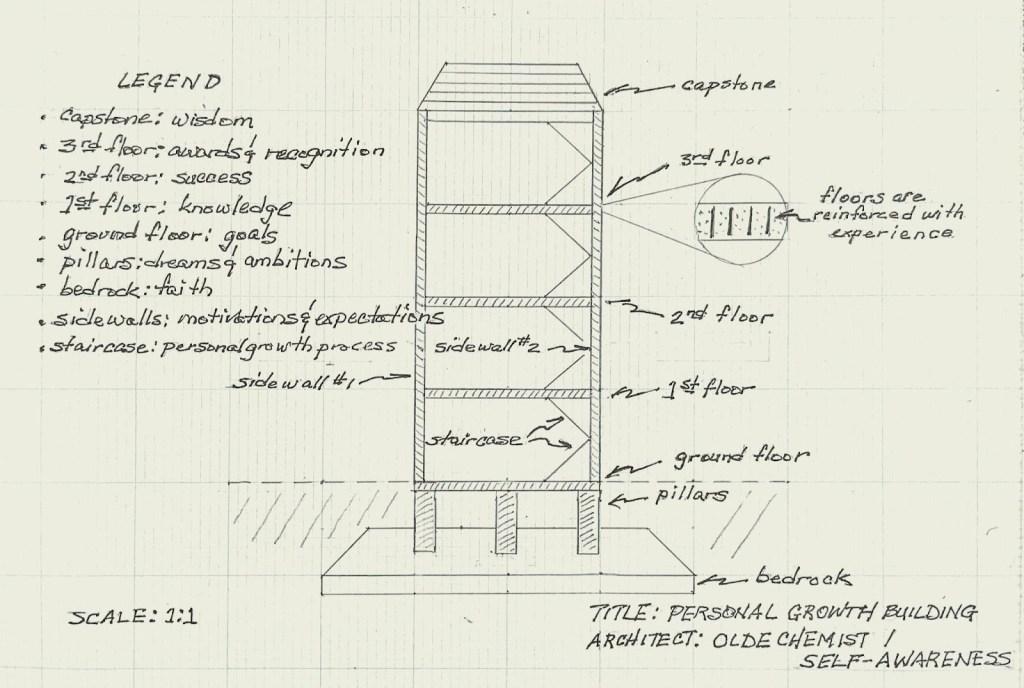
    Personal growth is driven by catalysts, which include the foundational steps of the personal growth “building” we discussed in a previous blog post, our dreams, aspirations, and goals. These are combined with both intrinsic expectations (how we expect ourselves to progress) and extrinsic expectations (the expectations of family and others) to propel us forward in our personal growth journey.


    Reaction Mechanism

    In chemistry, a reaction mechanism is the step-by-step sequence of elementary reactions that leads from reactants to products. It’s the detailed path the reaction takes. When we apply this to personal growth, the reaction mechanism is not a single, fixed procedure but a continuous, self-correcting process.

    In our campfire analogy, the reaction process is a combustion reaction, the process of combining fuel and oxygen with the activation energy provided by the match or a lighter, to initiate a chemical reaction that produces heat and light as products.

    Personal growth is a journey towards a goal or personal transformation, much like a chemical reaction. It involves a methodical process of learning, similar to the scientific method, where knowledge is gained and applied through observation. This leads to the development of strategies, which are then implemented through habits, discipline, and focus to transform effort into skill. Ultimately, this process enables us to identify and conquer obstacles.


    Products

    We define a product as the desired output of a process, or the desired outcome of success.

    In the campfire analogy, the products are heat (thermal energy) and light.

    The desired outcome of personal growth is multifaceted, encompassing skills and competencies, such as mastering a trade, or individual definitions of success, like a specific title or salary. Ultimately, however, I would argue, we should strive in the long-term to gain in wisdom.


    Byproducts

    A campfire’s combustion reaction produces unintended and undesirable byproducts: ashes, which are mineral waste, and smoke, a form of air pollution consisting of uncombusted particles.

    Our personal growth journey, unlike a chemical reaction, yields byproducts that can be either positive or negative, depending on the nature of the growth itself. When we engage in what we call “exothermic growth,” our investment of personal energy results in a positive return or outcome. This beneficial growth produces desirable byproducts such as compassion, critical thinking skills, humility, and resiliency.

    Conversely, “endothermic growth” occurs when we invest more personal energy than we receive in return. This imbalance can lead to negative, unintended emotional or psychological consequences, including anxiety, burnout, fear, frustration, and stress.

    Therefore, self-awareness is crucial. It enables us to identify and prioritize rewarding, exothermic activities while simultaneously recognizing and minimizing endothermic activities that drain our personal energy and are misaligned with our personal goals and ambitions.


    Conclusion

    In conclusion, just like a well-tended campfire provides warmth and light, a mindful approach to personal growth can yield profound and lasting benefits. By understanding the “chemistry” of our own development—recognizing the needed components, our supplies, reactants, and the crucial role of activation energy and catalysts—we can more effectively guide our journey. Cultivating self-awareness allows us to prioritize “exothermic growth” and minimize the less desirable “endothermic” byproducts, ensuring our personal evolution is not only productive but also sustainable and deeply rewarding.

  • Weekly Quotation: October 7, 2025: The Power of Humility and Wisdom

    Weekly Quotation: October 7, 2025: The Power of Humility and Wisdom

    For your consideration:

    The moment we believe that success is determined by an ingrained level of ability as opposed to resilience and hard work, we will be brittle in the face of adversity.

    – Joshua Waitzkin


    I believe we are all endowed by God with unique gifts and abilities. Our professional and personal success is determined by how we embrace the responsibilities that accompany these blessings. From my experience, the belief that one is the “smartest person in the room,” based on a misguided self-assessment or external validation, such as our parents for example, and therefore we don’t need to make an investment of time and effort in our own success, is pure arrogance and a path to failure.

    Throughout my life, I’ve made the mistake of thinking I didn’t need to put in the effort, acknowledge my shortcomings, or address my weaknesses by seeking counsel from more knowledgeable and experienced individuals. Shamefully, I follow the same pattern too often. When I’m offered a new opportunity that challenges my present mindset, I throw myself wholeheartedly into gaining the knowledge needed to be successful. Yet, once I feel like I am recognized as an “expert” by my supervisors, coworkers, or, worse yet, my own perception of my abilities, I become arrogant, stop seeking the input of others, and start to think that my way is the only way. For every step forward along my path to personal success, I take two steps back.

    Now in my sixties, I have lived enough life to understand that wisdom is a crucial component in facing adversity, in persevering through hard times, and in being resilient. Wisdom that comes through knowledge and experience. A wisdom I’ve found by rediscovering scripture, particularly the books of Psalms and Proverbs. Despite how the world and technology have evolved, the struggles we encounter as humans on our journey to becoming better people remain the same. We simply need to be humble enough to seek guidance beyond ourselves.

  • Personal Growth as a Series of Energy Transformations

    Personal Growth as a Series of Energy Transformations

    The Law of Conservation of Energy

    Have you ever felt completely drained after a project, even a successful one? Or, conversely, felt energized and alive after tackling a difficult challenge? The reason for this might be found in a fundamental law of the universe: the conservation of energy.

    The law of conservation of energy states that energy cannot be created or destroyed; it can only be transformed from one form to another. The principle of conservation of energy absolutely applies to the process of your personal growth. You can’t get energy out without putting energy in.

    In our chemical reaction analogy for personal growth, this principle is foundational. It means that the personal energy you have is a finite resource that must be accounted for. It can’t simply disappear.

    We can view our personal growth as a series of energy transformations. In this model, you are the most precious resource you have—your personal energy. Personal growth requires an investment of personal energy—your time, effort, focus, and emotional commitment—to initiate and sustain a change. The outcome you get is a direct result of this transformation.

    The key to living the life you desire isn’t about finding more energy; it’s about choosing where to invest the energy you have.


    Exothermic Personal Growth

    An exothermic reaction is one that releases more energy than it takes to get started. Think of a campfire: you invest a small amount of energy to light a match, but the fire then releases a much greater amount of heat and light. 

    Exothermic personal growth is a process that provides a net gain. In a highly efficient “reaction,” your invested energy is transformed into a net gain of new, positive energy. This is the ideal. It’s a process where your small, intentional investment of personal energy leads to a large and rewarding release of positive energy. 

    For example, the challenging work of learning a new skill that brings you joy, taking on a difficult but meaningful project, having a deep, honest conversation with your friend. These actions require effort, but the feeling of accomplishment, connection, and confidence you get in return is a powerful surplus. The emotional reward is far greater than the initial effort.


    Endothermic Personal Growth 

    An endothermic reaction is one that absorbs energy from its surroundings. Think of a chemical cold pack: it needs to absorb energy from the environment to become cold. The process leaves the surroundings with less energy. In a draining “reaction,” your energy is transformed into by-products like stress, frustration, and burnout. You put in a great amount of personal energy, but because the process is inefficient or misaligned with your goals, you are left feeling drained and with a net loss of energy.

    It’s when you are constantly investing a large amount of personal energy into a process or relationship, with very little emotional or mental energy being returned. This could be staying in a job that makes you miserable for too long, trying to earn the approval of someone who constantly criticizes you, or pursuing a goal out of obligation, not because you’re passionate about it. These are processes that leave you feeling drained. The energy you invest is not returned to you, or the products of the “reaction” aren’t worth the cost.


    Key Understanding

    In this analogy, you are the “chemist” of your own life. You can’t create more energy, but you can choose where to direct the energy you have. Your goal is to design a life filled with reactions where a small investment of intentional effort yields a significant release of personal energy, making the entire growth process both powerful and sustainable. To identify and pursue the exothermic reactions that fill you up and provide momentum for the next challenge. Just as importantly, you must recognize and minimize the endothermic reactions that drain your most precious resource: your personal energy.


    Personal Commentary: The Importance of Self-awareness

    I’m a perfect example of how the benefits of exothermic personal growth, such as accomplishment and confidence, can lead to negative outcomes. For much of my life, I have made the most of my God-given intelligence and my ability to grasp and explain complex concepts, gaining recognition and self-confidence. However, as this recognition grew, my self-confidence transformed into arrogance. I stopped recognizing and acknowledging my weaknesses, believing my way the the best or only way and that I no longer needed others’ help. This led me to forge ahead alone, alienating people and ultimately causing my failure. The very processes that were initially energizing became draining, leading to frustration, resentment, and the abandonment of those career paths.

    At the time, I blamed others for my setbacks. Now, with age, wisdom, and a new perspective, I realize I was my own worst enemy. This highlights the critical importance of self-awareness in navigating our lives. It shapes our perspective, ensuring we neither waste our energy nor allow positive, personal growth to become a long-term detriment. Self-awareness is the key to developing our action plan, the specific steps and habits we need to follow, the “procedure” in our chemical reaction analogy of personal growth. 

  • Weekly Quotation: September 24, 2025: Embracing Resilience: Overcoming Life’s Challenges

    Weekly Quotation: September 24, 2025: Embracing Resilience: Overcoming Life’s Challenges

    For your consideration:

    I think that life is difficult. People have challenges. Family members get sick, people get older, you don’t always get the job or the promotion that you want. You have conflicts in your life. And really, life is about your resilience and your ability to go through your life and all of the ups and downs with a positive attitude.

    Jennifer Hyman


    After undergoing five spinal surgeries in the past twelve years, I’ve come to accept chronic pain as my new normal. I understand this is the hand I’ve been dealt and must manage it daily. My faith in God and my perspective on life are the only things I truly control. I lean into stoicism, focusing on what I can control: my emotions, my reactions to situations, and my demeanor. I accept what is beyond my control—the actions and behaviors of others, external events, and fate.

    I strive to prevent my countenance from revealing my pain and discomfort, choosing not to complain about my situation. Instead, I try to be a concerned, interested, and active listener, showing compassion for others’ challenges. This path is not easy, but through prayer—asking for strength, wisdom, and compassion, and giving thanks for all of God’s blessings—I feel I am making progress toward becoming the best version of myself.

  • Weekly Quotation: September 17, 2025: The Journey to Wisdom: Life Lessons at Sixty

    Weekly Quotation: September 17, 2025: The Journey to Wisdom: Life Lessons at Sixty

    For your consideration:

    “The man who views the world at 50 the same as he did at 20 has wasted 30 years of his life.”

    – Muhammad Ali

    “The only true wisdom is knowing you know nothing.”

    – Socrates

    Now in my sixties, I often reflect upon the knowledge I have retained, my life experiences – my successes and failures, and the mistakes I have made, wondering how it all fits together. What have I really learned? What has my life up to this moment really taught me? Am I gaining in wisdom or making the same mistakes I’ve made consistently throughout my life? 

    Wisdom can be defined as the ability to think and act based on knowledge, life experiences, self-awareness, common sense, and insight into the world. It involves making sound decisions and exercising good judgment, an area I personally strive to improve. Now as I grow older, I attempt to focus more on managing complex situations, especially within my family dynamics, and offering thoughtful, considerate advice. This requires actively listening, a skill that is critical in all situations, and only providing my opinion when asked. I also continue to make a conscious effort to learn from every mistake.

    For me, wisdom is also deeply connected to my faith. I pray for God’s wisdom, asking for help in being more self-aware, compassionate, and developing a sense of purpose that exceeds simply obtaining material things. Part of this process is the recognition that I am not there yet, there is so much more I need to learn, about myself and my life’s purpose. But I know I am a better person today than I was yesterday, and perhaps that is the beginning of wisdom.

  • Weekly Quotation: August 26, 2025: The Smartest Person In The Room Complex

    Weekly Quotation: August 26, 2025: The Smartest Person In The Room Complex

    For your consideration:

    “Just knowing you don’t have the answers is a recipe for humility, openness, acceptance, forgiveness, and an eagerness to learn—and those are all good things.”

    – Dick Van Dyke

    Over the years, I mistakenly believed I had all the answers and was the “smartest” person in the room. My arrogance was compounded by my eagerness to dominate conversations and express my views, which only highlighted my lack of knowledge. However, with age came the understanding that true intelligence involves actively listening to others’ opinions and perspectives. There is much to gain if I simply take the time to listen. By humbly acknowledging my shortcomings, refraining from imposing my opinions, and remaining open to alternative approaches, I can cultivate humility and grow in wisdom.

  • Learning from Mistakes

    Learning from Mistakes

    “The greatest teacher failure is..”

    Yoda

    If I could identify one lesson from college that was the most valuable, it would be my professors’ requirement that we must identify the sources of error in every lab experiment. To recognize, through observation of the individual steps in an analysis, where there was the potential for an error that affected the eventual outcome of the experiment. Whether you obtained the correct answer or not. In every analysis we performed, there was always the potential for making a mistake in our preparation, observations, and calculations, each of which could give us the wrong answer.

    Fast forward to today, how does this concept apply in your world? If you apply an analytical approach to identifying sources of error when you get a wrong answer or make a mistake, it helps take the emotion out of the picture, allowing you to see it as a learning opportunity, encouraging you to identify and benefit from your mistakes in the future.

    I encourage you to consider the benefits of getting the wrong answer. Here are a few:

    Mistakes help us to identify what we don’t know. This can be a good thing because it allows us to redirect our learning and to focus on the areas where we need the most improvement.

    Mistakes can encourage us to think about how much effort we invested in learning the material. When we are trying to understand why we got the wrong answer, we are forced to think more deeply, develop a greater understanding of the concepts, versus simply rote memorization.

    Mistakes can help us become more resilient. When we make mistakes, it is important to learn from them and keep moving forward, which is an important skill for success in all areas of life.

    And, mistakes can help us to be more creative. When we are not afraid to make mistakes, we are more likely to try new things and to come up with new ideas. A valuable skill that is beneficial throughout our lives.

    How to we begin to learn from our mistakes? 

    To begin with, don’t beat yourself up. Everyone makes mistakes. It is important to forgive yourself and to move on.

    Then try to identify and acknowledge the mistake you made. What was the root cause of the mistake? Once you understand the root cause, you can take steps to avoid making the same mistake in the future.

    Finally, learn from your mistake. What can you do differently next time? Think about how you can apply what you have learned to improve your performance. Don’t be afraid to ask for help. If you are struggling to understand a concept or to solve a problem, don’t be afraid to ask for help. Take my advice, if you ask someone for help, be prepared to listen with and open mind and not get defensive. There is always someone wiser than you or me whose instruction is valuable.

    By following these three tips, you can turn your mistakes into learning opportunities and become the best version of yourself.

    Commentary

    As I have gotten older, my perspective has changed, and I’ve come to recognize and admit to myself the mistakes I have made over the years. I have always been able to apply the concepts of error analysis throughout my career. When it pertained to recognizing the weaknesses or failures in an analysis, it was one of my most recognized capabilities. I prided myself on my ability to apply the Scientific Method to almost any situation. However, very seldom did I apply the same skillset to my personal life.

    When we fail, especially in our careers or our personal lives, it is very easy to blame someone else, our boss, a coworker, our parents, spouse, or significant other. We may blame the situation we were in as if it were out of our own control. We blame anyone and everything in order to deflect the responsibility for our mistakes and failures from the person responsible, ourselves. I readily admit I am an example of these same habits. 

    The personal trait of self-awareness, which I will discuss in detail in a later post, allows us to recognize and acknowledge our weaknesses as well as our strengths. It acts as our internal GPS so to speak, showing us where we make a wrong turn in our lives and directing us back on track. Learning from each misadventure, becoming more humble, less arrogant and prideful, accepting blame where it is needed, and leading us on the path to wisdom. 

    I am nowhere close on my journey of personal growth, but I do believe I am getting better at admitting my mistakes and attempting to learn from them each day. And, hopefully, by doing so, I am a better person today than I was yesterday and will be an even better person tomorrow.