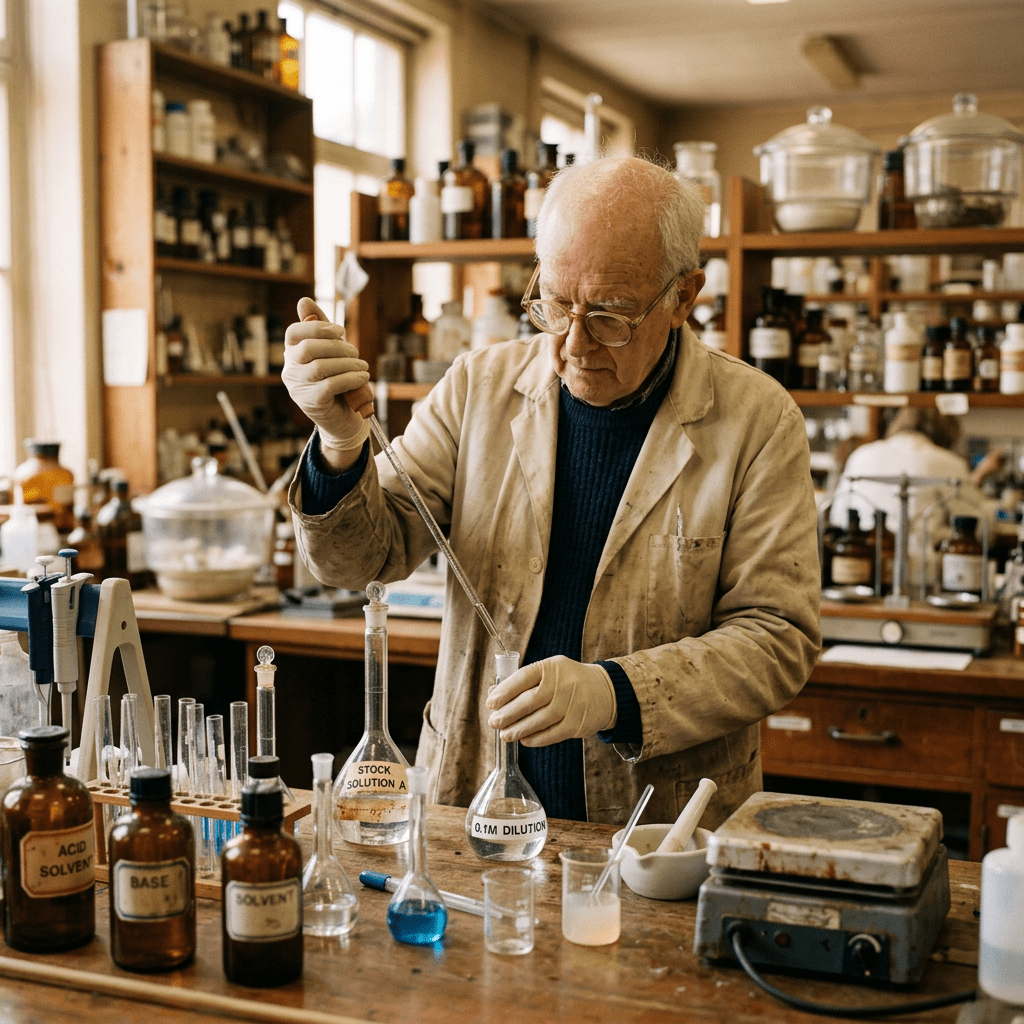
I plan to divide my metaphorical toolbox into two distinct compartments—one dedicated to personality traits and the other to the analytical skills we have explored. The second section would cover techniques such as the Golden Ratios, Dimensional Analysis, Scientific Notation, Conservation of Energy, Estimation, and Significant Figures. Joining this collection is the subject of today’s post: the Concentration x Volume relationship.
At 68 years old, the fundamental equations I mastered 46 years ago in my Chemistry, Mathematics, and Physics courses at Centre College remain in my memory. Throughout my career in various chemistry roles, one specific formula has proven to be an invaluable tool:
As an analytical chemist, the form of the equation that is most useful for preparing reagents:
I would be remiss if I didn’t include the definition of Molarity at this point:
Molarity (M) = moles of substance/ 1 liter of solution
Where 1 mole is equal to:
Side note: This formula applies to all units of concentration, whether it is Molarity, Normality, or Percent by Volume.
So, for example, 100 mL of a 1 M HCl solution is prepared by diluting concentrated 12 M HCl.
Plugging the known values into the formula:
Solving for the initial volume of 12M HCl:
(Note: to avoid an unfortunate reaction, remember that 12M HCl is highly reactive if the 8.3 mLs is added directly to water. The correct procedure is to add 60mL of deionized water to a 100 mL volumetric flask, then add the 8.3 mLs of 12M HCl to the volumetric flask, swirl carefully, then add the remainder of the deionized water until the bottom of the meniscus meets the 100 mL volume mark.)
The dilution formula truly is the Swiss Army knife of analytical chemistry. This formula applies to all concentration and volume-related situations. In my professional career, this specific dilution logic was essential for preparing buffer solutions for High-Performance Liquid Chromatography (HPLC), performing liquid-liquid and solid-phase extractions, and preparing standard solutions for Gas Chromatography (GC) and GC/Mass Spectrometry (GC/MS) analyses.
Beyond the laboratory, these exact chemical calculations easily transfer to my retirement activities and everyday household chores, such as precisely mixing liquid fertilizer, weed killer, and hummingbird food. These chemistry formulas I learned over 40+ years ago still apply in my everyday life. Obviously, you can take a chemist out of the lab, but you clearly can’t take the lab out of the chemist.
From the Lab to the Garden
When you are mixing liquid fertilizer or weed killer, you are doing the exact same math as your HCl prep, just usually swapping molarity (M) for volume percentage (%) or a ratio.
Let’s say you have a concentrated jug of liquid fertilizer that is a 50% nutrient solution, but your garden needs a milder 2% solution to avoid burning the roots. You want to fill a standard 1 Gallon (128 fl oz) watering can.
Using the concentration x volume formula:
Plugging in the numbers:
Solving for the initial volume of concentrate:
Conclusion
Now, forty-six years after receiving my degree in Chemistry, the mathematical core of the discipline of chemistry never changes. One specific formula has proven to be an invaluable tool: the exact same dilution equation I used to calibrate instrumentation such as HPLC and GC/MS systems during my laboratory career translates perfectly to this retired chemist’s backyard watering can or kitchen counter today.

Leave a Reply