
Musings of an Old Chemist

A Chemist's Perspective on the Habits and Skills STEM Students Need For Success

Tag: passion for learning

  • Personal Growth: The Campfire Analogy Explained

    Personal Growth: The Campfire Analogy Explained

    I associate the process of personal growth with building a campfire when I go camping. To begin to understand this personal growth/campfire analogy, it’s helpful to examine the basic steps and components of a campfire, which, by definition, is a combustion reaction. 

    The general formula for the combustion reaction process is:

    Reactants + Catalyst + Activation Energy ⇒ ReactionMechanism ⇒ Products + Byproducts

    Whether it is in a fireplace, a backyard fire pit, or a campfire, the combustion process is in its simplest form:

    Fuel + Heat (Spark) + Oxygen ⇒ (Reaction mechanism or process) ⇒ Light + Heat + CO2 

    Why Use a Campfire as an Analogy For Personal Growth?

    Here are five reasons why a campfire is such a powerful analogy for personal growth:

    1. Building a Campfire Requires Effort on Our Part 

    A campfire doesn’t happen by accident, and neither does personal growth. You can’t just throw a match at a pile of logs and expect it to burn. You have to collect the right materials and stack them together in the right order: tinder (paper, dry grass, and pine needles) to catch the spark, kindling (small twigs and branches) to build the heat, and larger logs to sustain it. Likewise, we can’t tackle the most complex challenges in our lives, whether it’s in the classroom, workplace, or at home, without first identifying and mastering the small, fundamental skills and gradually building on them.

    2. The Essential  “Spark”

    Even if you’ve built the perfect campfire, nothing happens without a spark or flame to ignite the fire. In personal growth, that spark is initiative, which ends with you taking action. It might come from within, something that piques your curiosity or a sudden desire to improve. Or, it may come from outside, such as encouragement from a teacher, parent, or mentor. Regardless of the source of the “spark”, your effort and energy must be applied to ignite the personal growth process.

    3. Room to Breathe

    Early on, one of the most common mistakes I made when building a campfire was rushing the process,  packing the firewood too tightly, too close together. If the fire doesn’t have enough space for airflow (oxygen) it needs, it gets smothered and dies. The same is true for learning and our development. If we feel overwhelmed, feel too much pressure to perform and meet high expectations, and are not given the “space” to make mistakes and process new information, we may lose our motivation to try. Personal growth requires breathing room.

    4. It’s a Transformation Process

    A campfire is a series of energy transformations. It takes raw materials (tinder, kindling, and logs) and turns them into heat and light that can warm a campsite and brighten the dark. Personal growth does the same thing. It takes our energy and efforts, our life’s lessons (both good and bad), time and experience, transforming them into new abilities, wisdom, and character traits that ultimately benefit us and the people around us.

    5. Campfires Demand Constant Attention

    A fire is never “finished” until it’s out. If you walk away from it, it will eventually burn through its fuel and fade into ashes. It requires someone to keep an eye on it, adding tinder, kindling, and logs whenever needed. Likewise, personal growth is a lifelong process; there is no point at which you can simply choose to stop learning and expect to remain as “sharp” mentally and emotionally.

    The Significance of Heat and Light

    Light: Clarity, Understanding, and Guidance

    Where the light of the campfire helps penetrate the darkness, light in our personal growth analogy represents our mental and emotional clarity and our understanding of who we are as a person. Clarity and understanding come in two forms: internal and external.

    • Internal: It is that “lightbulb” moment when a confusing problem, work assignment, or situation suddenly makes sense. When we struggle, regardless of the situation,  we are figuratively in the dark. As we grow, practice, and learn, we generate our own “light”—the ability to see solutions to our problems, and we begin to understand the world around us more clearly.
    • External: Our metaphorical light is visible to others from a distance. As we grow in character and knowledge, our “light” serves as an example for others. We become a leader, a teacher, a guide for our friends, coworkers, and family members, showing what is possible through hard work and dedication.

    Heat: Passion, Action, and Empathy

    Heat is energy you can feel. It provides warmth against the cold and the energy needed to do work. In personal growth, heat represents our passion, actions, and the impact we have on others. Like light, heat exists in two forms: internal and external.

    • Internal: Heat is the internal drive and passion that keeps us moving forward. It’s the energy and motivation to tackle the next challenge, study for the next test, complete the next project, or try again after failing. It is the active desire to improve.
    • External: Heat from a campfire radiates outward, warming the area. A well-tended fire warms everyone gathered around the campsite. Similarly, as we grow in character and wisdom, we radiate a “warmth” that impacts our community. This looks like empathy, kindness, and the willingness to help someone who is struggling.

    Final Thoughts: The Perfect Balance

    A fire that produces only light without heat is like a lightbulb; you can see the area around it, but it won’t keep you warm in the cold or roast your marshmallow for s’mores. A fire that produces heat but no light is hidden from sight; it emits heat energy, but you still can’t see where you are going.

    True personal growth yields both. We don’t just gain the “light” from our knowledge and experience; we also develop the “heat” of good character traits (compassion, empathy, humility, perseverance, and resilience), passion, and a desire to be a positive influence on everyone around us.

  • Ignite Your Growth: The Fire Triangle of Learning

    Ignite Your Growth: The Fire Triangle of Learning

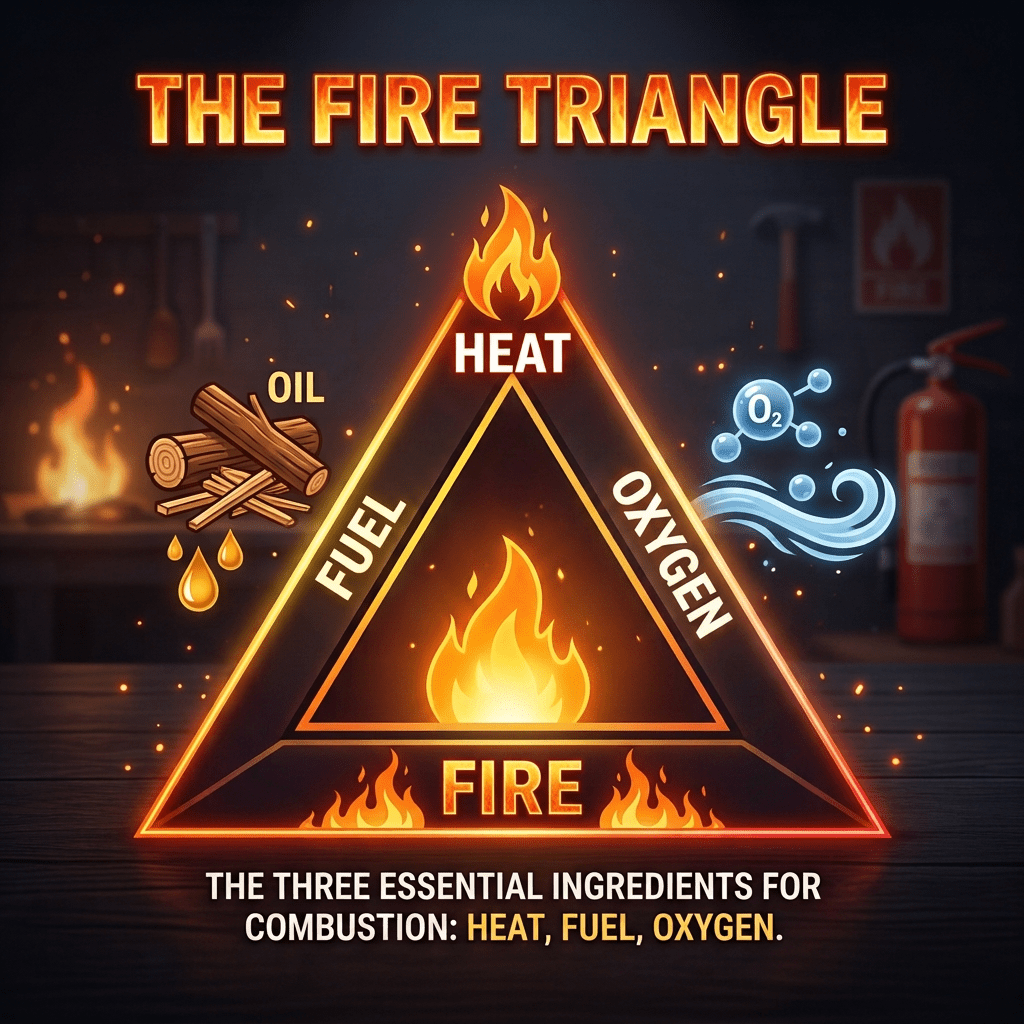
    Think about a campfire. To keep it going, you need three simple things: heat, oxygen, and fuel. Scientists call this the “fire triangle.” If you take even one of those away, the fire goes out, and you’re left with cold ash.

    Our minds work the same way. Whether you’re a student trying to learn something new or a parent helping them out, staying curious and excited about growth follows this same rhythm. To keep your “inner fire” burning, you have to know how to feed it, give it air, and light the match.

    Real change doesn’t just happen by accident. Just like a real fire, your personal growth depends on three main parts: Heat (the spark to start), Oxygen (your curiosity), and Fuel (what you’re learning)

    How to Get Things Moving

    To keep your momentum going, you need to let energy flow through four different types of fuel:

    Spark (Your Choice) → Tinder (Tiny Actions) →  Kindling (Your Routine) →  Logs (Big Goals)  →  Coals (Your “Why”)


    The Spark

    The Spark is just your decision; it’s your commitment. It’s that moment where you say, “Okay, I’m going to do this.”It’s tiny, but without it, the tinder (like opening a book, putting on your shoes, or in my case, writing the first outline) never catches fire. If you miss it, you can have the best plans and the best books, but without that one decision to strike the match, nothing happens. The decision to sit down right now and strike the match exclusively onto tinder. You don’t decide to “finish that report or project today”; you simply need to decide to take the first step and type one sentence.


    Heat: The Energy of Wonder

    Fuel just sits there unless something starts the reaction. In life, curiosity is what provides that heat. It’s asking, “What if?” or “How does this work?” That bit of wonder turns your potential into action.

    You can have the perfect amount of tinder, kindling, and hardwood and a gentle breeze providing the flow of oxygen, but nothing happens until you introduce heat. In science, that heat is the “activation energy” needed to get things started. For us, that heat is excitement and purpose. It’s that jolt you feel when you see a problem or a new skill and think, “I want to figure this out.” Allowing us to transition from being a passive observer to an active participant. Heat enables you to fully engage in the process.


    Oxygen: Fresh Ideas and Perspectives

    A fire can’t breathe in a closed container. Without fresh air, the flames just turn into smoke and go out.

    In our minds, oxygen is asking questions and listening. It’s easy to stick to what we already know, but a growing mind needs a “draft.” It needs us to listen to different ideas and welcome a good discussion. When we open up to new thoughts, we give our curiosity room to breathe.

    To keep the fire bright, try treating life like a science experiment. Try using the Scientific Method. That’s your oxygen. It just means trying something new, watching what happens, and thinking about the results. When you look at things this way, a “mistake” isn’t a failure—it’s just a clue. Adjusting your plan gives the fire a fresh breath of air.

    When you’re curious (oxygen is in excess), you do your work because you actually want to find a solution to a problem or just to see what happens. The question you ask yourself is: “What can I learn here that I didn’t know before?”

    When you’re just going through the motions, you’re just doing work to look smart or get it over with. When you’re just putting on an act, your efforts feel like a chore, and instead of a flame (heat),  you get just a pile of sticks.


    Fuel

    In our “campfire” model, your fuel is your love of learning. It’s your energy and beliefs just waiting to be tapped. Every fire needs something to burn. In your life, fuel is everything you’re taking in: books, hobbies, and even just observing the world around you.

    Learning doesn’t end when you leave the classroom. If you stop reading new things or trying new skills, you starve your “fire. To keep it going, you have to feed your mind with interesting stories, science, art, and new ideas every day.

    The Different Types of Fuel

    To keep your fire from going out, you can’t just throw everything in at once. Fire needs a specific order to work right. For example: If you throw a huge log on a tiny match, you’ll just squash the flame. If you only burn dry leaves, you’ll be striking matches all day without getting warm. To build a life that stays bright, you need to understand the four layers of your fuel pile.

    Tinder: Getting Started

    Tinder isn’t meant to last a long time. In our personal growth “campfire”, tinder is tiny, “No-Brainer” actions. Its only job is to get you off the couch and past that “I don’t want to do this” feeling.

    Since tinder is so easy to light, it doesn’t take much willpower. It’s just saying, “I’ll write one sentence,” or “I’ll just open my book.” Don’t try to plan your whole future with tinder; just use it to get things moving. For me, it’s opening this manuscript, reading the last sentence I wrote yesterday, or adding three bullet points to a chapter outline.

    Kindling: Building a Routine

    Once your tinder is lit, you need kindling. For students, this is your study habits; for the rest of us, this is our daily routines, the 30 to 90 minutes we spend actually focused on what we need to accomplish.

    Kindling turns that quick spark into real heat. Without a routine, our small decision to start an effort (tinder) just burns out.  Kindling keeps the flame alive until the big log catches. One session won’t finish a big project, but ten sessions in a row will. For me, it represents getting up early and spending 45 minutes writing, three days a week

    Hardwood Logs: Major Goals

    Logs are your major life goals, like graduating, writing a book, or mastering a hard skill. They contain a significant amount of energy but need a lot of heat to get started. They can give you personal success and satisfaction for a long time, but you can’t light them with a single match. You don’t just “start” with a log. You use your tender (decision) and kindling (habits) to build up enough heat until the log finally ignites. Once it does, it becomes a steady source of energy. You can’t just wish a big goal into existence. If you only focus on the massive finish line, you’ll just feel stuck. You have to work your way up. In my case, my hardwood “log” is a published, 60,000-word completed manuscript draft.

    The last consideration is one we do not often recognize to be part of our “campfire scenario, but is an absolute necessity for a successful, vibrant campfire: the bed of coals that exists under the burning fuel.

    The Bed of Coals: The “Why”

    Under the logs is the most important part of our personal growth campfire: the glowing coals. This is our core “Why”, the real reason we care about what we’re doing. This isn’t about grades or awards. It’s about your true desire to learn, to grow, and to help others along the way. When life gets hard, and the flames flicker, your “coals” stay hot. They keep your spirit alive so you don’t just give up, making

     it much easier to start the process again tomorrow. As long as your reasons are well grounded, you can always keep going.


    What Can Go Wrong

    1. No Oxygen (Just Going Through The Motions)

    Sometimes people just go through the motions. They aren’t curious anymore, and our life’s work starts to feel like a chore. That’s what happens when you cut off the oxygen. When you work without curiosity, it’s like closing the vent on a fireplace. You’re trying to burn wood, but you aren’t letting it breathe. Without air, you don’t get a nice warm fire. You just get a lot of smoke and feel drained. Working just because you “have to” feels like a waste of time. It leads to you feeling grumpy, bored, and tired of it all. You have to use raw willpower to get anything done. It’s exhausting, and you’re likely to give up once you get tired.

    1. Dying Coals (Burnout)

    Coals are what keep the heat steady. If you let your coals die and just try to keep a fire going with paper and twigs, you’re going to get burned out. This is like hustling really hard without a real reason. Without them, the fire goes out as soon as you stop feeding it. Working hard without a dream to support you takes a ton of effort. You get quick bursts of energy, but the moment you stop, you’re back to zero. Without your  “Why” (the coals), trying to stay motivated is exhausting. 

    1. Smothering the Fire (Feeling Stuck)

    Big logs need lots of heat to catch. You need tinder and kindling to build up the heat first.

    If you drop a huge log on a tiny match, it goes out instantly. This is like having big dreams without small habits to get you there. If you only think about the huge goal, you’ll feel overwhelmed. The goal is just too big to handle all at once, and you don’t know where to start. You don’t start with the log; you start with tinder. Trying to do too much at once just leads to feeling stressed and stuck.

    Troubleshooting the Problem

    If you feel stuck: Your goal is too big. Try starting with some tinder (tiny steps).

    If you’re busy but not getting anywhere: You’re burning through tinder but forgetting your kindling (habits and daily routines).

    If you feel burned out: You’re letting your coals die. Remember why you started in the first place.

    Final Thoughts

    You don’t finish a big project overnight. You do it by starting small, keeping a good routine, staying curious, and remembering why it matters.

    Staying curious is a skill you keep practicing, like tending a fire. By making sure your mind has plenty to burn, fresh air to breathe, and that spark of wonder, you can keep learning and growing your whole life. A well-tended mind doesn’t just help you—it shares its warmth with everyone around you.

    When curiosity, passion, and a little trial-and-error come together, they create something great. Your excitement starts the fire, your habits keep it going, and your curiosity keeps the air flowing, turning your hard work into real, lasting growth.

  • An Open Letter: Why Do I Spend So Much Time on the Personal Growth Building Metaphor?

    An Open Letter: Why Do I Spend So Much Time on the Personal Growth Building Metaphor?

    To my colleagues and fellow readers,

    I’ve recently been asked why my Personal Growth Building (Revision 2) focuses so heavily on the specific structural components for personal growth rather than just the “foundational” traits we all value: Curiosity, a Growth Mindset, the Passion for Solving Problems, and a Passion for Learning.

    It is a fair question. The “foundational” traits we value in STEM and other fields are often considered the prerequisites for student achievement. However, from my perspective, having spent time in scientific labs and learning drafting and surveying with my Dad, a civil engineer, I see a crucial element that is often overlooked: As Dr. Walkup famously stated, “You can’t build a skyscraper on an outhouse foundation.”


    1. “Readiness” vs. The “System.”

    Curiosity and a Growth Mindset represent how prepared a student is;  they indicate if a student is truly ready to jump into learning.

    The elements in the Personal Growth Building, though, are all about what a student does. They’re the tools that turn that potential into real results.

    Think about a student who’s “passionate about learning” but doesn’t have a solid understanding of the base of knowledge required to succeed. They’re like a car engine revving high but stuck in neutral. They have the “energy” necessary but no way to actually use it effectively. The “Building” provides the process and structure they need to shift a “simple interest” into “genuine understanding.”


    2. The Sustainability of Growth

    My intent is to prepare students for a 40-year career, not just a four-year degree. Traits like “Passion” can flicker and fade under the pressure of a professional environment.

    The components and structure of the “Building” are designed to train and support students so they’re capable of “adapting.” When a chemist’s specific technical knowledge becomes obsolete, it is the structure of their learning – their ability to categorize new information and logically assess and apply it – that allows them to pivot to new challenges. We don’t just want “curious” students; we want intellectually sound professionals.


    Closing Thought

    We shouldn’t choose between “traits” and “frameworks.” We must recognize that the traits are what make the building possible, but the framework is what makes the student useful to the world and resilient to change.

  • The Grade Illusion: Why High Test Scores Don’t Necessarily Equate With Concept Mastery (And How to Fix It)

    The Grade Illusion: Why High Test Scores Don’t Necessarily Equate With Concept Mastery (And How to Fix It)

    If you are an aspiring STEM student, or the parent of one, I want you to consider a terrifying possibility: It is possible to have a 4.0 GPA and know/retain almost nothing.

    I saw this contradiction in the students I would tutor. They were bright, hardworking, and ambitious. They had mastered the art of getting the “A.” They knew how to take tests, follow instructions, and allocate their time to receive a high score.

    However, if I asked them to apply a physics concept from two weeks before to a new problem assigned that day, they would freeze. Their knowledge of the material (data) was gone.

    This is the Grade Illusion. We have built an educational culture – especially in high-stakes fields like STEM, where the “High Score” has become the product. But in the real world, the test scores from high school and college courses are irrelevant. The only thing that matters is mastering the content.

    If you want to survive the transition from “A-student” to “successful scientist,” you need to understand how your own mind works. You need to stop renting knowledge and start owning it.


    The Knowledge Retention Misconception: RAM vs. Hard Drive

    To understand why intelligent students often feel like impostors, we need to examine how the brain stores information.

    Think of your brain like a computer. You have two types of storage:

    1. RAM (Random Access Memory): This is short-term, high-speed memory storage. It holds the data you need right now. It is volatile; when the power cuts (or the test ends), the data is wiped to make room for the next task.
    2. The Hard Drive: This is long-term storage. It is slower to write to, but the data remains there forever, ready to be recalled years later.

    The modern educational system encourages you to use your RAM, not your Hard Drive. We call this Cramming, or as we discussed in an earlier blog post, the act of memorization/regurgitation.

    When you cram for a calculus midterm, you are loading complex formulas into your RAM. You hold them there—stressfully—for 24 hours. You walk into the exam, dump the RAM onto the paper, and get a 95%. You feel successful. 

    But 48 hours later, that RAM is cleared to make space for Chemistry. The “Save to Hard Drive” function never happened.


    The Science of Forgetting

    This isn’t just a metaphor; it is a biological fact. In the late 19th century, psychologist Hermann Ebbinghaus mapped the “Forgetting Curve.”

    The curve shows that without deep processing (the struggle necessary to understand something), humans lose roughly 50% of new information within a day and 90% within a week.

    The student who crams and gets an “A” peaks at 100% on Tuesday morning. By next Tuesday, their retention dropped to nearly the same level as that of the student who failed. The grade is a record of what you knew for one hour, not what you carry into your career.

    From an economics perspective, consider this as the difference between Renting and Owning.

    • Cramming is Renting. You pay a high price in stress and sleep deprivation. You get to “live” in the knowledge for a day. But once the test is over, your “lease” is up, and you are evicted. You have zero equity.
    • Deep Learning is Owning. You pay a “mortgage” of daily, consistent study. It feels slower. It feels harder. But two years later, when you are designing a load-bearing bridge, for example, that physics principle is yours.

    The Illusion of Competence

    “But I got an A!” you might argue. “The test says I know the material.”

    Does it?

    In 1956, in the publication “Taxonomy of Educational Objectives: The Classification of Educational Goals,” a committee of educators chaired by Benjamen Bloom developed a framework to rank levels of understanding called “Bloom’s Taxonomy.”


    Shutterstock


    Most high school tests—and frankly, many college exams—operate at the bottom three levels: Knowledge (learn the formula), Comprehension (understand when to use the formula), and Application (plug numbers into the formula).

    If you are good at memorization, you can ace these tests without ever moving up the pyramid. But a career in STEM fields lives entirely at the top three levels:

    • Analysis: Why did the experiment fail?
    • Evaluation: Which method is best for this specific application?
    • Synthesize (Create): Develop an improved solution that isn’t in the textbook.

    The Illusion of Competence

    This creates the Illusion of Competence. You have a transcript full of “A’s” that certify you are an expert, but your internal drive has never been stress-tested at the “Analysis” or “Synthesis” level. When you eventually hit a problem that requires those skills, you don’t just struggle—you crash.

    The most dangerous side effect of the Grade Illusion isn’t academic; it’s psychological.


    The Performance = Identity Misconception

    When you spend your entire life chasing the “High Score,” you begin to associate your Performance with your Identity. You believe the equation: My Grade = My Worth.

    In STEM, this is lethal. In English class, a grade of “C” might seem subjective. In Physics or Chemistry, a “wrong answer” is objectively wrong. If you tie your self-worth to getting the right answer, every mistake feels like a character flaw.

    You need to adopt the mindset of a Scientist:

    • You are the Learning Process itself. You are the curiosity, the work ethic, the resilience.
    • The Grade is just Data. It is simply the output of a single, specific experiment on a single specific day.

    For example, if a Ferrari engine performs poorly because it had bad fuel, we don’t say the engine is trash. We say the input (fuel) was wrong. Similarly, if you fail a test, it doesn’t mean you are broken. It means your variables—your study habits, your sleep, your preparation—were off.

    A bad grade is not your identity. It is guidance.


    Breaking the Cycle

    Ready to shift from being a “Grade Hunter” to a true “Learner”? Use these two simple techniques to pinpoint where you are in that transition and determine the necessary steps to move forward.

    1. The “Two-Week Audit.”

    I challenge you to a challenging experiment. Take a test you aced two weeks ago. Sit down and take it right now, without reviewing your notes.

    The difference between your score then (95%) and your score now (55%) is your Fake (Lost) Knowledge. That 40-point gap represents wasted energy. It is time spent renting, not owning. If the gap is huge, your study method is broken, regardless of your GPA.

    2. The Feynman Technique (The Ownership Test)

    Physicist Richard Feynman had a simple rule for understanding, which he borrowed from Albert Einstein. To prove you have mastered a concept, you must be able to explain it in simple language, without jargon, to someone who has no background in the topic (like a smart 12-year-old).

    If you can’t explain it simply, you don’t understand it. You have only memorized the definition. You are stuck at the bottom of Bloom’s Taxonomy.


    The Bottom Line

    The world is full of influencers and algorithms showing you the easy way to obtain a high test score on the ACT and achieve the most sought-after degrees, jobs, and accolades. Yet they rarely show you how to retain the knowledge required for long-term success.

    Success in STEM requires three “old school” prerequisites that cannot be skipped: Curiosity, a Passion for Learning, and a Passion for Solving Problems.

    If you have these, the grades will eventually follow. But more importantly, later in life, when the grades stop mattering, the expertise will remain.

  • Weekly Quotation: August, 6, 2025: Rethinking Education to Prioritize Personal Growth

    Weekly Quotation: August, 6, 2025: Rethinking Education to Prioritize Personal Growth

    “We are a culture that worships the winning result: the league championship, the high test score. Coaches are paid to win, teachers are valued for getting students into the best colleges. Less glamorous gains made a long the way – learning, wisdom, growth, confidence, dealing with failure – aren’t given the same respect because they can’t be given a grade.”

    – William Zinnser (On Writing Well, 30th edition) (pg. 253)

    I wonder if the same can be said about the process of personal growth. I am absolutely certain that there are teachers whose passion lies in seeing they’re students grow as people of substance, encouraging their passion for learning, challenging students with inquiry-based lessons. I know this because I have worked alongside many of them. However, the pressure to meet state and federal established testing benchmarks by which schools are judged and state curriculum standards leaves little time for creativity and discussion in the classroom. So many feel like they are fighting a losing battle. And it not only these restrictions that affect the development of our students’ personal growth in the classroom.

    I have also experienced a paradigm shift in the STEM students I work with. While there are still some who are open to new ideas and are willing to explore and develop the foundations of personal growth: curiosity, a passion for solving problems, and a passion for learning. There is a growing majority of students whose primary interest is in just getting the grade, whose focus is on getting the highest ACT score possible, not through learning the baseline knowledge to support the score, but only in the quick techniques to “cheat” the test with the least amount of effort. And, with minimum ACT test score standards being implemented in school systems as graduation requirements, schools now offer courses teaching these methods. ” Memorize and forget” is now the status quo for many of our students.

    We are doing a disservice to our students. For when they get to college, and especially when they graduate and join the workforce without a solid foundation in knowing how to deal with failure, learn from their mistakes, develop a strong support network, to be resilient and to persevere – essential skills and traits that cannot be given a grade – I guarantee you they will struggle.

  • The Essential Traits for Personal Growth

    The Essential Traits for Personal Growth

    “You can’t build a skyscraper on an outhouse foundation.”

    Dr. John Walkup

    Three integral, interrelated traits: curiosity, a passion for learning, and a passion for solving problems, when combined with self-awareness, are the foundation or prerequisites for personal growth and eventual success, regardless of which career path you may choose.

    By definition, prerequisite is something that has to happen first, something that must occur, or in this case, a personality trait that must be developed, before you can get to the next step or goal.

    For example, in education, a prerequisite is a course or subject that a student must complete before enrolling in a more advanced course. This ensures that a student has the foundational knowledge or skills needed to succeed in the more complex material.

    For the sake of our discussion, these three prerequisites, curiosity, a passion for learning, and the passion for solving problems, ensure that we have the necessary foundation, the skills necessary to succeed on our journey of personal growth.

    Curiosity

    “We keep moving forward, opening new doors, and doing new things, because we’re curious and curiosity keeps leading us down new paths”.

    Walt Disney

    It all begins with curiosity – always asking “why?” and “how?”. Curiosity is a fundamental human trait, our longing to understand the world around us. Curiosity is the spark for our desire to learn and explore, to ask questions, and to seek knowledge beyond the obvious. It opens the door for new experiences and perspectives. And enriches our understanding of the world around us.

    When you’re curious, learning isn’t just memorizing facts. It’s actively exploring ideas, solving problems, and discovering what truly interests you. This makes learning more engaging, turns you into a better thinker, and fuels your creativity. It’s also key to understanding yourself and what you’re passionate about, setting you up for a lifetime of exciting discoveries and personal growth.

    And when combined with open-mindedness, seeking answers to questions in areas that interest us stimulates our passion for learning and our desire to solve problems, to investigate, experiment, and discover.

    While some people may be more naturally curious than others, the good news is that curiosity can be cultivated and nurtured.

    • The most effective way to build your curiosity, ask questions, lots of them. No question is too simple or too complex as long as the purpose is to gain more knowledge. Strive for deeper understanding in your learning, asking “why” and “how,” refusing to accept surface-level explanations. 
    • Listen and be open to different points of view, and actively seek out knowledge and understanding. Take time to research, participate in conversations, and explore diverse perspectives different than your own, which can broaden your horizons and deepen your understanding. Maintaining an open mind, willing to consider new ideas and perspectives, is essential to staying curious.
    • Embracing your passions is another powerful way to develop your curiosity. When we immerse ourselves in subjects that truly fascinate us, the desire to learn becomes naturally motivated.
    • Finally, persistence is the key. When faced with challenges or setbacks, a curious person will persevere, viewing obstacles as opportunities for learning and growth.

    Passion for Solving Problems

    Problems are a natural part of life, and the ability to solve them effectively is essential for success in both your personal and professional life. The passion for solving problems is the strong desire to identify and overcome challenges. It is the driving force that keeps you focused, motivated, and driven to find creative solutions to the complex and some not-so-complex problems you face in your lifetime. Without a passion for problem-solving, you may be less likely to take risks and try new things, and more importantly, less likely to persevere in the face of failure. This will greatly impact your career success regardless of what field you choose.

    Problem-solving skills are more important now than ever and are in demand by employers who want employees who can rapidly adapt to new situations and find innovative solutions to challenges they encounter in the workplace. People passionate about solving problems are looking for new challenges and ways to improve things. They are not afraid to think outside the box and create innovative solutions. This is a valuable skill in any field, as it allows people to overcome obstacles and achieve their goals.

    Here are some of the benefits of having a passion for solving problems:

    • It makes you more versatile. The ability to solve problems is essential for adapting to change. When things don’t go according to plan, people passionate about solving problems quickly come up with a new solution. This is a valuable skill in today’s rapidly changing world.
    • It makes you more creative and innovative. Problem solving requires creativity and innovation. People who are passionate about solving problems are always looking for new and better ways to do things. This is an important skill for success in any field, as it allows people to develop new products, services, and processes.
    • It makes you more competitive. In today’s competitive job market, it is important to stand out from the crowd. A passion for problem-solving is a great way to do this. Employers are always looking for people who can solve problems and improve things.
    • It makes you more successful in your career. Studies have shown that people who are passionate about their work are more likely to be successful in their careers. They are also more likely to be happy and fulfilled in their work.

    How can you develop or enhance your passion for solving problems?

    • The first step to developing a passion for problem solving is to find a problem that you are passionate about. This could be anything from a personal problem to a global issue.
    • Then, do your research. Once you have found a problem that you are passionate about, learn as much as you can about it. This will help you to better understand the problem and to develop potential solutions.
    • Be creative and think outside the box. Don’t be afraid to think outside the box and come up with innovative solutions. The best solutions are often the ones that no one else has thought of.
    • Don’t be afraid to fail. Failure is a natural part of the problem-solving process. It is an opportunity to learn and grow.
    • Finally, take time to celebrate your success. This will help you to stay motivated and to keep solving problems.

    Developing a passion for problem-solving takes time and effort, but it is worth it. A passion for problem-solving will help you to succeed in any career path you choose, making you a more valuable asset to your employer and to society as a whole.

    Passion for learning

    A passion for learning is important for success, in school and whichever career path you choose. This is because the world is constantly changing, and new technologies and ways of doing things are emerging all the time. In order to stay ahead of the curve and be successful in any field, it is important to be willing to learn new things and adapt to change.

    A need to be “the expert” about something rarely impresses others and can actually hinder your own growth. Always be in the process of learning. Seek the counsel of others. Listen to their experiences. Feel free to say, “I don’t know—instruct me.” And let them fuel your growth.

    Here are some of the ways a passion for learning can contribute to your success:

    • It makes you more adaptable. The ability to adapt to change is essential for success in today’s rapidly changing world. A passion for learning will help you to be more adaptable and to learn new things quickly.
    • It makes you more creative and innovative. A passion for learning will help you to think more creatively and come up with innovative solutions to problems. This is an important skill for success in any field.
    • It makes you more competitive. In today’s competitive job market, it is important to stand out from the crowd. A passion for learning will help you to develop the skills and knowledge you need to be more competitive and to land your dream job.
    • It makes you more successful in your career. Studies have shown that people who are passionate about their work are more likely to be successful in their careers. They are also more likely to be happy and fulfilled in their work.

    If you are passionate about learning, you will be more likely to succeed in any career path you choose. You will be more adaptable, more creative, more innovative, and more competitive. You will also be more likely to be happy and fulfilled in your work.

    Here are some tips to develop or enhance your passion for learning:

    • Find something you are interested in. The first step to developing a passion for learning is to find something that you are interested in. This could be anything from a hobby to a subject in school.
    • Set goals for yourself. Once you have found something you are interested in, set some goals for yourself. What do you want to learn about it? How can you learn it?
    • Find a mentor. If you are serious about learning about something, find a mentor, a friend, a teacher, or a boss who can help you. And be willing to listen and open to their instruction. A mentor can provide you with guidance and support and help you to stay on track.
    • Join a group of people with similar interests and goals. There are many cohorts of people who are passionate about learning. Joining a group can help you stay motivated and connect with other people who share your interests.
    • And finally, make an investment to make learning a part of your daily routine. Set aside some time each day to learn something new. This could be reading a book, watching a documentary, or taking a class.

    Commentary

    I would like to think that my foundational skills were sufficient for me to succeed. I was, and still am, extremely curious about the subjects I am passionate about. I still keep up on discoveries in chemistry, physics, and education, and have acquired new interests such as gardening and writing, with this blog being an example.

    I had the passion for solving problems throughout my childhood, then, nurtured in college under the mentorship of Dr. Walkup and then the technical training I received in my years with Hewlett-Packard’s Analytical Products Division, it has become a major strength.

    Looking back, I can clearly see my past and present weaknesses. While my passion for learning is a strength, I’ve always been an independent learner, often to a fault. This reluctance to seek direction or advice from others is a significant weakness. I cannot stress enough the importance of developing and nurturing the skill of asking for guidance and humbly accepting instruction without defensiveness. My pride and arrogance led me to believe I knew more than those around me, and I deeply regret the missed opportunities to learn from them.