Musings of an Old Chemist

A Chemist's Perspective on the Habits and Skills STEM Students Need For Success

Tag: self-improvement

  • Overcoming Procrastination: Unlocking Your Activation Energy

    Overcoming Procrastination: Unlocking Your Activation Energy

    Have you ever sat down to study for an exam, write a difficult paper or report, or tackle a massive project, only to feel completely exhausted before you even begin? Staring at a blank screen or a pile of notes on a cluttered desk can feel like a heavy physical weight. You might interpret that feeling as a sign of weakness, that the task is impossibly hard, or that you simply lack the drive or ability to complete the task successfully. In our campfire example, you are facing a fundamental chemistry concept known as activation energy, the energy needed to initiate a reaction or process.

    The “Spark” That Initiates a Reaction

    Before a fire can burn, or a chemical reaction can release its energy, it requires an initial spark. You can build a perfect campfire with its dry wood, tinder, and plenty of oxygen, but it will sit there forever doing nothing until you strike the first match. That “spark” provides the activation energy: the absolute minimum amount of energy required to disrupt the state of the current situation and get things moving. In chemistry, this is often described as a steep energy “hill” that molecules must climb before they can react. Once they cross the crest of that hill, they roll down the other side, colliding and generating a reaction. Imagine trying to dissolve sugar in a glass of iced tea. You have to add energy by stirring in order to start breaking the chemical bonds in the sugar molecule to initiate the “dissolving” process.

    The Procrastination Barrier

    This physical law perfectly describes why we procrastinate, why we stay stuck in a nonrewarding job, and why we resist building new habits. The hardest part of any challenge, whether it is changing jobs or career paths, repairing a strained relationship, or sitting down to solve a complex problem, is almost always overcoming that initial act of procrastination. That mental resistance you feel isn’t a lack of ability. It is just the activation energy barrier. The barrier doesn’t mean the task is impossible; it just means the very beginning requires a concentrated, intentional burst of your energy.

    Once you push your effort over that initial hill, the process begins to generate its own momentum. Just like a campfire catching a log on fire, your effort becomes an exothermic (heat-releasing), self-sustaining reaction. Suddenly, the steps to complete a project become clearer, the words for a report or, in my case, a manuscript, start flowing, and the work doesn’t feel so overwhelming anymore.

    Overcoming the Initial Energy Barrier

    To be successful, in the classroom, the boardroom, or at home, you have to learn how to find and manage your activation energy. Here are four steps you can try to help you overcome your initial resistance to starting the task at hand.

    1. Identify the Energy Barrier
      1. The Boulder on the Hill Analogy: In chemistry, activation energy is like pushing a heavy boulder up a hill before it can roll down the other side on its own. What is a “boulder” you are currently avoiding pushing? Write down exactly what the top of the hill looks like (the moment the task finally gets easier).
      2. Name Your Resistance: What is squelching your activation energy? Fear of failure, perfectionism, or simply feeling overwhelmed by the sheer size of a project? Identify your biggest obstacle and describe how it actually feels when you stare at that untouched task.
    2. Reduce the Energy Barrier
      1. Chopping the Wood: When building a campfire, you cannot light a massive log with a single paper match; you have to chop it into kindling first. Take one intimidating project currently on your plate and break it down into manageable steps. What are the three smallest steps you can take today?
      2. Be Your Own Catalyst: In the lab, a catalyst is a substance that lowers the activation energy needed for a reaction to happen. Who or what is a catalyst for your situation? This may be moving to a quiet place, free of distractions, to study or work; blocking off time on your calendar; setting aside one time block a day to focus on the task at hand; or teaming up with a friend, coworker, or study partner who will hold you accountable. Which catalyst will you employ this week?
    3. Generate the Spark
      1. The 5-Minute Rule: The act of striking a match only lasts a second. Commit to doing your most dreaded task for exactly 5 minutes, just enough to create a “spark.” Give yourself permission to stop after 5 minutes if you want. Notice how you feel after those 5 minutes are up. Did a “fire” catch? Did you gain a new perspective on your ability to complete the task successfully?
      2. Striking the Match: We often wait around for inspiration to strike, but in reality, action creates the spark. What is one small, physical action you can take right now to create friction and start your momentum? For me, it’s setting my alarm on my phone to get up one hour earlier each morning, then setting a one-hour timer on my computer screen, focusing all my efforts on writing for that amount of time with no distractions.
    4. Recognize the Reaction (Exothermic Growth)
      1. The Heat Release: Once a campfire catches, it gives off warmth and light. Think of a time you finally started a difficult task and felt that wave of relief when you discovered it was not as difficult as you initially thought and you could accomplish it. Describe that feeling. How can remembering that satisfaction help you start the ball rolling the next time you face a tough task?

    Final Thoughts

    It is important that we understand activation energy and how the concept applies in our process of personal growth. So very often we let our emotions, the fear and self-doubt, affect how we approach our day-to-day living. Because we have either too little self-confidence or, in some cases, too much self-confidence, we procrastinate, either never attempting to complete an assigned task or, worse, because we’re overconfident, never giving the task our best effort, assuming we only need to do just good enough and feel that is all the effort required for the best result. Knowing ourselves (self-awareness) is key to making positive change in our lives and how we address new challenges.

  • Ignite Your Growth: The Fire Triangle of Learning

    Ignite Your Growth: The Fire Triangle of Learning

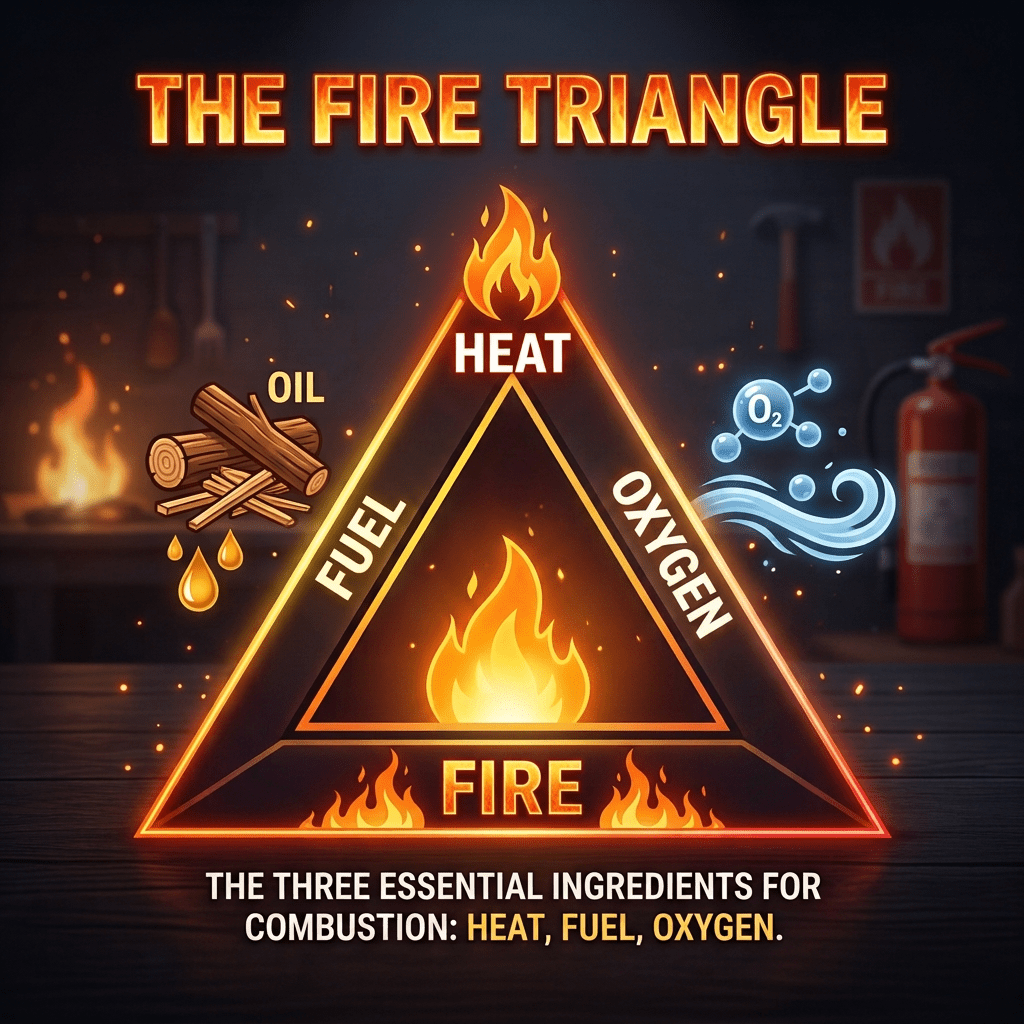
    Think about a campfire. To keep it going, you need three simple things: heat, oxygen, and fuel. Scientists call this the “fire triangle.” If you take even one of those away, the fire goes out, and you’re left with cold ash.

    Our minds work the same way. Whether you’re a student trying to learn something new or a parent helping them out, staying curious and excited about growth follows this same rhythm. To keep your “inner fire” burning, you have to know how to feed it, give it air, and light the match.

    Real change doesn’t just happen by accident. Just like a real fire, your personal growth depends on three main parts: Heat (the spark to start), Oxygen (your curiosity), and Fuel (what you’re learning)

    How to Get Things Moving

    To keep your momentum going, you need to let energy flow through four different types of fuel:

    Spark (Your Choice) → Tinder (Tiny Actions) →  Kindling (Your Routine) →  Logs (Big Goals)  →  Coals (Your “Why”)


    The Spark

    The Spark is just your decision; it’s your commitment. It’s that moment where you say, “Okay, I’m going to do this.”It’s tiny, but without it, the tinder (like opening a book, putting on your shoes, or in my case, writing the first outline) never catches fire. If you miss it, you can have the best plans and the best books, but without that one decision to strike the match, nothing happens. The decision to sit down right now and strike the match exclusively onto tinder. You don’t decide to “finish that report or project today”; you simply need to decide to take the first step and type one sentence.


    Heat: The Energy of Wonder

    Fuel just sits there unless something starts the reaction. In life, curiosity is what provides that heat. It’s asking, “What if?” or “How does this work?” That bit of wonder turns your potential into action.

    You can have the perfect amount of tinder, kindling, and hardwood and a gentle breeze providing the flow of oxygen, but nothing happens until you introduce heat. In science, that heat is the “activation energy” needed to get things started. For us, that heat is excitement and purpose. It’s that jolt you feel when you see a problem or a new skill and think, “I want to figure this out.” Allowing us to transition from being a passive observer to an active participant. Heat enables you to fully engage in the process.


    Oxygen: Fresh Ideas and Perspectives

    A fire can’t breathe in a closed container. Without fresh air, the flames just turn into smoke and go out.

    In our minds, oxygen is asking questions and listening. It’s easy to stick to what we already know, but a growing mind needs a “draft.” It needs us to listen to different ideas and welcome a good discussion. When we open up to new thoughts, we give our curiosity room to breathe.

    To keep the fire bright, try treating life like a science experiment. Try using the Scientific Method. That’s your oxygen. It just means trying something new, watching what happens, and thinking about the results. When you look at things this way, a “mistake” isn’t a failure—it’s just a clue. Adjusting your plan gives the fire a fresh breath of air.

    When you’re curious (oxygen is in excess), you do your work because you actually want to find a solution to a problem or just to see what happens. The question you ask yourself is: “What can I learn here that I didn’t know before?”

    When you’re just going through the motions, you’re just doing work to look smart or get it over with. When you’re just putting on an act, your efforts feel like a chore, and instead of a flame (heat),  you get just a pile of sticks.


    Fuel

    In our “campfire” model, your fuel is your love of learning. It’s your energy and beliefs just waiting to be tapped. Every fire needs something to burn. In your life, fuel is everything you’re taking in: books, hobbies, and even just observing the world around you.

    Learning doesn’t end when you leave the classroom. If you stop reading new things or trying new skills, you starve your “fire. To keep it going, you have to feed your mind with interesting stories, science, art, and new ideas every day.

    The Different Types of Fuel

    To keep your fire from going out, you can’t just throw everything in at once. Fire needs a specific order to work right. For example: If you throw a huge log on a tiny match, you’ll just squash the flame. If you only burn dry leaves, you’ll be striking matches all day without getting warm. To build a life that stays bright, you need to understand the four layers of your fuel pile.

    Tinder: Getting Started

    Tinder isn’t meant to last a long time. In our personal growth “campfire”, tinder is tiny, “No-Brainer” actions. Its only job is to get you off the couch and past that “I don’t want to do this” feeling.

    Since tinder is so easy to light, it doesn’t take much willpower. It’s just saying, “I’ll write one sentence,” or “I’ll just open my book.” Don’t try to plan your whole future with tinder; just use it to get things moving. For me, it’s opening this manuscript, reading the last sentence I wrote yesterday, or adding three bullet points to a chapter outline.

    Kindling: Building a Routine

    Once your tinder is lit, you need kindling. For students, this is your study habits; for the rest of us, this is our daily routines, the 30 to 90 minutes we spend actually focused on what we need to accomplish.

    Kindling turns that quick spark into real heat. Without a routine, our small decision to start an effort (tinder) just burns out.  Kindling keeps the flame alive until the big log catches. One session won’t finish a big project, but ten sessions in a row will. For me, it represents getting up early and spending 45 minutes writing, three days a week

    Hardwood Logs: Major Goals

    Logs are your major life goals, like graduating, writing a book, or mastering a hard skill. They contain a significant amount of energy but need a lot of heat to get started. They can give you personal success and satisfaction for a long time, but you can’t light them with a single match. You don’t just “start” with a log. You use your tender (decision) and kindling (habits) to build up enough heat until the log finally ignites. Once it does, it becomes a steady source of energy. You can’t just wish a big goal into existence. If you only focus on the massive finish line, you’ll just feel stuck. You have to work your way up. In my case, my hardwood “log” is a published, 60,000-word completed manuscript draft.

    The last consideration is one we do not often recognize to be part of our “campfire scenario, but is an absolute necessity for a successful, vibrant campfire: the bed of coals that exists under the burning fuel.

    The Bed of Coals: The “Why”

    Under the logs is the most important part of our personal growth campfire: the glowing coals. This is our core “Why”, the real reason we care about what we’re doing. This isn’t about grades or awards. It’s about your true desire to learn, to grow, and to help others along the way. When life gets hard, and the flames flicker, your “coals” stay hot. They keep your spirit alive so you don’t just give up, making

     it much easier to start the process again tomorrow. As long as your reasons are well grounded, you can always keep going.


    What Can Go Wrong

    1. No Oxygen (Just Going Through The Motions)

    Sometimes people just go through the motions. They aren’t curious anymore, and our life’s work starts to feel like a chore. That’s what happens when you cut off the oxygen. When you work without curiosity, it’s like closing the vent on a fireplace. You’re trying to burn wood, but you aren’t letting it breathe. Without air, you don’t get a nice warm fire. You just get a lot of smoke and feel drained. Working just because you “have to” feels like a waste of time. It leads to you feeling grumpy, bored, and tired of it all. You have to use raw willpower to get anything done. It’s exhausting, and you’re likely to give up once you get tired.

    1. Dying Coals (Burnout)

    Coals are what keep the heat steady. If you let your coals die and just try to keep a fire going with paper and twigs, you’re going to get burned out. This is like hustling really hard without a real reason. Without them, the fire goes out as soon as you stop feeding it. Working hard without a dream to support you takes a ton of effort. You get quick bursts of energy, but the moment you stop, you’re back to zero. Without your  “Why” (the coals), trying to stay motivated is exhausting. 

    1. Smothering the Fire (Feeling Stuck)

    Big logs need lots of heat to catch. You need tinder and kindling to build up the heat first.

    If you drop a huge log on a tiny match, it goes out instantly. This is like having big dreams without small habits to get you there. If you only think about the huge goal, you’ll feel overwhelmed. The goal is just too big to handle all at once, and you don’t know where to start. You don’t start with the log; you start with tinder. Trying to do too much at once just leads to feeling stressed and stuck.

    Troubleshooting the Problem

    If you feel stuck: Your goal is too big. Try starting with some tinder (tiny steps).

    If you’re busy but not getting anywhere: You’re burning through tinder but forgetting your kindling (habits and daily routines).

    If you feel burned out: You’re letting your coals die. Remember why you started in the first place.

    Final Thoughts

    You don’t finish a big project overnight. You do it by starting small, keeping a good routine, staying curious, and remembering why it matters.

    Staying curious is a skill you keep practicing, like tending a fire. By making sure your mind has plenty to burn, fresh air to breathe, and that spark of wonder, you can keep learning and growing your whole life. A well-tended mind doesn’t just help you—it shares its warmth with everyone around you.

    When curiosity, passion, and a little trial-and-error come together, they create something great. Your excitement starts the fire, your habits keep it going, and your curiosity keeps the air flowing, turning your hard work into real, lasting growth.


  • The Power of Grace: Key to Personal Growth

    The Power of Grace: Key to Personal Growth

    What is Grace? 

    Grace is just about being kind, patient, and forgiving without anyone having to earn it. It means choosing not to beat yourself up (or someone else) when things don’t go perfectly, or expectations aren’t met.

     I see grace as a foundational element of our character that requires constant tending as we grow into the best person we can be. It is critical in our relationships, whether it is with our loved ones, coworkers, or those we may supervise. I see it as a function of our self-awareness and a result of our perspective on life and how we perceive ourselves.


    Offering Grace to Others

    Offering grace to others means choosing kindness and patience in the situation, even when your expectations aren’t met. Start by assuming positive intent—believing that, for the most part, people do not intend to cause harm—and try to recognize that everyone deals with “stuff” you may not see or know about, such as stress, fatigue, or past experiences that influence their behavior. Choose to cultivate the long-term success of your relationship over the temporary satisfaction of winning an argument, and you may nurture deeper connections. A practical and, at times, very difficult way to implement this is to “pause,” wait ten seconds before reacting to someone else’s negative reaction or response. This brief interval provides you with the necessary mental and emotional clarity to ensure a compassionate, thoughtful response that triumphs over an immediate, impulsive reaction.


    Offering Grace to Yourself

    Grace is a result of how we perceive ourselves, and self-grace is often the toughest form of kindness to master because most people are their own harshest critics, demanding a level of perfection we would never expect of a friend. 

    When I fall short of my own high expectations—whether in my writing, personal habits, relationships with family and friends, or the goals I set for myself—self-grace serves as the crucial remedy for shame. Guilt might correctly tell us that we did something bad, but shame goes even further and wrongly whispers, “You are bad.” Grace steps in to remind us that we are human. Without grace offering this form of self-kindness, our foundation of self-confidence can become fragile, leading to emotional and physical stress. But by actively choosing grace, we can maintain our self-integrity, allowing us to reset, recalibrate, and try again without the burden of past mistakes holding us back. When we have a healthy level of self-awareness, we recognize our own intellectual, emotional, and physical limits. If we are honest about our own tendencies for making mistakes, we cannot deny the same margin for error to others. In this sense, grace is the ultimate act of intellectual and emotional honesty. 

    Growing into the “best person we can be” implies a path of continuous improvement. However, growth is rarely linear; it involves loops, plateaus, and declines. Grace is the tool that allows us to navigate those non-linear moments. It provides the “buffer” needed to handle life’s conflicts without burning out or becoming cynical.


    Grace as it Applies to STEM Students

    Life is full of major shifts, much like a “phase transition” in physics, where something changes from one state to another—think of ice turning into water. You might start with a high-pressure, “solid” focus on career and salary, but eventually, you move to a more “fluid,” rewarding state focused on things like family, helping others (“paying it forward”), or, like me, a personal passion like gardening. This process reveals that your life’s “vector,” with its direction and magnitude (where you’re headed, and how fast you’ll succeed, for example), will change, and it’s completely fine to stop chasing the title of “smartest in the room” and instead aim to be the “kindest” person. Remember that perfection is a myth; it’s unattainable. The real goal, your personal true North Star, is finding internal peace, which comes from aligning your life with what truly matters, not the size of your salary. In fact, this idea connects directly to how you approach subjects like science and math, where precision over performance is key: the integrity of your data and the exactness of your logic are always more important than rushing to an answer.


    My Shift in Perspective

    “The meaning of life. The wasted years of life. The poor choices of life. God answers the mess of life with one word: ‘grace.’”

    – Max Lucado

    My perspective on life has changed in the last 10 years. I now find grace in my personal relationship with God. When I  recognize and acknowledge the mistakes I’ve made in the past, God’s grace has saved me. 

    Additionally, I’ve lived enough life to recognize that grace is not the lowering of standards, but the management of the human element required to meet them. For example, I’m currently tackling this massive project of turning my blog posts into a cohesive book, and honestly, it’s a huge challenge. I feel this constant pressure—like trying to maintain a certain “velocity”—that always seems to clash with the reality of writing. There’s a definite mental and emotional “tug-of-war” inside me because I have super high standards.  When my progress doesn’t match my own strict deadlines, I now choose to be kind to myself. It’s about remembering that even though I want to finish fast, the most important thing is the quality of the work. I prioritize the quality of work and its concepts since I want this book to be a tool for my grandsons and granddaughter as they enter their middle and high school STEM courses.  And sometimes that means slowing down and giving myself a break. Showing myself grace by letting the work rest is essential, because it’s not just about finishing the book; it’s about modeling self-awareness and showing them that it’s okay for “first drafts” to need serious editing—that process is valuable, and having the wisdom to take my time is more important than rushing to be “perfect”.


    Conclusion

    Grace, combined with wisdom, is the capstone of our personal growth. The major component of wisdom is acknowledging that there is “grace”. Grace in knowing you don’t have to be perfect, that there are many paths to reaching a goal. And, grace in knowing that the goals you have today will be in constant flux as you grow older. But the ultimate goal is to find “peace” in who you are and what is most important to you. Your passions in life will change, as mine have as I’ve grown older. From the goal of career, making the highest salary, being the smartest person in the room, to focusing on my grandchildren, my gardening, and paying it forward through my writing. 

  • Translative Communication Skills: Using Simple Analogies for Complex STEM Ideas

    Translative Communication Skills: Using Simple Analogies for Complex STEM Ideas

    If you can’t explain it simply, you don’t understand it well enough.

    – Albert Einstein

    Being able to “translate” complex ideas, “translative communication”, is the secret superpower in STEM (science, technology, engineering, and math) fields. Some students think using huge, confusing words makes them look smart. But the really smart thing is being able to take a tough idea and make it so simple that anyone can understand it. That’s how you show you truly get it: by providing an “Aha” moment for your audience.


    Try this out: explain the twisted-ladder structure of DNA and how it uses the base pairs: adenine/thymine, and guanine/cytosine to an 8-year-old. Use an analogy to show how DNA serves as a set of instructions for building every living thing.


    The “Feynman Technique”

    Richard Feynman (May 11, 1918 – February 15, 1988) was an American theoretical physicist, a contemporary of Albert Einstein, best known for his work on nanotechnology and Quantum Electrodynamics (QED), the latter of which I will discuss in detail, along with its analogy to personal, in a later post.

    Feynman is also famous for the strategy, the “Feynman Technique”, in which he believed that if you can’t explain a complex idea to a 6-year-old, you don’t actually understand it yet; you’ve just memorized a bunch of fancy words. It was a technique that he truly mastered, as evidenced by his “The Feynman Lectures on Physics” (1961 – 1964), of which I own the original cassette version. Yes, I’m old enough to remember and own a Sony “Walkman”.

    An application of the Feynman Technique can be illustrated with my original question: Can you describe the structure and function of DNA to an eight-year-old?  When we use large, technical terms to describe a scientific principle, such as the structure and role of DNA in a cell’s reproductive cycle, we often lose our audience. To resolve those issues, we select an analogy. When describing DNA, we may use a Lego block analogy to describe its double-helix structure and associated base pairs, and to illustrate how it serves as the set of instructions for cellular reproduction. 


    The Analogy Toolkit

    To be an expert using analogies as a function of “translative communication”, there are three essential steps:

    Step One: Find a simple, everyday thing to use as an analogy for a complicated system. Be creative, think outside the box during this process.

    The formula for choosing a great analogy?: Your Target Science or Math Concept + Familiar Everyday Object or Idea = Understanding.

    For example, electricity is like water flowing through pipes; a computer’s hard drive is like a filing cabinet; and its RAM is like the surface of your desk that you clean off when you change classes or leave for the day.

    Step Two: Check Your Wording (Verbage). 

    Find the “science or math-only” words that can sound confusing (like “osmosis” or “coefficient”) and swap them for simpler words everyone uses. Your presentation, your explanation, the words you choose, should exhibit your deep understanding of the material, not simply rote memorization.

    Step Three: Always be sensitive to and aware of your audience and their level of understanding. 

    Constantly ask yourself, “What does my listener already know, and what will confuse them?” You don’t want to use words and concepts that are too complex, and you don’t want to offend your audience by being overly simplistic.


    Why This Is Your “STEM Superpower”

    There are three primary reasons why mastering this concept of “translative communication” is a key to your success.

    1. When working together with other students, you’ll be the person everyone wants in their lab group because you make things clear.
    2. When assuming a leadership role, leaders communicate a vision, not just do the math.
    3. When you start your career, whether you become a chemist, an engineer, or a social media “influencer”, your success depends on people understanding your ideas.

    The “Grandparent Test” 

    Consider the following assignment: take a tricky science or math topic you learned in school – maybe it’s how photosynthesis works or the secret to solving algebraic equations – and explain it to a family member who isn’t in your class. This is called the “Grandparent Test” (but you can explain it to anyone, like an aunt, uncle, or your parents). The goal is to make it so clear and simple that they say, “Wow, I finally get it!” If you can achieve that “Aha!” moment for them, it proves you haven’t just memorized the facts; you actually understand the concept well enough to be extremely successful, no matter which field you choose as a career. Remember: the best scientists aren’t just experts; they’re amazing storytellers who can share their knowledge with the world.

  • Mastering Study Habits: 3 Steps to Improve Grades

    Mastering Study Habits: 3 Steps to Improve Grades

    Do you feel like you’re putting in your maximum effort, spending an extraordinary amount of time studying, yet your grades on exams don’t reflect your efforts? It’s a common frustration, but the issue often isn’t your effort – it’s your strategy. To succeed in tough subjects like math and science, you need to control the parameters that truly impact your learning. This post outlines a simple, three-step system for better study habits: start with the environment where you study, then perfect your note-taking technique, and finally apply a consistent daily review to retain information in your long-term memory.


    Step One

    When I’m tutoring a student who is struggling in math or science, the first thing I discuss – with both the student and their parents – isn’t usually the actual schoolwork. Instead, it’s about a simple idea: how well you study totally depends on where you’re doing it.

    A lot of students think “studying” just means having their textbook open. But if they’re sitting in their bedroom, surrounded by video games, the TV, music, and their bed, they’re basically inviting distractions. The bedroom isn’t a focused setting; it’s set up for relaxing, not for the serious mental effort it takes to really learn difficult material.


    Personal Commentary

    Students like to study together, and while I enthusiastically endorse study groups, I find they work best in a controlled, supervised environment such as a library or at a kitchen table with the assistance of a parent or a qualified tutor.


    Compare it to a science experiment. The first step to a successful one is controlling all the components. In the same way, you can’t truly figure out if you understand a subject if your attention keeps getting broken by your surroundings.

    The quickest and most effective way to see better grades is to move to a spot with fewer distractions. Places like the dining room table or a kitchen island are neutral, structured areas. That physical move actually signals to your brain that it’s time to focus on work. This change lets you pay critical attention and concentrate for genuine understanding.


    Step Two

    After you’ve got your study space all set up, the next big thing for effective studying is how you actually write things down, your note-taking technique. Similarly, like a science project, you need clear, neat data collection so you can actually look at it later.

    Many students make the mistake of trying to write down everything the teacher says. However, just being a human tape recorder doesn’t mean you’re learning anything. Good note-taking needs to be an active, organized process.

    Using a structured layout, especially for math and science, is a major upgrade. One very successful method is to split your paper into separate columns, one for your main notes. Leaving one for when you are reviewing your notes, for key formulas, questions, or reminders, and for a summary – you force your brain to figure out and organize the concepts or formulas as they’re taught, instead of just mindlessly copying them.

    Taking notes is the second step in this process, but the real goal is actually to retain the information long-term. That’s exactly why you have to develop the habit of reviewing them every single day.


    Step Three

    Human memory is imperfect. If you write notes on Monday and then don’t look at them again until right before a Friday test, you’re going to lose a great deal of that information. At that point, you’re not actually reviewing – you’re basically starting over and relearning everything.

    To beat this whole “forgetting curve” thing, you need to use those great notes in a smart way. I once read an article recommending that for every hour you spend in the classroom, you devote two hours at home completing the assigned homework and reviewing/studying the notes from that day’s lesson. When you start, hit the main points and use your notes to quiz yourself. This small, consistent effort stops the forgetting process dead in its tracks. It’s the secret for locking complex ideas into your long-term memory, turning studying from a frantic, last-minute panic session into a calm, steady climb to mastery.


    Personal Commentary

    I had a student in an advanced math and science program, in which I taught, who, when reviewing her notes at home, spent time highlighting the key, crucial facts she needed to commit to memory. Her notes then became a major learning tool in her success in the classroom.


    Conclusion

    In summary, becoming less frustrated about your academic success isn’t solely about working harder – it’s about controlling the right variables. If you commit to this simple, three-step system, you can fundamentally change the way you learn. Start by mastering your environment to eliminate distractions and signal your brain it’s time to focus. Next, upgrade your note-taking technique from passive copying to active organization. Finally, defeat the “forgetting curve” by implementing a small, consistent daily review. These three strategic habits combined are the secret to mastering complex ideas, turning your time investment into genuine, measurable success.


    This blog post’s development was supported by Gemini (an AI from Google). I used AI to structure complex technical arguments and to synthesize current educational trends as of 2026. Every piece of AI-generated material was reviewed against recent educational research and adjusted to incorporate my own perspective.


  • An Open Letter: Why Do I Spend So Much Time on the Personal Growth Building Metaphor?

    An Open Letter: Why Do I Spend So Much Time on the Personal Growth Building Metaphor?

    To my colleagues and fellow readers,

    I’ve recently been asked why my Personal Growth Building (Revision 2) focuses so heavily on the specific structural components for personal growth rather than just the “foundational” traits we all value: Curiosity, a Growth Mindset, the Passion for Solving Problems, and a Passion for Learning.

    It is a fair question. The “foundational” traits we value in STEM and other fields are often considered the prerequisites for student achievement. However, from my perspective, having spent time in scientific labs and learning drafting and surveying with my Dad, a civil engineer, I see a crucial element that is often overlooked: As Dr. Walkup famously stated, “You can’t build a skyscraper on an outhouse foundation.”


    1. “Readiness” vs. The “System.”

    Curiosity and a Growth Mindset represent how prepared a student is;  they indicate if a student is truly ready to jump into learning.

    The elements in the Personal Growth Building, though, are all about what a student does. They’re the tools that turn that potential into real results.

    Think about a student who’s “passionate about learning” but doesn’t have a solid understanding of the base of knowledge required to succeed. They’re like a car engine revving high but stuck in neutral. They have the “energy” necessary but no way to actually use it effectively. The “Building” provides the process and structure they need to shift a “simple interest” into “genuine understanding.”


    2. The Sustainability of Growth

    My intent is to prepare students for a 40-year career, not just a four-year degree. Traits like “Passion” can flicker and fade under the pressure of a professional environment.

    The components and structure of the “Building” are designed to train and support students so they’re capable of “adapting.” When a chemist’s specific technical knowledge becomes obsolete, it is the structure of their learning – their ability to categorize new information and logically assess and apply it – that allows them to pivot to new challenges. We don’t just want “curious” students; we want intellectually sound professionals.


    Closing Thought

    We shouldn’t choose between “traits” and “frameworks.” We must recognize that the traits are what make the building possible, but the framework is what makes the student useful to the world and resilient to change.

  • Wisdom: A Function of Knowledge, Experience, Self-awareness, and Faith

    Wisdom: A Function of Knowledge, Experience, Self-awareness, and Faith

    Introduction

    “When you see something that is technically sweet, you go ahead and do it, and you argue about what to do about it only after you have had your technical success. That is the way it was with the atomic bomb.”

     – J. Robert Oppenheimer

    A review of 20th-century history reveals a critical, undeniable fact: Intelligence is not a guarantee of a positive result.

    The Manhattan Project stands as a technical masterpiece, having assembled the foremost experts in physics to tackle intricate theoretical challenges surrounding nuclear fission. The team successfully developed and engineered a mechanism to initiate this reaction in a practical setting, meticulously following every step to achieve a logical and verifiable result. However, despite this technical brilliance, the outcome was the creation of a weapon with the power to extinguish human civilization.

    J. Robert Oppenheimer, the lead physicist, later famously quoted Hindu scripture, realizing the gravity of what his “success” meant: “Now I am become Death, the destroyer of worlds.”

    How can a project be a perfect success in the lab, but a potential failure for humanity? Knowledge and Expertise do not equate with Wisdom.


    What is “Wisdom?”


    Wisdom as a Mathematical Equation

    If you are entering a STEM field today, you are spending years building your intellect. You are accumulating Knowledge (formulas, axioms, laws of physics) and gaining Experience (labs, internships, projects). These are the tools that help you succeed in the world.

    But intellect without wisdom is just an uncontrolled force.

    “Yesterday, we fought wars which destroyed cities. Today, we are concerned with avoiding a war which will destroy the Earth. We can adapt atomic energy to produce electricity and move ships, but can we control its use in anger?”

     – Robert Kennedy

    To be truly successful – not just as a scientist, but as a leader, and a human being – you need more than just the inputs of knowledge and experience. You need to solve for a different variable entirely. You need to solve for Wisdom.

    Wisdom is not a mystical concept reserved for philosophers on a mountain top. It is a function of four specific variables. And just like any complex system, if you ignore one variable, the equation falls apart.


    Defining the Wisdom Function

    If we accept that Wisdom is the desired outcome, we need to understand the components (inputs) required to generate it. Wisdom is not a random occurrence; it is the result of a specific integration of variables.

    We can define the Wisdom Function as follows:

    W=f(K,E,S,F)W = f(K, E, S, F)

    To solve for W (Wisdom), you must understand the nature and function of each variable.


    1. KK= Knowledge (Your Database)

    In our equation, Knowledge is the raw data. It is the accumulation of facts, information, and established laws.

    Think of Knowledge as the hard drive of your computer (your brain). It is filled with terabytes of information – years of research, chemical equations, and physics constants.

    But a hard drive full of facts has a limitation; it knows that a tomato is a fruit (botanical classification), but it does not know that a tomato does not belong in a fruit salad. It has content, but no context.

    2. EE = Experience (Real-life Application)

    Experience is the application of Knowledge in a real-world environment. It is the process of converting theory into practice through repetition.

    Consider this analogy: experience is the Lab Experiment. You take a hypothesis (KK) and test it against reality. Experience is the collection of data points derived from failures and successes.

    But experience has a limitation: It is reactive. It tells you what has worked in the past, but it cannot always predict what will work in a completely new future environment or application.

    3. SS = Self-Awareness (Internal Calibration)

    Self-Awareness is the understanding of our own influence on the data.

    Consider this instrumental chemistry analogy: Instrument Calibration. In any experiment, the instrument used to measure the data may affect the result. For example, if your electronic balance is not zeroed out (tared), every measurement you take is flawed.

    Self-awareness is the process of checking to see if we’re solving problems the right way, and for the right reasons. It forces us to stop and ask: What am I really trying to do here? Are my actions to benefit the project’s outcome, to fix a problem, or just to make myself look better? Are my personal feelings clouding my judgment? Am I ignoring facts that don’t fit my hypothesis? And ultimately, does the outcome match my core beliefs? If you skip this internal check, all your knowledge  (KK) and experience (EE) may not matter, and the solution will be biased.

    4. FF = Faith (The Constant)

    This is often the most difficult variable for the scientific mind to accept, yet it is essential for the equation. Faith has many forms. There is a faith in a set of scientific axioms or principles, which may or may not continue to be valid in the current situation. There is faith in your knowledge and skill, the ability to adapt and solve any problem you may face. And there is a faith in God or a higher power, which gives you strength and guides your moral compass.

    Faith acts as a moral constant, an internal compass guiding you when all the facts are not yet known. It’s what helps you discern not just what can be achieved, but what is right, connecting what is understood to what is yet to be discovered.

    The Scientific Analogy: A great deal of scientific work starts with a theory or idea that hasn’t been completely proven yet. It’s all built on a fundamental trust – like believing the established rules of physics will hold up in any new situation, no matter what.


    Personal Commentary

    He who can no longer pause to wonder and stand rapt in awe is as good as dead; his eyes are closed.

    – Albert Einstein

    Sometimes, because we are trained to be analytical thinkers, we convince ourselves that we are agnostic. And when we look and see something we don’t understand, when we should be filled with awe and wonder, we are so busy trying to find a scientific explanation that we convince ourselves it’s not a miracle, that it is not the act of God or a higher power. Wisdom, for me personally, is my recognition that I cannot underestimate the power of God and his plan. 


    Now that we have defined the variables, we can see how they interact. The mistake most students make – and the mistake the educational system often encourages – is focusing entirely on the first two variables, Knowledge and Experience.


    Two Wisdom Function Analogies


    Scalar vs Vector Measurement Example

    Most of us in the science realm were introduced to the concept of vectors and the difference between scalar and vector measurements in our middle school science classes and again in our high school and college physics classes.

    As a refresher for these concepts, consider the following example: Imagine you were to ask me directions to a local restaurant, and I were to say you drive 45 miles per hour for 15 minutes. This is a scalar measurement. You have no idea which direction you were to drive; you have only one piece of information, the velocity at which you are to drive, and you need the direction. The definition of a vector is that it has a magnitude, in this example, 45 miles per hour, and a direction, let’s say directly east. You now have both components of a vector. The directions to the restaurant are to drive east at 45 miles per hour (vector) for 15 minutes.

    Now, think of your career trajectory as a Vector.

    The sheer power of your abilities, the Magnitude of your professional vector, is determined by your Knowledge (KK) and Experience (EE).

    These factors directly influence:

    • The depth of intellect you can bring to bear on any challenge.
    • The speed with which you can reach a solution.
    • The sophistication and complexity of the problems you are capable of solving.

    A person with great intellect and extensive experience is a force to be reckoned with. However, magnitude is a scalar quantity, it lacks direction.

    The Direction in your life’s “vector” is determined by Self-Awareness and Faith.

    • Self-Awareness provides calibration for the “Why?”: It answers the question, ‘Why am I doing this?’
    • Faith ensures your internal belief system is aligned: It addresses where your actions fit within your personal moral and internal convictions.

    The Guided Missile Example

    Our scientific power has outrun our spiritual power. We have guided missiles and misguided men.

    – Martin Luther King, Jr.

    Imagine a missile guidance system.

    • If you have low Knowledge and Experience (Low Magnitude), the missile barely leaves the launchpad. It’s ineffective and harmless.
    • However, if you have incredible Knowledge and Experience (high Magnitude) but lack Self-awareness and Faith to set the coordinates in the right Direction, you have created a disaster. You have a high-speed projectile aimed at the wrong target.

    The STEM Trap

    In your classes, you are graded almost exclusively on Magnitude. Did you get the right answer? Did the chemical reaction work? Did the bridge you designed hold the weight?

    But in life, Wisdom is the vector sum. It is useless to be the smartest engineer in the company if you are building something that ultimately causes harm because you didn’t ask the “faith” or “self-awareness” questions.


    Conclusion

    Wisdom (WW) is the alignment of your Magnitude (K+EK+E) with the correct Direction (S+FS+F).

    Wisdom is not an accident. It is not a trait you simply “pick up” as you get older. It is the deliberate integration of what you know (KK), what you do or have done (EE), who you are (SS), and what you believe (FF).

    If you remove any variable, the function fails.

    • Without Knowledge, you are clueless.
    • Without Experience, you are just theoretical.
    • Without Self-Awareness, you are unreliable.
    • Without Faith, you are adrift.
  • Mastering Emotional Intelligence for Personal Growth

    Mastering Emotional Intelligence for Personal Growth

    When we talk about the subject of personal growth, we usually split things into two buckets: “Inner” growth (a growth mindset, self-awareness, and resilience) and “Outer” growth (relationships, communication skills, achievements, and recognition). However, here’s the missing piece in our model: Emotional Intelligence (EQ). Emotional Intelligence (EQ) is the bridge that unites these two separate ideas, preparing you to be successful as a functioning member of society, regardless of your chosen career path. Producing real-world success that people actually notice.

    Emotional Intelligence (EQ) isn’t just about being nice; it is the ability to understand and manage your own emotions while recognizing and acknowledging the feelings of others. If your IQ measures your intelligence or book knowledge, EQ measures your people skills and self-control. It is the connection between thinking and feeling.


    The Four Core Pillars of Emotional Intelligence (EQ)


    Pillar #1: Self-awareness

    In a previous blog post, we defined Self-Awareness as the GPS for our process of personal growth. And it is the absolute starting point for emotional intelligence (EQ). It’s all about understanding your own moods, feelings, what drives you, and how all that affects the people around you. To master this, you need to take an honest look at what you’re good at and what you struggle with, and feel genuinely confident in yourself. The key thing is, a self-aware person doesn’t just feel an emotion; they can actually figure out why they’re feeling frustrated, happy, or stressed. This deep internal check is the groundwork for everything else in emotional intelligence.


    Pillar #2: Self-control

    The second component, self-control (self-management), follows self-awareness. It is crucial for keeping destructive emotions and urges in check, so you can stay calm and collected, even when things get stressful. Think of it as emotional control—it’s that ability to hit the pause button between feeling an impulse and actually doing something about it. This pause allows you to make smart, principled decisions instead of just reacting impulsively or defensively. Self-management includes being flexible, taking initiative, and keeping a positive attitude in order to reach your goals, even when you face roadblocks.

    Common Examples:

    When receiving constructive criticism, someone with low emotional intelligence (EQ) might immediately become defensive, blame someone else for their mistake, or just give the person the silent treatment, which is not helpful. In contrast, a person with high emotional intelligence will pause, acknowledge that the criticism, while it may feel uncomfortable, is justified, and then ask what they need to do to improve, genuinely thanking the person for being honest. 

    When having a “bad day,” a person with low emotional intelligence stressed about a meeting or a deadline, might react by snapping at their parents, spouse, friend, or even someone in a restaurant or store, just because they are in the way. A highly emotionally intelligent response is to recognize the feeling of being overwhelmed and directly tell a partner, “I’m having a ridiculously stressful day and I’m a bit on edge. I need 20 minutes of quiet to de-stress so I don’t accidentally take it out on you.” 


    Pillar #3: Social Awareness

    Social Awareness (Empathy) is the third key ability, which is shifting your focus away from yourself and focusing on others. This crucial skill enables you to sense, understand, and respond well to the emotional needs and concerns of those around you. Often described as being able to “read the room”, it requires you to see things from someone else’s perspective and grasp the mood of the situation. It goes beyond just seeing that someone is upset; strong social awareness helps you to understand why they are feeling that way, which is critical for great relationships and connecting with others.

    For Example:

    During a big disagreement, either at home, school, or at work, a person with low emotional intelligence makes their goal to “win” the argument and prove the other person is wrong. Conversely, a highly emotionally intelligent individual focuses on understanding the other person’s perspective, asking questions like, “Help me out here – why is this so important to you?” because they value the relationship more than being right.


    Pillar #4: Building Relationships

    Building Relationships is the final stage of emotional intelligence. It’s where you combine your emotional intelligence and social skills to manage complicated social situations, inspiring others. This is the top level of emotional intelligence, showing how well you can influence people, get them on board, and help them grow. It covers multiple social and communication skills—things like building trust and connection, communicating your message clearly and powerfully, addressing disagreements without a fight, and promoting change in a variety of settings, at home, school, and work. Bottom line? Relationship Management is about taking what you know about yourself (self-awareness) and what you feel for others (empathy) and turning that into positive interactions with those around you.


    Conclusion

    Emotional intelligence (EQ) is an essential skill for genuine, lasting success. Without it, attempts at inner growth become mere wishful thinking that fails when the pressure mounts. And outer growth results in shallow relationships that lack the trust necessary for long-term progress and achievement. Emotional intelligence links your inner strength to your outer results, establishing a mechanism that accelerates both personal growth and professional success.

  • Essential Skills for Success in STEM: Initiative, Resolve, Perseverance, Resilience

    Essential Skills for Success in STEM: Initiative, Resolve, Perseverance, Resilience

    You may be doing well in your math and science courses, or perhaps you’re already interested in areas such as computer programming, robotics, or video game design. While a passion for STEM and strong academic performance are certainly vital, true success in these fields requires more than just intelligence.

    The key drivers—the qualities that will propel you through challenging projects, demanding courses, and even career setbacks—are the four absolutely vital tools in your personal growth toolkit for anyone charting a course in STEM: Initiative, Resolve, Perseverance, and Resilience.


    What is Initiative, Resolve, Perseverance, and Resilience? 


    1. Initiative

    What it is: The ability to self-start, take action without being told, and seek out new opportunities or skills.

    Why it matters in STEM: The STEM fields are constantly evolving. What you learn today may be outdated in five years. Initiative is crucial for lifelong learning—the willingness to constantly teach yourself new skills (computer programming, robotics, advanced data analysis, or new analytical instrumentation) to remain current and competitive in the industry.

    When performing research or problem-solving, it takes initiative to troubleshoot errors, design a better experiment, or learn to use a new piece of equipment before it’s required. It’s what drives you to excel.

    Example: Your Chemistry professor assigns an open-ended laboratory project. The explicit expectation is a successful, unique final product. You must show the initiative to search for resources, organize the necessary equipment and reagents, and learn to operate the necessary tools needed to complete the project because the assignment demands it, not just because you feel like it.


    2. Resolve

    What it is: A firm determination to achieve a specific goal, resisting distractions, and maintaining focus even when things get tough. The unwavering focus needed to complete a difficult project, solve a complex equation, or commit to the years of study required for a specialized field of study.

    Why it matters in STEM: STEM fields demand long-term commitment. Resolve is what helps you stay committed to completing that difficult assignment, even when exhaustion hits. Push through a difficult physics derivation, knowing the understanding will unlock new perspectives. See past a frustrating semester or a challenging first-year chemistry, physics, or math course, reminding you of your ultimate career aspirations. It’s the inner conviction that keeps you on track.

    Example: Introductory college courses, such as Organic Chemistry, Physics, and Calculus, are often intentionally challenging to test your preparedness to succeed in upper level courses. When faced with a low grade, resolve is the quality that prevents you from abandoning your major. Initiative is the drive to seek out help by finding a tutor, joining a study group, or meeting with the professor to grasp the material you do not understand, instead of simply giving up.


    3. Perseverance

    What it is: The sustained effort to keep working despite difficulties, serving as the dedication required to solve tough problems through hours of calculations, research, or repeated experiments. It’s the long-term, consistent effort.

    Why it matters in STEM: STEM is rarely a straight line to success. Perseverance means spending countless hours debugging computer programming, even when you’re convinced it’s flawless. Re-running an experiment five times because you’re confident there’s a pattern you’re missing. Staying up late to understand a complex mathematical concept until it finally clicks.

    Example: You struggle with a Chemistry laboratory assignment and are tempted to give up. Your instructor intervenes, not by giving you the answer, but by offering a small suggestion, confirming the difficulty of the task, and requiring you to follow up in an hour. This structured support prevents you from feeling abandoned in your efforts, reinforces the importance of struggle, and teaches you the value of perseverance.

    While the ultimate decision to continue is yours, external factors, the support from your instructor, are essential. The setting of an expectation, the modelling of how to continue in the process, and the structured support act as powerful motivations, transforming your ability to just keep going into an established, automatic behavior (perseverance).


    4. Resilience

    What it is: The capacity to recover quickly from setbacks, disappointments, or outright failures, viewing setbacks not as defining moments but as valuable data and learning opportunities. 

    Why it matters in STEM: Failure isn’t a setback in STEM; it’s a feature. Scientific discovery often involves many “failed” experiments before a breakthrough. Resilience allows you to: bounce back from a low test score, analyze what went wrong, and adjust your study habits.

    Example: It can be challenging for you to picture what “resilience” looks like. Mentors provide a crucial model. When you witness your research advisor’s experiment fail, and instead of getting discouraged, your advisor calmly analyzes the data, identifies the potential sources of error, and immediately starts correcting the issues for the next trial run. These actions model resilience and teaches you how to respond appropriately to setbacks.

    STEM fields are characterized by constant challenges and an emphasis on complex problem-solving. Success relies less on your natural talent and more on your willingness to engage in a productive learning process. And that success rarely comes on the first try. It is common for an experiment to produce unexpected results or a mathematical proof to contain an error. Instead of seeing these setbacks as personal shortcomings, students need the mindsets of resilience and perseverance to see a failure as a starting point.


    Is Initiative, Resolve, Perseverance, and Resilience a Personality Trait or a Learned Skill?

    Initiative, resolve, perseverance, and resilience are generally understood as learned behaviors. Psychologists like Carol Dweck argue that these qualities stem from a Growth Mindset—the belief that our abilities and intelligence can be developed, rather than a fixed personality trait.  While some people might appear naturally more determined to manage and learn from their struggles, everyone has the capacity to develop these essential skills. 

    Think of initiative, resolve, perseverance, and resilience as learned skills that, when practiced consistently, become an integral, defining part of your character or personality. For a STEM student, it is critical to recognize the value in treating them as skills that require deliberate practice.


    The Power of Role Models, Mentors, and External Expectations

    The skills of initiative, resolve, perseverance, and resilience isn’t something you can achieve entirely on your own, however you can always begin the process. The most effective and the smoothest path to growth in these areas requires external guidance. Role models, mentors, and the right external expectations act as a vital catalyst in forging these qualities.

    How do role models, mentors, and external expectations cultivate these critical skills? Here are four key examples:

    Observation: Professors, Mentors, and Role Models provide critical “how-to” knowledge. Observing an experienced chemist handle an instrument failure calmly or a scientist gracefully accept and learn from a failed experiment offers a real-world demonstration of resilience and perseverance in action.

    Accountability: External expectations, whether it is from a professor, mentor, or a course syllabus, establish defined goals and deadlines that require action. Taking on a challenging project with its external pressures, its deadlines and reporting requirements, serves as a catalyst. It triggers the initiative needed to start and, crucially, builds the internal resolve and strength required for sustained effort toward completion.

    A Defined Strategy for Success: Effective teachers and mentors avoid simply giving answers. Instead, they offer focused, constructive feedback, guide individuals through roadblocks, and recognize small achievements. This strategic support reinforces successful behaviors, driving long-term competence and success.

    Reinforcement and Feedback: These critical skills are only learned effectively when you receive balanced feedback from your professors and mentors, parents as well – positive reinforcement when you suceed and constructive criticism when you fall short. 


    A Strategy for Your Personal Growth and Success

    As you navigate your academic life and plan for a career in science, technology, engineering, or math, your focus must extend beyond formulas and facts. You need to actively look for opportunities to develop your initiative, resolve, perseverance, and resilience. So take action with the following approach:

    1. Embrace the Hard Stuff: Never shy away from difficult assignments or complex projects. Challenges are opportunities in disguise.

    2. Treat Failures as Data: Every setback is not an end, but a valuable data point. Analyze what went wrong and adjust your approach.

    3. Actively Seek Mentors: Find someone whose approach to challenges inspires you, and commit to learning from their wisdom and experience.

    4. Practice Self-Reflection: When things get tough, take a moment to ask yourself: How did I react? What could I do differently next time?


    Conclusion

    These qualities are not just career buzzwords; they are the foundation of personal growth and the essential fuel for scientific discovery and innovation. The combination of strong grades and these four psychological attributes is what ultimately separates a good student from future success in their career path, capable of making a difference in a STEM field. Cultivate them, and you will do more than just succeed in STEM; you will thrive in every aspect of your life.

  • Beyond the Textbook: Why Critical Thinking is Your Ultimate STEM Skill

    Beyond the Textbook: Why Critical Thinking is Your Ultimate STEM Skill

    As a STEM student, you’re constantly immersed in data, complex equations, and technical concepts. You’ve known and mastered the Scientific Method—observing, hypothesizing, experimenting, and concluding—but that structured process is only half the battle. The other, perhaps more crucial, half is Critical Thinking. While the Scientific Method is a rigid framework for inquiry, critical thinking is the flexible process that drives it. It’s the difference between merely memorizing a formula and truly understanding its foundations and limitations. For you, this means going beyond rote learning to actively and skillfully analyze, synthesize, and evaluate the information you encounter in the lab, the lecture hall, and the world around you.

    This analytical mindset comprises several core skills essential to your future, regardless of which career path you choose.. 

    First, you must develop a relentless habit of questioning information. Don’t just question external sources; turn that rigorous examination onto your own work. You must constantly ask: Is this data truly reproducible? Are my initial assumptions that led to this result reliable? This internal skepticism is key. 

    Second, the ability to perform careful error analysis is primary. This means moving past simply reporting a “failed” test and instead recognizing the subtle flaws in your experimental design, data collection methods, or calculations. Master the ability to identify the sources of error in your experiment. This isn’t about placing the blame on yourself or others; it’s about learning and improving. 

    Third, you must effectively evaluate information sources. When researching a project, learn to distinguish sound, evidence-based conclusions from claims based upon false assumptions or bias. This skill is vital when designing an experiment or reading specialized technical literature.


    Real-world Example: Evaluating an Information Source

    A thoughtful, analytical evaluation of an Information source serves as an excellent example of applying this critical evaluation skill—essential for navigating the complex media environment today. All too frequently, we accept what we encounter online or on message boards as fact. Regardless of whether we agree with the content or not, we rarely take the time to determine its validity. This requires a rigorous assessment of the information’s credibility, accuracy, and fairness. 

    Your process begins with understanding who the source is; this means performing quick additional research to assess who created the content, including the purpose behind the creation of the content and any editorial bias, while verifying the author’s expertise. Highly sensational headlines or anonymity should immediately raise your suspicion. 

    Next, shift your focus to fact-checking the content itself. Examine the quality of evidence, looking specifically for hard data, statistics with cited methodologies, and primary sources, while simultaneously checking the language for emotional arguments or wording that signals an intent to persuade or distract you intentionally, versus simply reporting objectively. 

    Finally, your evaluation must thoroughly assess the argument’s fairness and completeness. This means checking that the source acknowledges and fairly represents opposing viewpoints, offers criticized parties a chance to respond or rebut the information or opinion, and avoids relying on unstated, implied assumptions.

    Ultimately, this comprehensive process moves you beyond merely accepting the Information as fact, leading you to an informed decision about the material’s actual validity and practical usefulness.


    Conclusion

    Critical thinking is the key factor that elevates a capable STEM student into an innovative and successful scientist or engineer. It’s the powerful mechanism that allows you to process complex, unstructured data, recognize underlying patterns, and formulate valid logical conclusions where standard solutions may not exist. This skill deepens comprehension and improves retention, translating theoretical concepts into practical, usable knowledge for your future development.

    I strongly urge you to cultivate your expertise in challenging assumptions, analyzing evidence, and applying logical reasoning now. By doing so, you position yourself as an active contributor in your field, not merely a passive learner and recipient of information. As the volume of data and pace of technology accelerate, remember this lasting truth: your most indispensable tool for lifelong learning and effective problem-solving isn’t the newest gadget or a sophisticated piece of machinery. It is your inherent capacity to think in an evidence-based, exact, and open-minded manner.